
Dada did not have homogenous and formal characteristics as other art styles. Dada cannot be considered an art style per se, but in general, an anti-art movement that began as a response to the mercantilism and colonialism that gave rise to the World War I with its ensuing jingoism and perversions now openly exposed with millions of walking dead in its aftermath. it was a rupture with the pre-existing aesthetic approach to life including, necessarily, a questioning of established art forms,and their tendency to crystalize and become rigid as the process of monetarization of their work drained it of its original vitality and from it, and in turn helped sustain the system. In principle, it was thought a more elementary art could save humankind from the violent insanity of the period and the further catastrophies that could be foreseen. All the ”isms” were guilty. The aim was to free art from its role as a cover or facade on a society detached from morals and drowning in hypocrisy. Predictable ideas of beauty had become ridiculous and had degraded into fetish objects.
German Dadaism cannot be separated from the political and social context of postwar Germany. Acutely sensitive to the political collapse of the country and the horrifying aftermath of the war – the dead, the wounded, the disabled, and the starving, unemployed masses – Berlin Dada was anti-Prussian, anti-bourgeois, and anti-capitalistic from its inception. Siding with the Spartacist revolutionaries such as Rosa Luxemburg, the Dadaists vigorously opposed the creation of the Weimar Republic; and their strong political commitment influenced all of their activities. Artistically speaking, even if they denied it, these artists had all been influenced by Expressionism, and some by Cubism and Futurism; after 1920, they were heavily influenced by Giorgio de Chirico.
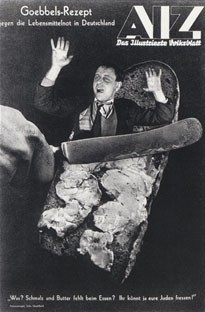
This image shows Goebbel's solution for ending the food shortage in Germany. It was featured in Berlin's Arbeiter-Illustriect-Zerlung (AIZ)(Workers Illustrated Newspaper) as a political satire. The caption reads: "What? No butter or lard? Well then, eat your Jews?" This demonstrates the German leader's general view of the Jews. They are seen as expendable if the rest of Germany is at stake. Why go hungry when we can eat those who's lives have no value.
Throughout their history, the Dadaists used the collage technique they had inherited from Cubism; and eventually combining this technique with photography, they innovated and created modern photomontage.One of the main aims and functions of photomontage is to denaturalize the way we are socialized into seeing the world, to make the familiar strange or problematic, to interrogate photographic representations of reality by fragmenting and juxtaposing them in ways other than those intended by the original producers and thus to uncover the ideology behind photographs and the society which they are made to represent.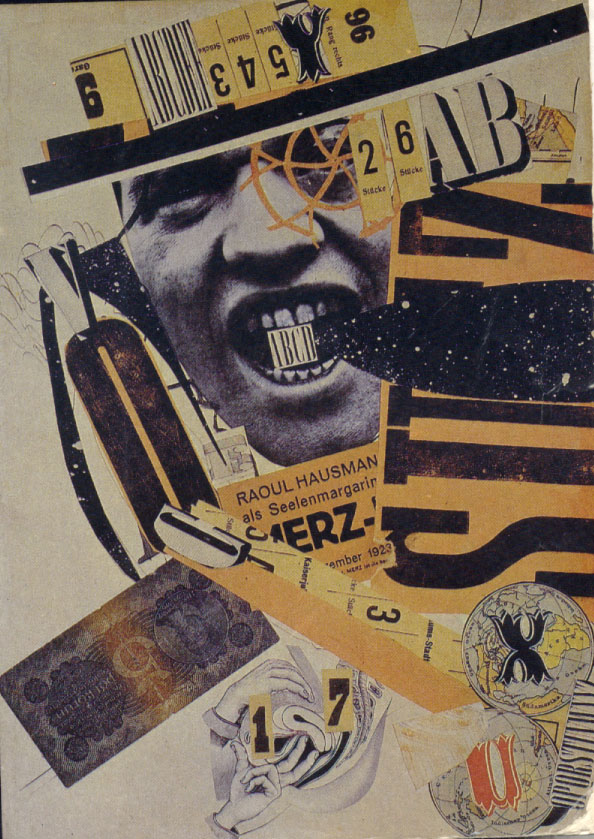
At its core, Dadaism supported all types of misunderstandings and confusion in a belief that form would be established through the function of expression. It was based on common ethics of art, which through various places and people, new individual forms of expression arose.In the beginning… In 1915 – at the beginning of World War I – Hugo Ball, a writer and theatre director, came with his female partner Emmy Hennings from Munich to Zurich .On Saturday February 3, 1916, was the inauguration of the Cabaret or ‘artist-tavern’ Voltaire located at Spiegelgasse 1 in Zurich.Hugo Ball made an agreement with the owner of the tavern ‘Meierei’ to use the backroom for a literary cabaret and to increase the sale of beer, sausages and sandwiches. An evening with music, dance, manifestos, theory, poems, pictures, masks and costumes presented by Hugo Ball, Emmy Hennings, Marcel Janco, Tristan Tzara, Georges Janco and Hans Arp. Despite World War I, the atmosphere in Zurich was very liberal.Interestingly, in the same narrow alley, Spiegelgasse 14, where the Cabarat Voltaire played, lived a certain Mister Uljanow aka Lenin. Apparently,the authorities were much more suspicious about the chaotic dadaists than the reclusiv, quiet,and studied Russians …
The only edition of the magazine Cabaret Voltaire was published on June 15, 1916.It was initiated by Hugo Ball and contained contributions from Kandinsky, Arp, Modigliani and others,and marked the first print of the word Dada! In addition to the literary character of Cabaret Voltaire, the Zurich Dadaism inaugurated a second phase devoted to the pictorial art .At the Bahnhofstrasse 19, they exhibited works from Kandinsky, Klee, Arp, de Chirico, Feininger, Ernst, Janco, Modigliani, Macke, Kokoschka and others.
”The word Dada symbolises the most primitive relation to surrounding reality, a relation with which Dadaism in turn establishes a new reality. Life appears as a simultaneous confusion of noises, colours and spiritual rhythms, and is thus incorporated — with all the sensational screams and feverish excitements of its audacious everyday psyche and the entirety of its brutal reality — unwaveringly into Dadaist art. This is the clearly marked dividing line which separates Dada from all previous artistic directions, most particularly from FUTURISM, which recently some imbeciles took to be a new version of impressionist realization. For the first time Dadaism has made a break with the aesthetic approach to life by rending all the slogans of ethics, culture and inwardness, which are mere cloaks for weak muscles, into their component parts.”
 " height="500" />
Hannah Hoch, Berlin Dada
In Jan, 1917, RichardHuelsenbeck returned to Berlin. He is tired of abstract art and is looking for something that can relate to the reality of the time. Avant-garde art would soon fragment into the pure opticality and formalism of artists like Picasso and the movement articulated by the Dadaists in Germany with its emphasis on Surrealism, futurism and constructivism. In May 1917,Huelsenbeck publishes “Der Neue Mensch” ,”The New Man”. A text with a positive philosophy engaged in the betterment of humanity through non-revolutionary action. In February, 1918 Huelsenbeck’s presentation at the Neue Sezession Saal of DADA in Zürich and proclamation that DADA is the Future: “DADA wants to be the war party of the great international art movements. It is the transition to the new joy garnered from real things.”
In March 1918, Huelsenbeck created the Club Dada in Berlin with Jung and Hausmann. Baader, Mehring, Grosz and the Herzfeld brothers join in. The following are excerpts from the Berlin Dada manifesto which in its corrosive, provocative fashion, articulates an aesthetic that endures to this day in various permutations and combinations:
”What did Expressionism Want: It ” wanted” something, that much remains characteristic of it. Dada wants nothing, Dada grows. Expressionism wanted inwardness, it conceived of itself as a reaction against the times, while Dadaism is nothing but an expression of the times. Dada is one with the times, it is a child of the present epoch which one may curse, but cannot deny. Dada has taken the mechanisation, the sterility, the rigidity and the tempo of these times into its broad lap, and in the last analysis it is nothing else and in no way different from them. Expressionism is not spontaneous action. It is the gesture of tired people who wish to escape themselves and forget the present, the war and the misery. To this end they invented “humanity,” and walked versifying and psalmodysing along streets on which the escalators rise and descend and the telephones ring shrilly. The Expressionists are tired people who have turned their backs on nature and do not dare look the cruelty of the epoch in the face. They have forgotten how to be daring. Dada is daring per se, Dada exposes itself to the risk of its own death. Dada puts itself at the heart of things. Expressionism wanted to forget itself, Dada wants to affirm itself. Expressionism was harmonious, mystic, angelic, Baaderish-Superdadaist — Dada is the scream of brakes and the bellowing of the brokers at the Chicago Stock Exchange. Vive Dada!
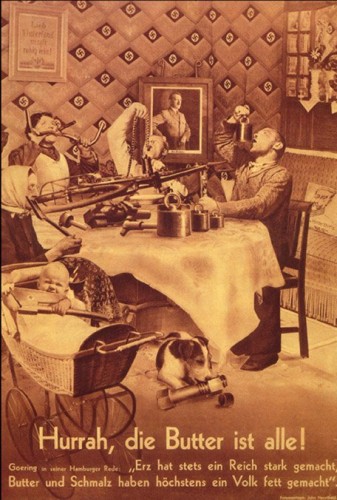
Heartfield, in collaboration with his brother Wieland Herzfelde and others, staged photographs subsequently cutting them together or superimposing negatives to create a single “scene.” (Here a pointed critique of the Hermann Göring’s suggestion that “Iron ore makes an empire strong – butter and lard have at most made it fat.” Now that their butter is gone, the nationalistic family cheerfully scarfs down a bicycle, while their baby is teething on the blade of an axe). The results of this formal manipulation look somewhat realistic at first glance, yet completely off-kilter and out of joint on closer examination – an appropriate figure for the dire circumstances Heartfield’s designs were meant to diagnose and attack.
The execution and direction of art depends on the times in which it lives, and artists are creatures of their epoch. The highest art will be that whose mental content represents the thousandfold problems of the day, which has manifestly allowed itself to be torn apart by the explosions of last week, and which is forever trying to gather up its limbs after the impact of yesterday. The best and most unprecedented artists will be those who continuously snatch the tatters of their bodies out of the chaos of life’s cataracts, clutching the intellectual zeitgeist and bleeding from hands and hearts.
Under the pretext of inwardness the Expressionist writers and painters have closed ranks to form a generation which is already expectantly looking forward to an honourable appraisal in the histories of art and literature and is aspiring to honours and accolades. On the pretext of propagating the soul, their struggle with Naturalism has led them back to those abstract, pathetic gestures which are dependent on a cosy, motionless life void of all content. Their stages are cluttered with every manner of kings, poets and Faustian characters, and a theoretical, melioristic understanding of life — whose childish and psychologically naïve style will have to wait for Expressionism’s critical afterword — lurking at the backs of their idle minds. Hatred of the press, hatred of advertising, hatred of sensationalism, these indicate people who find their armchairs more important than the din of the streets, and who make it a point of pride to be conned by every petty racketeer. Their sentimental opposition to the times, no better nor worse, no more reactionary nor revolutionary than any other, that feeble resistance with half an eye on prayer and incense when not making papier maché cannon balls from Attic iambics — these are the characteristics of a younger generation which has never known how to be young. Expressionism, which was discovered abroad and has quite typically become a portly idyll in Germany with the expectation of a good pension, has nothing more to do with the aspirations of active people. The signatories of this manifesto have banded together under the battle cry of DADA!

John Heartfield, Berlin Dada


 COMMENTS
I enjoyed reading your article, you have a great delivery style! I have forwarded a link to my dad, and will definately be back for more updates.
Fast Car,
Thanks for getting off the super-bahn to read.
Cheers,
Dave
Outstanding use of period quotations with excellent translation, not to mention the Hannah Höch video, which I had never seen. You have done justice to a very complicated subject and captured the essence of the movement, The inclusion of Expressionism’s failures as related to Dada is an added positive. I think. Will be linking this on my Facebook page so others can enjoy it.
thanks peter. sometimes, we end up pulling a good one off. Best