

Throw Buster from the train.Faster than a speeding locomotive,the Superman of comedy knew the eccentric side of Southern living. Carson McCullers ”The Heart is A Lonely Hunter ” and Buster Keaton’s film , ”The General’ ( 1927 ),a newly released on Blu-Ray, show the same dynamic from two different era’s of life below the Mason-Dixon line. The stereotypes are subverted, then disconnected and re-connected in different form. An anti Gone With the Wind, Keaton’s, The General shows the same yearning heart of alienation and marginality that Mc Cullers so exquisitely articulates in her first novel.The meditative sweep of morality in Gone With the Wind, is tossed into the woodpile by Keaton, the athletic stuntman extraordinaire and McCullers, a sickly writer whose feeble body hid a warrior’s pen; both captured the fury and drama of accidental people who by coincidence happen to inhabit confederate backwaters, though their concerns would be pertinent in any context. The beauty of both works is the abundance of modern archetypes who appear without notice, people without discernible pasts, who paths criss-cross, lightly touch and move on.

Buster Keaton
Keaton captures the epic sweep of his art, drawing the vaudeville and danse hall genre to a dignified close in the General.Johnnie Gray is modern man, more passionately attached to the materiality of his Locomotive than his love for the heroine. His perilous adventures begin at the call to arms in 1861. Except, he has the political consciousness of ” The Good Soldier Schweik”, a satirical Czech novel on the World War One, where Shweik and other Czechs participate in conflicts they do not understand which breeds indifference towards those whom they are risking their lives to. Both McCuller’s and Keaton’s work are equal part art and genius.
The General is memorable for its strong story-line of a single, brave, but wild Southern Confederate train engineer doggedly in pursuit of his passionately-loved locomotive (“The General”) and to a lesser degree, the woman he thinks he loves. His stoic, unflappable reactions to fateful calamities, his ingenious and resourceful uses of machines and various objects (water tanks, a large piece of timber, a cowcatcher, a rolling artillery cannon on wheels, and unattached railroad cars), and the unpredictable forces of nature, provide much of the plot. A hall of fame effort, incorporating the complete inventory of all the slapstick, physical humour that both he and Chaplin were most credited for.

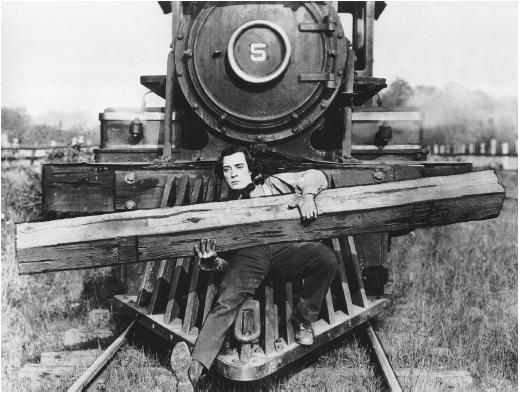
Buster Keaton, The General, 1926
”Johnnie races to the general store, which is now a makeshift recruitment office. Taking a shortcut he manages to be the first in line. The door to the office is opened and Johnnie comes marching in—only he and the rest of the line go in two different directions, and he has to jump over several tables to get in front again. He gives the enlistment officer his name and occupation, but the man rejects him. Johnnie is more valuable to the South as an engineer. Later, Annabelle believes that Johnnie didn’t even try to enlist. She refuses to speak to him again until he’s in uniform. What follows is a classic moment: Johnnie sits on the connecting rod of his engine. He’s so miserable that he doesn’t notice when he starts moving up and down, until just before t
rain enters a tunnel.”

Carson McCullers
”Marion Mack leaves no mark of her personality on the screen. She deserves credit mainly for being willing and able to take it. Bette Davis and Katharine Hepburn were never thrown around, trod upon or knocked about the way Marion Mack was. She has hilarious moments. The excitement of the chase does not prevent her from taking out a broom to sweep the dusty floor of the engine. An exasperated Johnnie tells her to keep throwing wood into the fire. She takes a small stick and daintily puts it in. Johnnie sarcastically hands her a sliver, and she puts that in, too. Then, in a moment that has an audience roaring and clapping, Johnnie grabs her and half-throttles her before kissing her instead.”
Heart of a Lonely Hunter by McCuller’s explores the spiritual isolation of misfits ,and quirky but well defined and redeeming figures of the South. It effectively predates and circumvents, a perhaps manufactured ”new consciousness” that was written by sociologist academic David Riesman in ”The Lonely Crowd”, which became an accepted template for analyzing society. Riesman writes of three very different character types in his book “The Lonely Crowd.” McCuller’s world is of people perennially in exile, always a few steps ahead of their personal Babylon,and at once accessible, yet incomprehensible.
The first type, tradition directed, is driven by cultural demands to act in an approved way, and is enforced through fear of being shamed or losing honour. The second type, inner directed, is driven by an inner gyroscope” that is set primarily by his parents. The inner-directed person behaves according to this “internal piloting” and often senses feelings of guilt, rather than shame, if his behavior shifts from these parent-instilled values. The third and final type, other-directed, is the group that Riesman has nicknamed “the lonely crowd.” The behavior of other-directed individuals is governed primarily by their set of peers at any given moment. According to Riesman, other-directed individuals have an internal “radar” for sensing and responding to their peers and makes them “capable of a rapid if sometimes superficial intimacy with and response to everyone.” The “lonely crowd” of inner-directed individuals is where most Americans today would belong according to Riesman’s categorizations”
McCuller’s other novels employed similar narratives played out over a Southern setting, an its impact is almost coincidental. Her central theme; the huge importance and nearly insoluble problems of human love. Her characters are aggressive people whose tendencies are tempered by a deep curiosity and sensibility making them empathetic, and almost biblical in stature.
In a discussion with the Irish critic and writer Terence De Vere White she confessed: “Writing, for me, is a search for God.” This search was not acknowledged by all of her colleagues – Arthur Miller dismissed her a “minor author”, but Gore Vidal praised her work as ”one of the few satisfying achievements of our second-rate culture.”


 COMMENTS


Thanks so much for reading. I don’t subscribe to her work, in general, being termed ”Southern Gothic”. Its a label of convenience that misleads.Dave