

Interpreting the mythology of a work of art may fall under the domain of the art sleuth, and an intrepid one at that.Take for example Sandro Botticelli’s masterpiece, ”Primavera”. Those who are willing to settle for a poetical tableau and a virtuoso’s exercise in arabesques will be amply satisfied. For those who want to read the mythology, the answers are not easily forthcoming. There are many sidetracks leading to inconclusive way stations.In addition, the historical subtext remains central to this period of transition resulting in a clash of opposing visions that continues to influence to this day.
”The Renaissance concept of the dignity of man did not draw on a new secularization of culture as is generally taught, but rather on a synthesis of ancient esoteric religious and philosophical ideas enumerated by Pico in hisOration. These ideas, mostly of oriental origin, had inundated Italy since the time of Marco Polo, but flowed in with greater impact after the fall of Constantinople to the Ottoman Turks in 1453. Foremost among these were Hermeticism, Kabbalah, and the Orphic Mysteries combined with the Neo-Platonism of, Plotinus, Proclus and Iamblichus.”

Primavera, from left, Mercury, The Three Graces, Cupid, Venus,Flora, Chloris,Zephyr
The painting insists on looking like what it is, which is a complex allegory that has been waiting several centuries for the discovery of its original literary inner structure and its precise iconographic program. It needs that program in order to become fully coherent and expressive as visual art in the same way as an opera score requires a libretto to become musically coherent and expressive.
Primavera asks more questions than there are answers. For whom and when was the picture painted?, Does it contain topical allusions? What philosophy guided the artist in his striking mixture of sensuousness and idealism? Who are the flower people on the right, the beautiful people on the left and the young matron in the middle? Is the idealism focused on specific ideals?, If the return of spring, ”La Primavera”, is the subject, why are the trees carrying an autumnal load of ripe, golden fruit? Botticelli’s actual ”libretto” may well be hidden somewhere, in a cave in the Florentine hills like the Dead Sea Scrolls, but until that discovery is made, we have to write our own, under conditions of fading light, but aided by a spirit willing to rebel against routine. Centuries of excavations have yielded results have been paltry, intermittent and less than satisfactory.

Flora and Chloris
The painting, it seems, was ordered for Lorenzo de Medici’s second cousin. The drawing does not have much of the dramatic wiry vigor that Botticelli favored a couple of years later; it show instead the tendency toward soft gracefulness that can be seen in Uffizi’s ”Adoration of the Magi” which was painted in 1476-77. Botticelli was in the midst of one of the most productive periods in his career, and perhaps the happiest period of his life, although with Botticelli happiness seems to have been relative.
Giorgio Vassari’s ”Lives’, published in 1550, forty years after the death of Botticelli said the painting was about Venus denoting Spring; whose presence an ordinary viewer might not suspect. Nearly everybody now agrees that she is the young matron in the middle under the Cupid, although her being fully clothed has provoked a few doubts. Spring motifs account for some of the personages and decor , but it leave enough unexplained to look into additional theories. One class of interpretations are based on the ”simple theory” These are that the picure simply celebrates womanhood, or it depicts a meeting of lovers. Still another is that it allegorizes the round of the seasons; beginning with the wintry wind on the right, move through spring, summer and autumn, and back through the laden trees to winter again. The problem with these theories is their being too easy and abridged an explanation given the exhaustive data available.

This is a traditional sand painting from Arizona and it is another instance of a cultural heritage that not only genders nature, but also separates spheres of existence into dualities: one "belongs" to the feminine, and one "belongs" to the masculine.
Another theory is the ”topical-sentimental” in which different gods and prominent Florentine personages, events and legends fill in the blanks. For example, the puffing god on the right is Zephyr, and the windblown nymph in his grasp is Chloris. The last set of theories is that the ”Primavera” is primarily a philosophical picture and that the philosophy behind it is Florentine Neo-Platonism. This system of thought mixed a good deal of eclectic mysticism and occultism with standard Neo-Platonic doctrine as the idea of reaching the heavenly kinds of love and beauty through the earthly kinds. There are documents to support such speculation, but none so far can be called an explicit, comprehensive program for the picture.
 89" />
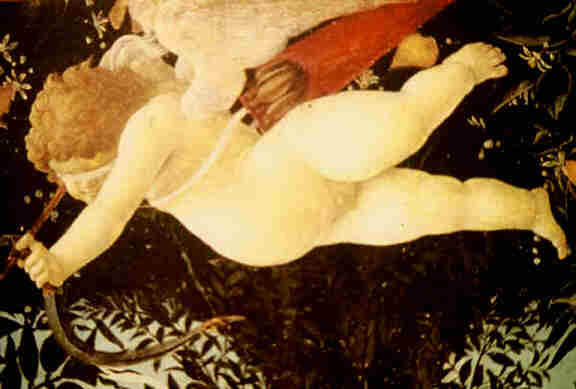
Botticelli, Cupid, blind. detail from the Primavera
A most accepted theory has the painting as portrayal of a bucolic scene from the pagan past with nostalgia; it containing within its very core an imaginative portrayal of the erotic nature of Renaissance thought. ”According to Renaissance scholar, Edgar Wind, the key to this painting lies in the words of Pico della Mirandola, that “the unity of Venus unfolds in the trinity of the graces” and that this simile pervades the totality of universal pagan myth. In Primavera, following Plotinus and Pico, there are nine figures which form an Ennead, that is to say an emanation in multiples of three”.
Art historian E.H. Gombrich made similar, compelling arguments that Botticelli’s fully clothed young matron is this Venus humaitas, and the painting is an allegory of the kingdom of Venus, of an ideal world where nature and instinct, embodied by the erotic Zephyr and Flora, are ennobled by culture and civilization, embodied by Venus; representing humanity and accompanied by the three Graces. The conclusion is plausible, but where did Botticelli find the images that convert the abstact philosophy into such a vivid representation? The ambiguity in the allegorical meaning is also overlaid with an ambiguity in the general emotional tone of the painting which appears to be historical, a dominant mood vibrating between the Renaissance and the middle ages. It exhibits a Renaissance delight in sensuous experience and melodic and balletic qualties. On the other hand, the painting can qualify equally well as a medieval production. Venus-Humanitas does not look at all pagan and the the three Graces, supplied with wings, would make excellent Gothic angels. Mercury could pass for a Christian saint, and Chloris and Zephyr as desparate souls pursued by a devil.
The painting may also be an attack against established norms of physical beauty and its opposite, that being, the representation of physical beauty as a uniquely European expression reflecting their superiority; a superiority leading to predominance. Thus all cultural diversity is dragged into the denominator of distorted whiteness.However, the theory of a European artistic and racial consciousness in the painting would betray a Renaissance aesthete that drew generously from theistic Easten influences, Sufism, Jewish mysticism and Egypt. The iconography could certainly suggest fragility of the Euro-centric view, and its incoherence in the face of nature whose physicality owes allegiance to no racial grouping. There is also a mocking of illusion, shown by the paintings lack of linear perspective and very unorthodox handling of space. Yet, it is documented that Botticelli had easily mastered and was capable of obeying the recently invented laws of linear perspective.
Primavera can also be perceived as a gender study, regarding gender roles, separation and duality:”This painting relies on images of women to act as symbols for different aspects of nature; Western ideals of beauty, grace, and femininity are portrayed connected with the concept of nature. The women in this painting are all barefoot, further symbolizing their connection to and rootedness with the earth, whereas males are airy, disconnected from the earth. Mercury, on the left, is an airy god of communication, constantly in transition; Cupid, at the top of the picture, is also of the air and is not in contact with the earth.” Primavera is also an allegory on the harmony of nature and humanity with Venus as central figure acting as the link between nature and civilization. Thus, the painting also questions our relationship with nature when it is gendered, anh how those assumption affect our behavior and relationship to nature. 
There is plenty of external evidence that when the ”Primavera” was being painted, there was a spiritual conflict between medieval-Renaissance or Christian-pagan in the minds of many devout Florentines. It cannot be supposed that the puritanical religious revival led by Savonarola arose from nothing.Chloris, the earth nymph who runs away from the embrace of Zephyr, or perhaps chased from celestial harmony is now pushing her breath,perhaps a moral halitosis, over the earth and represents the dark side of the Renaissance. The painting is then a conflict of two opposing and mutual exclusive visions, that confounded even Leonardo Da Vinci: ”Sandro, you tell us not why some things appear lower than others…”
”There is little consensus among historians as to when or how the so-called Renaissance came about, but most would agree that an affirmation of the dignity of man was the result. While the Church had always insisted that man was made “in the image and likeness of God” and therefore worthy of the highest respect, his status as a creature was strictly maintained. Man, to reach his proper end, the beatific vision, needed Sanctifying Grace supplied through the sacraments of the Church. Renaissance thought, at first subtly and then openly, challenged this view… This blurring of distinction between the Divine Logos and human nature was carried further by Pico della Mirandola in his famous Oratio de hominis dignitate published in 1469. …Pico had no open desire to break with the Christian faith, but according to his concept of unlimited human potential, the advent of Christ, the Word Incarnate, did not inaugurate a new supernatural order embodied in the Church, but stimulated, a rebirth of natural man and human potential. In the words of Walter Ulmam, “Through [Baptism] there was a rebirth of natural man; through this restoration into his natural state, cosmological perspectives came to be opened up which were hitherto barely perceived … Natural man was awakened from the slumber of the centuries: he was reactivated.’ ” ( Hamilton Reed Armstrong )
The most radical theory is an interpretation of Primavera based on the ” hermetic octave” Michael Hayes, in The Infinite Harmony: Musical Structures in Science and Theology, determined that certain hermetic ideas may be found in many of the world’s major religions, including Christianity. In particular, he asserts that the concept of the hermetic octave is included in many of these religious belief systems. Hermetic octaves have two potential fault points which may lead to their eventual decay; however, appropriately placed interventions or shocks may permit the avoidance of these natural tendencies. La Primavera depicts eight major figures associated with the Pythogorean octavefrom right to left. Zephyr and Mercury marking the beginning and end of an octave. The two semitones or critical points occur.First, between Flora and Venus, and secondly, between Thalia and Mercury. Each critical point has one of the gods, either Venus or Mercury, involved in the interval. The implication is that the successful crossing of each critical point or interval may require divine,or an least supernatural, even paranormal assistance. Also, the cupid hovering over Venus and the caduceus held by Mercury are considered to be markers of these important transition points.
”The Pythagoreans proposed that, for evolutionary or “intelligent” octaves to have a fully harmonious `ring’ to them, it was necessary to exceed the bounds of ordinary practical music and actually introduce the additional concentrations of resonance at the points of vibrational retardation – between the notes “mi-fa” and “ti-do.” These additional concentrations of resonance, or `metaphysical semitones’, were to be created, in time, by the individual himself. Remember the seven-tone octave of practical music reflects a natural cosmic process which is in reality disharmonious. That is, without the two additional semitone `shocks’ it is not possible for a developing scale of `intelligent’ resonance to exactly double its rate of vibrations and so square its possibilities. In other words, in lacking the aforementioned semitones the natural, living octave must, given time, either `decompose’ (involve), or be deflected or consumed by other more powerful orders of energy and form passing through its given sphere of influence – hence the vast multiplicity of natural forms existing in the universe and why, as has already been suggested, there are no apparent straight lines in nature.” ( Michael Hayes )
A possible conclusion to all this is that the strange charm of the ”Primavera” comes from an effort to balance historical and personal tendencies that ultimately could not be balanced. Botticelli never tried to paint this kind of picture again. His painting style veered back and forth between realism and anti-realism, and whose behavior careened between the melancholic and ecstatic. In ”Primavera” the artist showed a dreamy pageant, played by the flower people of Florence, but the question of who are they and what are they doing in the woods remains unanswered; overall an enigma for the ages.The only persisting and consenual point of departure is that element of interpretation suggesting the mythological figures in the painting undergo transformation to show a progressive sublimation of sensual love in intellectual contemplation. This sublimation is in accordance with the harmony that governs the cosmos and is evoked in the figure of Venus.


 COMMENTS

Thank you for sharing.
his is a very good approach of Primavera.
I will put a link to it in the post I’m doing about Primavera.
What a shame that you didn’t include the pai ting central to the novel by Marina Fiorato “The Botticelli Secret” ~~ Da Vinci Code for another painting. Very interesting theory.