
”But then my mind was struck by light that flashed and, with this light, received what it had asked. Here force failed my high fantasy; but my desire and will were moved already – like a wheel revolving uniformly – by the Love that moves the sun and the other stars.” (Paradiso,Dante, Conclusion) Dante expressed in words what Giotto was trying to convey in images. Both Dante and Giotti were recognizing their humanity in its purely emotional, individualistic expression, not being particularly shy or frightened of exploring the more dark, gothic, sinister sides of their identity.Giotto’s gods, saint, and mortals have an existential and spiritual energy and tension which chemically and intangibly bonds them.

Giotto, The Betrayal of Christ. detail. the encounter between Jesus and Judas is anthing but enigmatic. The eye contact indicates both men know exactly what is in store for each other.The second fresco of Judas’kiss represents a very different interfacial constellation. It presents an antithetical spherical tension. The antagonism between the two is depicted on three levels. The first is metaphysical, distinguishing between god-man and man by using one single aureole. The second is physiognomic, depicting the distinguished versus the vulgar. The third is the spherological gap between the faces. There is an open sphere-creating force in the eyes of Jesus while Judas is unable to enter the sphere. Instead he selfishly tries to steal entrance. The kiss represents the gesture of someone who wants to enter the love space with the attitude of an outsider. There is no possibility for a shared life in their eyes.''
On the frescoes of Giotti, even Jesus is bestowed with a unique human face, something for which Giotto was criticized for, as it was considered heretic, particularly among the Eastern Orthodox tradition. However, for Giotto, Jesus was not just the son of God, but also a unique person with psychological traits. From Giotto onwards, faces have become the site of psychological richness. Giotto made the idea that faces are the condition ”sin qua non’, of humanity imaginable. To put in words used much later by Deleuze and Guattari ( 1987) , the genesis of a human being is inconceivable without ”faciality” . It is the face that makes us human. Human encounters are typically taking place in an interfacial space. Giotto has shown us what this might entail.

Giotto, Noli Me Tangere, 1320
”if God does not exist,everything is permissable” according to Dostoevsky in the Brothers Karamazov. Gilles Deleuze inverts the condition to arrive at ”it is with God that everything is permissable”. Indeed, morally the worst atrocities and most heinous acts against humanity have always managed to find a divine justification. Deleuze’s hypothesis may also be true aesthetically. In the hand of a painter like Giotto the constraint becomes a condition of radical emancipation. In painting the Divine, one could take literally the idea that God must not be represented; an idea that results in an extraordinary liberation of line, color, form and movement. With God, painting found a freedom it would not have had otherwise. A form of pictorial atheism.In each case, form is destroyed, relief is renounced, and a determination is made. Far from being the materialization of irrationality and chaos, what emerges in these images is a profound and difficult kind of vision.
”In William Blake’s primal scenes of awe, terror, or creation, an emblematic figure blazes in the center of a depthless surface. These paintings and drawings manifest no respect for norms of proportion or sense, the key elements of perspectival visual representation. Such distortion is not limited to the nineteenth century, that is, it is not tied to a particular historical era in the West. Giotto’s fourteenth-century Arena Chapel interior likewise articulates a highly differentiated kind of pictorial space that sharpens the viewer’s awareness of the picture surface. In the scene of hell, in particular, there is a total collapse of hierarchized space: shattered architecture, a completely flat surface, fading anddisappearing color and bodies. In none of these cases does what appears on the surface correspond to any account of progressive or contemporaneous technological or historical ideas about space.”
What was and is still so fascinating about the work of Giotti there, is not that easy to spot for the modern eyes. One has to keep in mind the exact historic and cultural context in mind. Giotti painted in an era of iconic representations where humans portrayed looked like they were ashamed of their own flesh; their terrestrial roots. Balancing somewhere between the pale perfectness of angels and gods and the heroic mysticism of saints, they hardly ever touched the ground with their feet. With Giotto, the places are real, we can hear the sand and rocks being replaced by the figures, and , what really matters, the emotions are real. In ”Lamentation” , there is a black rainbow of pain, anguish, disbelief, grief… even angels above abandon themselves in expressing their deep sorrow.
It is the idea of the infinite painting. The transcendent infinity of Giotto’s frescoes being multiple and varied infinities being essentially the infinity of crossing over borders and through diverse operations concerning art and the world, or the infinity of movements and passages which open onto a field of real and virtual forces, where painting is implicated. Painting is emptied of its traditional supporting structure in favor of the multiple, materialized and abstract.

Giotto, flight into Egypt.
But Giotti was also the beginning of what Deleuze refers to as the abstract machine of faciality; in other words a selective process. A binary relation of the yes and no type. At every moment, the machine rejects faces that do not conform or seem suspicious. But this only at a given level of choice since there is a first choice, tolerated second, less accepted third and so on. Even madness is a face conforming to an X th choice, but not the last since there are mad faces that do not conform to what one assumes madness to be.This end period of Dante and Giotti was also a time of consolidation of race and the nation state crystalized into normative looks. ”Far from leading us to a true appreciation of art, subjective compensation ends by making the work of art itself into a mere link in our associations of ideas; as in the case of Swann who never admires Giotto or Botticelli so much as when he discovers their style in the face of a kitchen maid or a beloved woman” ( Deleuze )

Giotto. Meeting at the Golden Gate.It is eye contact which makes the frecoe so dynamic. The interfacial space can thus be seen as a site of tenderness or terror. The Space, like in '&
The Betrayal of Christ'' is also filled by enigmatic and contorted facial parts.If there is a representation of the figure and face that is in fact Christ,he should resemble an ideal of the average white man. The first deviencies, the first divergent types are then racial; with yellow and black and other tones and hues assuming their peg on the scale.In turn, these types, according to Deleuze must also be Christianized or in his terms facialized. Interestingly for Deleuze, European racism as the white man’s claim has never operated by exclusion, or by the designation of someone as Other. This is instead, only found and practiced in primitive societies. Racism necessitates a level of belonging and operates by the determination of degrees of deviance in relation to the White-Man face, which endeavors to integrate nonconforming traits into increasingly eccentric and backward waves, sometimes tolerating them at given places under given conditions, in a given ghetto. From the viewpoint of racism, there is no exterior, there are no people on the outside. There are only people who should be like us and whose crime it is not to be. The dividing line is not between inside and outside but rather is internal to simultaneous signifying chains and successive subjective choices.To Deleuze, racism never detects the particles of the other; it propagates waves of sameness until those who resist identification have been wiped out and its cruelty is equaled only by its incompetence and naivete.Though on a more positive note, painting began exploiting all the optics of the Christ face to produce deviant forms:
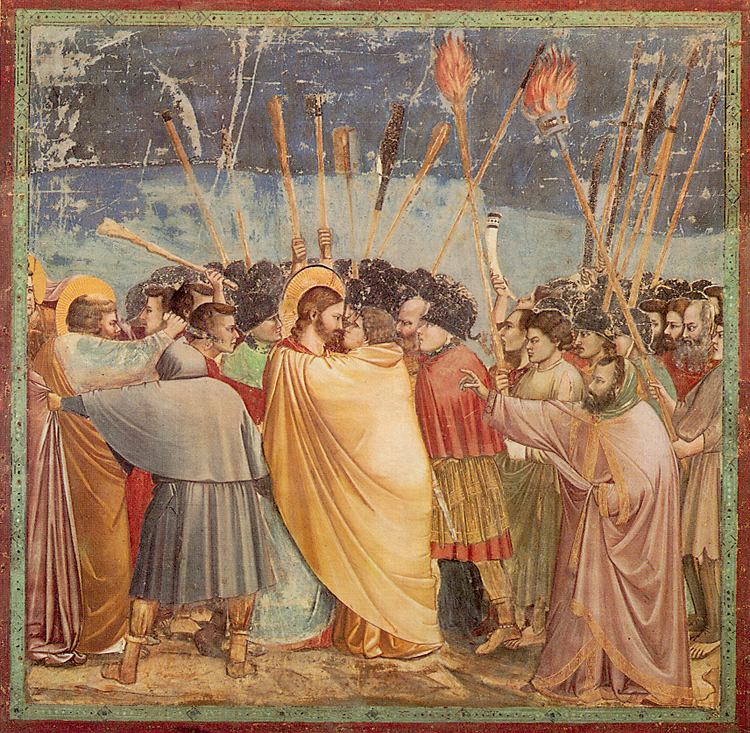
Giotto. The Betrayal of Christ.Tenderness is fully absent and togetherness takes on an entirely different and more horrifying form. There is no halo on Judas who remains a lonely and inner directed subject. They look at each other in the eye, but understand that togetherness between them is, if anything, an illusion.It is by virtue of the eye contact that Judas comes to realize the magnitude of his crime and that Christ begins to resign to his fate.
”In this respect, there is an exultation in the painting of the Middle Ages to the Renaissance, like an unbridled freedom. Not only did Christ preside over the facialization ofthe entire body (his own) and the landscapification of all milieus (his own),
but he composed all of the elementary faces and had every divergence at hisdisposal: Christ-athlete at the fair, Christ-Mannerist queer, Christ-Negro,or at least a Black Virgin at the edge of the wall. The most prodigious strokes of madness appear on canvas under the auspices of the Catholic code. A single example chosen from many [Giotto, The Life of St. Francis,scene XII, The Transfiguration—Trans.]: against the white background ofthe landscape and the black-blue hole of the sky, the crucifiedChrist-turned-kite-machine sends stigmata to Saint Francis by rays; the stigmata effect the facialization of the body of the saint, in the image of the body of Christ; but the rays carrying the stigmata to the saint are also the strings Francis uses to pull the divine kite. It was under the sign of the cross that people learned to steer the face and processes of facialization in all directions.’, ( Deleuze, Guattari )
Giotto. Meeting at the Golden Gate. 1305. detail. There is tenderness and trust, but an enigma and puzzling regard:''The first one depicts the moment where Joachim and Anna meet after they had a vision they were going to be parents of holy Mary. This moment where they are partners in the shared secret of the other is a moment where an interfacial sphere is created. Giotto represents this by placing both faces in a two-poled aureole. With a nice optical trick a third face appears in this two-poled sphere. The visible-invisible face that emerges refers to the new life that will be in Anna’s body. It is however not the face of a child that emerges from the faces of the future parents and resembles grandchild Jesus rather than their child, Mary.''


 COMMENTS