

Even more extremely than most great painters, Pieter Bruegel the Elder exists at two levels. At the popular one, his rollicking peasants are taken at face value and bought by the thousands in reproduction. A curious and delightful painter; obvious charms as a pictorial skin. At a higher level, Bruegel is an exceptionally complex painter-philosopher who had a very sobering view of man’s place in nature as integral, but not central. He probably stands with the small company of the greatest artists of any time and place, and in his own century he may have been the only genius to appear in northern art after Durer and before Rubens.
”He is the master of snow, this painter who gave us the lovely Hunters, but here he deploys that whiteness in the blankest way imaginable. The emptiness of the white covering, the deathliness of the stripped trees, the frozen ground, suggest a world betrayed and nature itself turning on the innocents.You feel winter’s cruelty in this painting: you feel the pain of those peasants when they tried to dig into the frozen earth, their hunger when there were no birds to catch and the streams were locked with ice. And then this final assault, this murder by soldiers with no pity, no compassion. Men with snow in their hearts.”( Jonathan Jones, Guardian):

Bruegel. Massacre of the Innocents. 1565-67. Though Biblical in subject the painting is set in a wintry Netherlandish locale. In the slaughter of Jewish infants by Herod's soldiers, Bruegel may have seen a parallel to the cruel occupation of the Netherlands by Spanish armies.
Unfortunately, little his known about him. When he died in 1569 he may not have been forty. There is little to support a personality portrait of the man although not for lack of effort. Most popular is the Bruegel invented to explain his fantastic paintings, apparently the member of some secret religious cult whose esoteric and perhaps satanic form of catechism could be attributed to cabalistic symbols or allegories. Whatever else he was, the real Bruegel was a man whose interests in common people and in fantastic invention were neither discordant nor contradictory, but were interdependent aspects of reflections upon the nature of man, his relationship to himself and his small world, and to the cosmos that turns that world through its seasons.
All efforts to particularize this man are frustrated. He was famous and successful, since the Hapsburgs were among his patrons. He must have been well educated, since he was part of the liberal humanist circle that included Abraham Ortelius, Plantin, Frans Hogenberg, and Goltzius, and he was not there as court jester. The single fact that is known about her personal life is that in 1653, he made a respectable marriage to Mayken, the daughter of he painter Pieter Coecke van Aelst, a man who may have been his teacher.

Bruegel. The Procession to Calvary

Bruegel lived during a time of social, political, and religious upheaval that affected him directly, but his convictions are known only through deduction from his art. He left no writings or letters from which to surmise what moral agonies or aesthetic arguments determined the nature of his art. Therefore, one has to always come back to his paintings where at least some of his general principles of belief can be discerned. Essentially, the overriding thematic is that men as individuals are faulty, and their most degrading sin is materialism, with covetousness and avarice as the most crippling symptoms of their folly.
But, generically, man is noble and heroic. In a state close to nature, man comes closest to realizing this potential. And the proof of man’s dignity is that he is worthy of inclusion as an integral part of the rhythm of the cosmos, which identifies the tempo of man,s life with the majestic succession of night and day and the turn of the seasons, which accepts him without question and without privilege as part of an ineffable complex that unites everything from the flight of a bird to the circling of the planets. In Bruegel the human flaw is not tragic, like the ancient Greece, but simply contemptible. Man is free to enjoy his appetites so long as he has the strength not to abuse them, and he needs no redeemer to restore him to bliss because he finds his own bliss in identification with the cosmos.
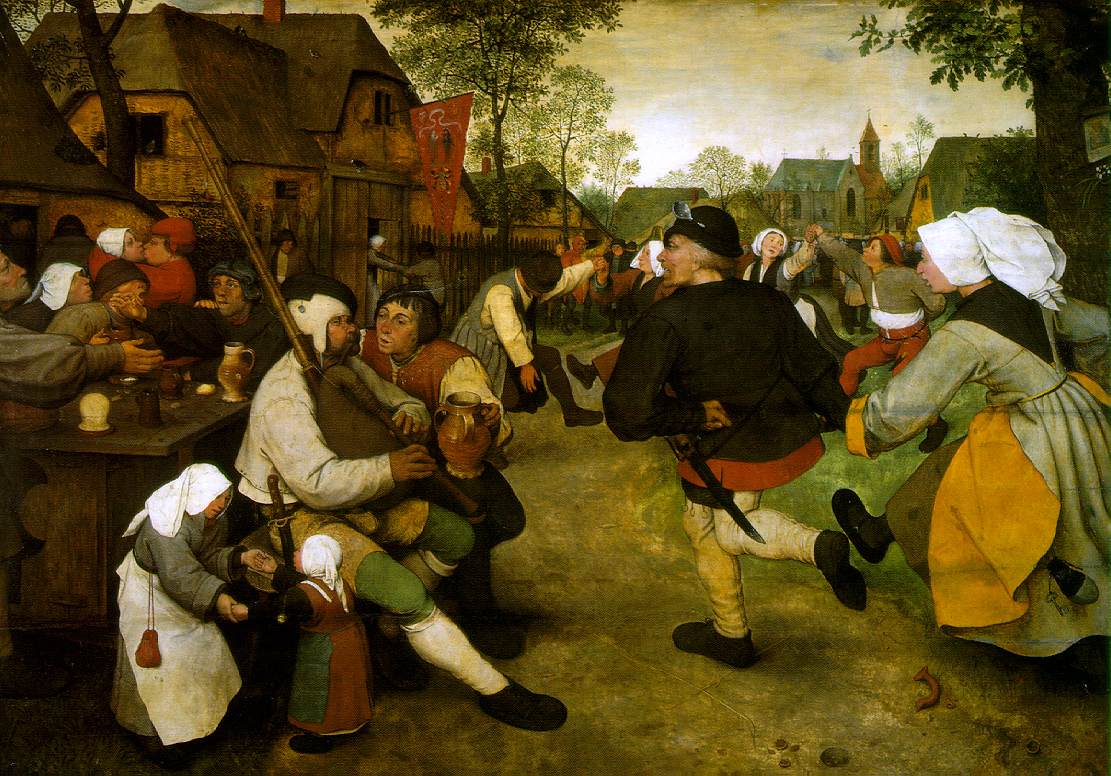
Bruegel. The Peasant Dance. Anything but a scene of pure rustic jollity. Lust, anger and gluttony mingle with joy and the excitement of a Netherlandish kermis, or church fair.
In Bruegel’s universe nothing is static. Everything moves, grows, and responds in endless harmonies of action and interaction. This was in contrast to the medieval universe which was almost too neat, too clinical, like a filing cabinet surrounded by a void; its minor virtue of tidiness imposed the major flaw of static definition. Finally, in his more vigorous way, Bruegel anticipated intellectually the nineteenth-century romantics’ emotional identification of man with nature, but without falling into the romantic fallacy of endowing nature with emotions corresponding to man’s.
As for Bruegel’s God, his religious affiliation can only be surmised, and that conjecture leads to him being a deviant Catholic. But, when he painted Biblical subjects he painted them to his own terms, neither manufacturing them according to the formulas that enabled even the most unreligious painters to turn out satisfactory holy pictures nor giving them any Christian mystical turn of its own.
m name="allowfullscreen" value="true" />
”But while these works demonstrate the artist’s attentive eye for detail and attest to his direct observation of village settings, they are far from simple recreations of everyday life. The powerful compositions, brilliantly organized and controlled, reflect a sophisticated artistic design. Bruegel was, in fact, patronized mainly by scholars …. The ongoing debate over the interpretation of Bruegel’s “peasant” images underscores the complexity and originality of his conception.Bruegel’s use of landscape also defies easy interpretation, and demonstrates perhaps the artist’s greatest innovation. Working in the aftermath of the Reformation, Bruegel was able to separate his landscapes from long-standing iconographic tradition, and achieve a contemporary and palpable vision of the natural world”. ( Jacob Wisse )
The ”Massacre of the Innocents”, beneath its nominal subject, is a sub rosa indictment of the eevastation of the Netherlandish populace by Spanish military force. ”The Procession to Calvary” becomes an execution scene concerned less with the victim than with exposing the baseness of human beings who can watch his suffering with callous indifference. ”Christ and the Woman Taken in Adultery”,ostensibly a parable pleading for charitable compassion between human beings, is extended to a social allegory of religious intolerance.
”The Numbering at Bethlehem” shows Mary joyously shielding with her cloak the glorious secret that she carries in her womb. Thus, she becomes a symbol of the presence of miracle ignored in the petty bustle of everyday affairs. Just as the villagers are blind to the presence of a miracle in this painting, so are the men who plod across the landscape of ”Hunters in the Snow” oblivious to anything but the business at hand. If we recognize their integration with the cosmic rhythm, they are too busy even to suspect it.
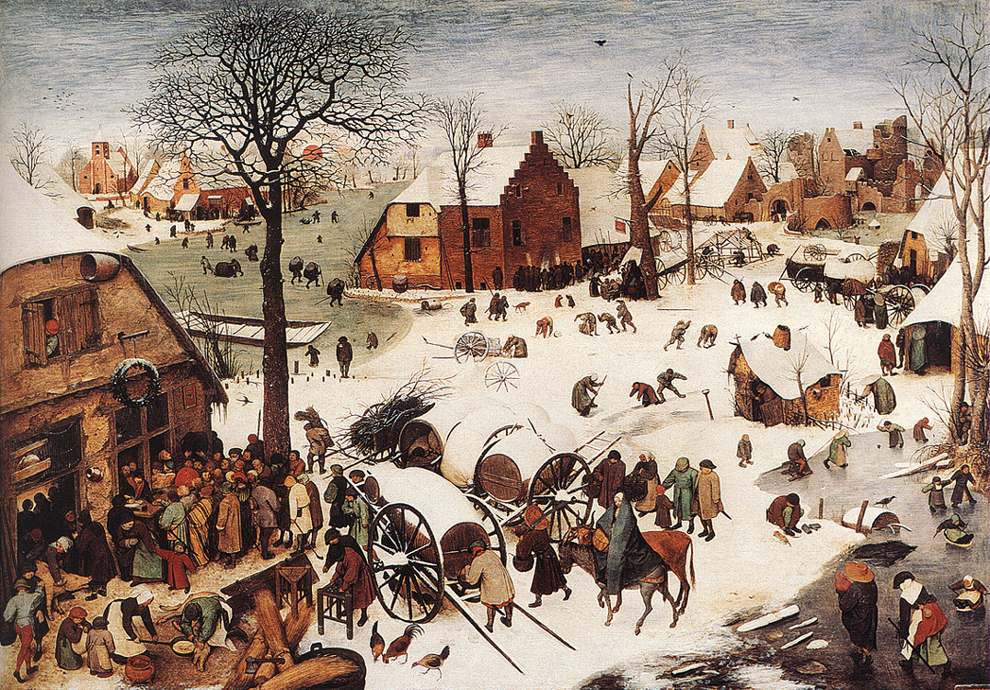
Bruegel. The Numbering at Bethlehem
This ”religion” of the cosmos was surely not something that Bruegel thought of as religion. But a person’s true religion is whatever they believe most deeply, and by this definition Bruegel was a pantheist. On evidence in his work, his God was not a force that could be isolated as a central personality as in the Old Testament, an eternal ruler with all pervading force.
”One of the most perfect of Bruegel’s human comedies is his famous picture of a country wedding. …The feast takes place in a barn, with straw stacked up high in the background. The bride sits in front of a piece of blue cloth, with a kind of crown suspended over her head. She sits quietly, with folded hands and a grin of utter contentment on her stupid face. The old man in the chair and the woman beside her are probably her parents, while the man farther back, who is so busy gobbling his food with his spoon, may be the bridegroom. Most of the people at the table concentrate on eating and drinking, and we notice this is only the beginning. In the left-hand corner a man pours out beer – a good number of empty jugs are still in the basket – while two men with white aprons are carrying ten more platefuls of pie or porridge on an improvised tray. One of the guests passes the plates to the table. But much more is going on. There is the crowd in the background trying to get in; there are the musicians, one of them with a pathetic, forlorn and hungry look in his eyes, as he watches the food being carried past; there are the two outsiders at the corner of the table, the friar and the magistrate, engrossed in their own conversation; and there is the child in the foreground, who has got hold of a plate, and a feathered cap much too large for its little head, and who is completely absorbed in licking the delicious food – a picture of innocent greed. But what is even more admirable than all this wealth of anecdote, wit and observation, is the way in which Bruegel has organized his picture so that it does not look crowded or confusing. Tintoretto himself could not have produced a more convincing picture of a crowded space than did Bruegel with his device of the table receding into the background and the movement of people starting with the crowd at the barn door, leading up to the foreground and the scene of the food carriers, and back again through the gesture of the man serving the table who leads our eyes directly to the small but central figure of the grinning bride”:

Pieter Bruegel.Peasant Wedding. circa. 1567



 COMMENTS