

”‘Moloch’ certainly, despite the horror it holds for Ginsberg, is after all only the comfortably unreal reality of bourgeois America. It is as much ‘invisible suburbs’ as it is ‘monstrous bombs’, and even the poet admits that it ‘entered my soul early’ and that it entails ‘epiphanies’ as well as ‘despairs’ . Rockland too, while it gorges itself eternally on the damned but ‘innocent and immortal’ soul of Solomon, is composed as much of ‘the spinsters of Utica’ as of electroshock therapy, while the latter even provides an opportunity for another apparent mystical experience.” ( Aaron Taylor )
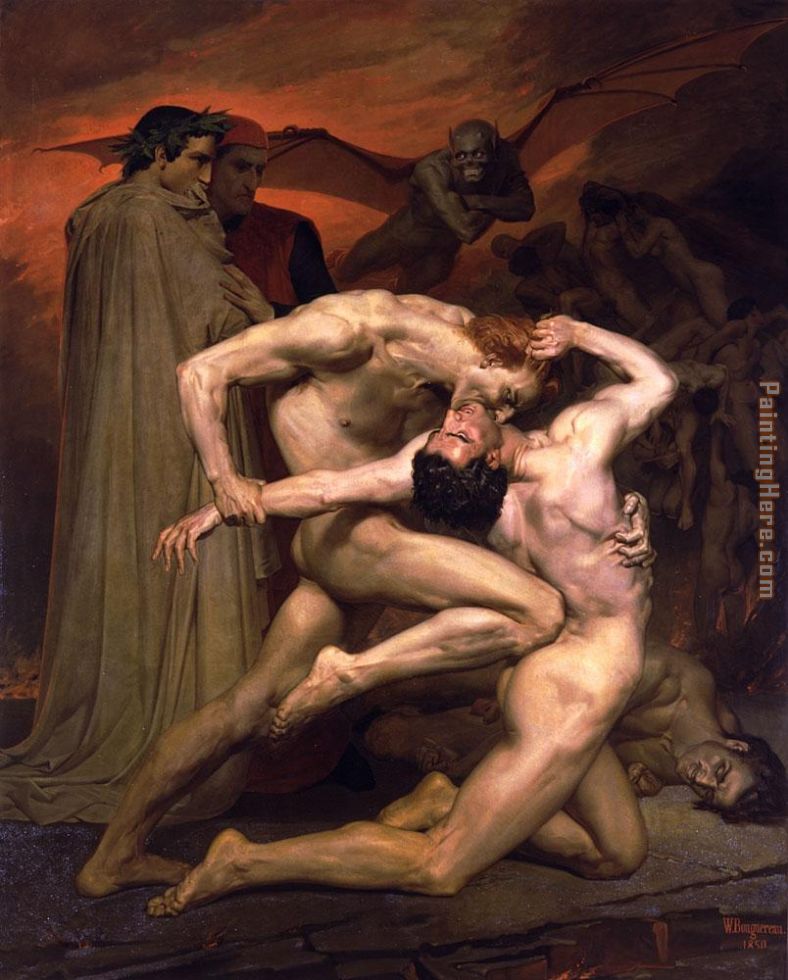
Dante & Virgil. William Adolphe Bourguereau. 1850
The implications of Dante’s Divine Comedy are readily apparent. Morality became a question of degree, a measure on a scale of weights and measures, al neatly categorized as almost Darwinian. Morality as a survival of the fittest. Dante had nerve; the sheer blatancy and hubris of his aspiration to totalize and systematize thought within his Inferno/Purgatory/celestial/ symphony. The diversity of the textual forms and intellectual interests of the Divine Comedy have defied all academic efforts to place Dante under the purview of a single dominant idea. The problem being the shape shifting nature of aesthetics practiced by Dante inwhich no scholar is nimble enough to keep in captivity. Once captured, Dante continues to dematerialize only to appear at a different unexpected venue.
Clearly, part of Divine Comedy is a treatsie on materialism, whether of a spiritual, intellectual or material accumulation in excess leading to a tour of the deep south with Virgil. For the Beats, morality is very nearly exhausted by the fatiguing requirement to seek experience and authenticity; to be ”real” and rebel for the style and the look , yet demands a consumption of everything at the same time; consumption itself being the password for admittance into Dante’s dens of iniquity whether on penthouse or basement level. The ”Howl” is both a cry of ecstasy and a scream of pain, for they are both the same so for Ginsberg to extoll and glorify both makes perfect sense. Think of Divine Comedy as open ended structure where poets like Ginsberg could contribute to its ultimate final status as a collective, group project.

Ary Scheffer. Ghosts of paolo and Francesca Appear to Dante and Virgil
Despite the absence of tracts about beauty and art, aesthetic issues did command the attention of people in the Middle Ages. Whenever poets or philosophers turned their thoughts to the order of the heavens, whenever they delighted in music or art, they contemplated how the pleasure they took in the artistry of the universe was related to the God who created it. For Dante, aesthetics was the discourse of being and could not be narrowly defined. The aesthetic became the domain in which he considered not only form and proportion, but questions of love, identity, and perfection of the self. In Dante’s Divine Comedy, the aesthetic is transformed into a language of existence, and a multiplicity of ”being”, Falsehood could now also be considered a gift of the graces, since the nature of the lie was ambiguous, open to discussion and the facts interpreted as ”images” and no loger as the stiff, aloof icons they were in the Byzantine period.The painter who visually articulated this was Giotto, and a century and a half later, Leonardo DaVinci.

Ginsberg. Howl. 1959
” It matters little to Ginsberg whether the experience is a vision of God (as implied on p. 17) or burning ‘cigarette holes’ in his arms (p. 13). Both constitute a fundamental rebellion against the Moloch that is 1950’s American society. But while the Beat critique of that society is a deep one that can leave few thinking, feeling persons completely satisfied with the status quo, it is also at the same time a glorification of self-destruction, a promotion of a lifestyle that led many of its most prominent devotees to a sad and premature death. To my mind, the Beat life and the bourgeois one are a Scylla and Charybdis. When I read ‘Howl’, it is truly, for me, a journey through Hell (one of which I too have ‘partaken’ to an extent) and indeed, a prophecy of conflagration. It is a description of a Holocaust that can be justified neither by the fleeting ecstasies and elations of its tormented subjects, nor by their dramatic escape from the other, more widely accepted flames of Moloch”

Davinci. Ginevra de Benci
Completed in 1457, Leonardo DaVinci’s portrait of Ginevra de Benci is a masterpiece still shrouded in mystery. A riddle with DaVinci is that he failed frequently and lamentably to finish the paintings he had started. Othes often completed the master’s partly finished canvases for him, or for themselves. Of many paintings it was often impossible to say which portion was Leonardo’s and which was the work of a follower. In the entire world, it is surmised that there are no more than seventeen authenticated paintings by Leonardo. The low figure is nine. Or like Fellini, perhaps 9 1/2. This is a scanty output for a half century long career. A Leonardo painting, then, is an extreme rarity, though any Leonardo work is far more than that.
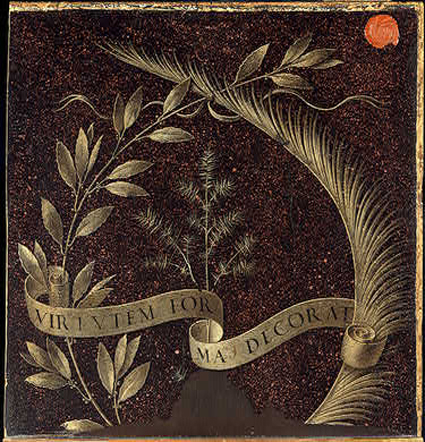
Davinci. Ginevra. obverse side. the emblem of the juniper is painted on the
of the portrait panel; the seal is that of an eighteenth century ruler of LiechtensteinFew as DaVinci’s paintings are, their cumulative force is unsurpassed, for they revolutionized the art of of the Western world. The art of beautifully modeled figures set in a palpable atmosphere of light and air, this was the art invented by Leonardo. After Leonardo, Western art took a course uniquely its own. What some have referred to as the predominant artistic expression of the white man:
”The Renaissance began in the cities of northern Italy – significantly in those regions which had been occupied by the Indo-European Lombards, who moved into the area well after the original Romans had been extinguished through integration with the hundreds of non-White nationalities who had filled Rome prior to the fall of that empire.It was the presence of these Indo-European Lombards which gave northern Italy its pre-eminent position in the Renaissance, and not the left over mixed-race populations from southern Italy. The Lombards produced all of the famous Italian Renaissance figures: Leonardo Da Vinci, Dante and Michelangelo, to name but a few.”
DaVinci’s portrait of Ginevra de’ Benci was completed at the outset of his career when he was not yet master of his mature style. Nonetheless the mark of the original genius is upon this masterpiece. The face in the painting is lovely, but it is also uncomfortably tense. It is youthful but strangely wary. It is the face of a lady who cannot relax or relent. Two decades before the Mona Lisa, he showed command of a unique power to portray the soul with all its maledictions.
Florence in Ginevra’s lifetime was at the height of its glory, ruled over by Lorenzo de’ Medici. It was a city that lived exuberantly on a heady diet of gorgeous pageants, masques and reckless carnivals. It was life loving city, happily and creatively bursting the bonds of its stern republican past. It was the Renaissance spirit incarnate. Ginevra came from a prominent banking family, but the face Leonardo saw when he set out to paint her portrait is one of a woman out of step with her own exciting time. She was frail, frequently ill and an extremely devout pious lady who at the age of sixteen was married off to a widower twice her age, well placed in the government. She was so scandalized by her twenty three year old aunt Bartholomea’s affair with Lorenzo, that she quit Florence and lived in the countryside to avoid ”this furnace of abomination”, an incarnation of Sodom and Gommorahwhose conflagrations in the Bonfire of the Vanities would soon pass.
When the searing, fulminating Savonarola began in 1490 to denounce the prevailing vices and vanities, the painted faces of Florentine women and the pagan worldliness of the wellborn, it is plausible that Ginevra was among those who flocked to hear that spellbinding voice.


 COMMENTS

A very interesting aprouch to the permanent question about Reinaissance and its impact uppon the following generations in the West. Yet the point I have valued more is the fine quality of the images, some of them very poor known to the common readers, like the one by Bouguereau. Just some decades away, the french painter was considerer almost litter, a “neoclassical” painter, kind of obsolete and retrograde stuff. Now we are understanding better the beauty of his Works. Other paintings that depict Dante’s Inferno are very old and have a strong medieval taste, you know. But they are beautiful in their own rigt. Thank you for writing about things of merit.
very kind of you! humankind has been dealing with the same issues for a long time, the same themes, and when we see these older works, we in effect “re-emancipate” them into a new context meaning the substance is actually quite fluid. thx.
Dave
O thank you very much! I think that the old matters are now of great consecuence, because of we, as species, are at the brink of an enormous change, but just we do not if it will be good or wrong. Some people, like you, are very concious, intelligent and gentle, so I can feel much relieved from pain. You know how bad the things are in so many places around the world. It´’s an unexpected pleasure to find a person like you.