

He played with a devilish brio at the piano. With his ”Etudes of Transcendental Execution”, he transformed the whole art of piano playing. The fierce onrush of trills, skips, and runs, the sudden blows and stormy flourishes, shattered the last vestiges of classical symmetry in keyboard music. In Franz Liszt’s hand the piano became a surrogate symphony orchestra.Like Paganini, the music was so difficult, it was thought Liszt had entered into a pact with the devil and denounced his soul in exchange for amazing virtuosity. That led to the discussion of immoral people and good art and fueled the romantic notion of individual genius, mutated and vacuum packed into the vacuous modern caricature of celebrity, or notoriety, which in Liszt’s case deflects from what is truly great about him.
Whether playing the rake or the monk or the lover of the pianoforte, Liszt was especially fond of cadenzas. Had he never composed a single note, Franz Liszt would still have been one of the most fascinating figures of the romantic age. It is almost a story of split personality, a remarkable duality confined within one individual. He has been incorrectly slandered as a kind of beautiful buffoon who happened, as if by coincidence, to be both irresistible lover and incomparable pianist.

Franz Liszt (1811-1886), Hungarian composer and pianist, plays for Alexander Dumas (the Elder), Aurore Dupin (George Sand), and the Countess Marie d'Agoult (all seated), Hector Berlioz, Niccolò Paganini, and Giacomo Rossini (standing). A bust of Beethoven by Anton Dietrich sits atop the piano and a portrait of Lord Byron hangs on the wall. Painting by Josef Danhauser, 1840.
Liszt was an elegant long haired ”arriviste” from Hungary who swept assorted countesses off their feet and between the sheets while at the same time managing to compose vast quantities of music. It was one of the most productive and at the same time dissolute lives of the century; a modulation from the sublime to the ridiculous and back again. There is technical wizardry of acrobatic proportions, executed in a frenzic state, yet at other times the choreography of the fingers submits to a dance of ideas and audacity of sounds. There is a melancholic grandeur that stamps his ”Sonetti del Petrarca” as the work of a great composer, perhaps one of the greatest of his time.
A long and crowded career that began with a kiss from Beethoven, passed through sponsorship of Chopin, championed Richard Wagner, discovered Mussorgsky and prepared the way for Debussey. His life, from 1811-1886 was a perpetual series of experiments in matters pertaining to the flesh as well as the spirit; a bizarre triangle between music, women and the state of his soul. It was a personal version of the century’s great quest for the absolute romantic experience.

Franz Liszt playing for Emperor Franz Joseph … … and Empress Elisabeth in the Redoute of Buda. Replica by Franz Schmaus and Karl Lafitte.
In later years he took minor orders in the Catholic church and wore a cassock, as though to disavow the follies of his youth, but even then the scandalous rumours that were spread about his private life had trouble surmounting the facts. Women adored him, and he was entirely dependent on them. To some people he was a model of generosity and to others a monster of vanity. In his own estimation he was half gypsy and half Franciscan. He claimed ancestral Hungarian nobility, but never learned to speak Hungarian. He fathered several children out of wedlock and never had a permanent home. He was a kind of tireless vagabond a musical refugee shuttling from one DP camp to another. However, the rootlessness, also prevented his music from becoming Germanic and conventional. He also abolished the the frontiers of musical Europe and eliminated the established division of labor between left hand bass and right hand treble on the piano, so that his two hands could range the full length of the keyboard, ready to strike singly or in pairs.

Liszt
None of this is surprising considering Liszt was born on the borderline between nations and epochs. Born on the border of the feudal domains of the Esterhazy princes of Hungary and only 100 kilometers from Vienna. Both parents descended from peasant families, with his father, an estate manager of the Esterhazy’s, being a combination frustrated amateur pianist and anxious and ambitious to give his son advantages he had not known.
Like Leopold Mozart demonstrated, ambitious fathers can make efficient drillmasters, and like Mozart, Liszt was packaged and promoted as a child prodigy, a groomed show dog, in Paris. ” You cannot imagine how it spoils one to have been a child prodigy”, Liszt said in his later years. It was an emotionally deprived childhood. His upbringing fit the classic pattern outlined in Alice Miller’s Drama of the Gifted Child ( 1979) in which the child has learned to equate love and acceptance with fulfilling the parents expectations of achievement. It also explains Liszt’s dependence on women and the need for an audience: ”The parents have found in their child’s “false self” the confirmation they were looking for, a substitute for their own missing structures; the child, who has been unable to build up his own structures, is first consciously and then unconsciously … dependent on his parents. He cannot rely on his own emotions, has not come to experience them through trial and error, has no sense of his own real needs, and is alienated from himself to the highest degree. Under these circumstances he cannot separate from his parents, and even as an adult he is still dependent on affirmation from his partner, from groups, or especially from his own children. ( Miller )

Liszt
He revolted against his father,s petty tyrannies in the form of religious fantasies; ardent prayers that were interminable and a declaration of an intention to become a monk. His father tried to cure these disconcerting tendencies through the baths at Boulogne, but died before the ”treatments” were terminated. ”On his deathbed in Boulogne my father told me that I had a good heart and mind, but that he feared that women would dominate me and confuse my life. This was a curious premonition, for at sixtteen I still had no idea of what a woman was…” Even Liszt’s father would have been surprised as how speedily his prophecy would be fulfilled.

''The Wise Old Man corresponds to the archetype of the Self or god image because he embodies the best qualities of both the puer and senex without being identified with their extremes: ungrounded youth and entrenched age. He is able to balance the tension of both within himself without becoming polarized or one-sided. He takes the best qualities of each and applies them to life. He has the youthful curiosity and spontaneity of the puer, yet the experienced mastery of the senex. The wise old man archetype also fits composer/pianist Franz Liszt. The 1879 oil painting by Elisa Ransonnet-Villez catches the true spirit of Liszt.
The saga of Liszt as lover began by falling in love with the most attractive of his pupil’s, the seventeen year old Countess Caroline de Saint-Cricq, but her father, the finance minister to Charles X, cut the lessons in mid chord and bundled her off to a marriage in the south of France. it was the hey-day of Byronic love and Liszt was smitten with Lord Byron’s vision, and suffered accordingly through Byron’s expressions of excitable passions as well as through the poet’s excessive lifestyle and monetary and romantic debacles.
She walks in beauty, like the night
Of cloudless climes and starry skies;
And all that’s best of dark and bright
Meet in her aspect and her eyes:
Thus mellowed to that tender light
Which heaven to gaudy day denies….( Byron, She Waks in Beauty )

A debonair young aesthete. Liszt posed in 1839 for this sketch by Ingres
He became a firm believer in Saint-Simonism, a secualar belief system that pre-figured the Marx-Engels utopia by presenting a form of socialist panacea calling for a war on poverty and the destruction of the European caste system.Musically, his encounters with Berlioz, Paganini and Chopin were ore important for his art than the July Revolution which broke out in 1830. His rendition of Berlioz’s ”March to the Scaffold” lead Heinrich Heine to remark, ”The ladies always act intoxicated when Liszt has played something for them.”
Liszt became fascinated by the hard wiry sound of Paganini, who was termed ” the vampire with the violin”. There were people in the audience who claimed to have seen the devil standing at his elbow. It was a lesson in showmanship that was not lost on Liszt. The art of making virtuosity sound diabolic by conveying suffering, misery and torture. ”All European elites started talking about divine talent of this man. Passionate performing, marvelous unusual techniques and demonic appearance caused numerous gossips about Paganini. Some were saying that Paganini was a son of the devil himself. That is why many people were attracted to his performances not only because of his incomparable playing, but also due to his mystical reputation. Schwarz described “the phenomena of Paganini” as the following: “It was more than technical wizardry that attracted the masses: there was a demonic quality as well as an enticing poetry in his playing’ ” Chopin completed Liszt by teaching him the value of understatement without quelching Liszt’s more fiery disposition.

After 1865, Liszt donned the habit of a Franciscan abbe, but avoided chastity. Liszt apportioned his last years between women and composing music
When Liszt was twenty-two he met the ”river nymph” with whom he was to embark on the great romantic adventure of his life. The Countess Marie d’Agoult was then twenty-eight, a mother of girls. She was said to be ”six inches of ice over twenty feet of lava”. A crisis came when she realized she was going to have Liszt’s child. They eloped in 1835 to Switzerland. She saw herself as a ”chosen one , destined as an offering for the salvation of this divine genius”. After three years of living in self-imposed exile on her terms, Liszt returned to his vagabond ways as the traveling virtuoso. He toured Europe from one end to the other, with much acclaim, pomp, medals, parties and circumstance including playing for the young Queen Victoria and the Sultan of Turkey.

''Marie d'Agoult (1805 - 1876) - Also known as Countess Marie d'Agoult, she was a German writer using the pen name Daniel Stern. Marie fell in love with Franz Liszt in 1833. During that time, she was married to Comte Charles d'Agoult but soon left her husband to be with Liszt. Marie and Liszt had three children but ended their relationship in 1844.''
At thiry-five he fell in love again, with a lady of immense wealth and exalted rank which was clearly incompatible with his gypsy life. Princess Carolyne Sayn-Wittgenstein was separated from a German prince in the service of the Russian czar and hoped to attain an annulment so that she could marry Liszt and they took up residence in the German Grand Duchy of Weimar. It was already the late afternoon of romanticism, and Liszt’s music now acquired some of the pomposity that was so prevalent in German music at mid-century.For this, the Princess was at least partially responsible.
Having treated the piano like an orchestra, Liszt now treated the orchestra like a piano, so that the symphonic poems sounded like arrangements of a vast keyboard improvisation. At first he knew so little about orchestration that he had to have an assistant help him with the scoring. the town of Weimar then had a population of only twelve thosand, but under Liszt’s aegis its opera house became a proving ground for all the avant-garde music of Europe. Wagner himself arrived in Weimar, a fugitive from the Dresden police after the abortive Saxon revolution, from where he was smuggled to Switzerland.

Liszt and Wagenr. N.C. Wyeth ( 1882-1945 )
Only the townspeople of Weimar seemed to take a less respectful view of their distinguished visitor, and regularly hissed at his productions in the theater. It was his morality rather than his art which sparked their ire, and his mistress was morally condemned for being seen smoking cigars in public. In 1858, Liszt followed the princess to Rome. Their hopes of being married however, were dashed at the eleventh hour when Pope Pius IX ordered a postponement of their wedding so that the case could be reviewed.
In 1865, he was received into the first four of the seven degrees of the Franciscan order after which he wore a cassock and became known as Abbe Liszt, a sort of Mephistopheles disguised as an Abbe who had not taken a vow of chastity. His vow to abandon worldly ambitions did not prevent him from adding to his warehouse of experiences. At sixt, he had a nerve wracking escapade with Olga Janina, the ”Cossack Countess” , a wild Ukranian horsewoman who afterward, as a woman scorned, penned a corrosive and embarrassingly detailed expose of their affair. Her homicidal temperament and his world-weariness made an explosive mixture.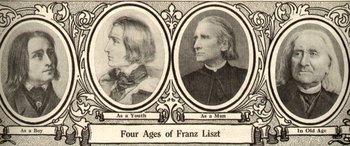
Liszt’s great discovery of the 1870’s was Russian music such as Mussorgsky and Rimsky-Korsakov which was drawn from the vast reservoir of Russian folk songs. It was modal music with harsh dissonances which proved to be a needed antidote to the emollient style of the Wagnerians which he called ”fat sounds” that risked to submerge him in lifeless stagnation. The late Liszt music had also turned equally modal and dissonant, but in his own fashion; stark open fifths , complex polytonal chords, and an increasingly melancholic mood accentuated by a stripping away of all the pianistic ornaments of the princess Carolyne years in Weimar. Though considered to strange to be published, the final works prophesized much of what the twentieth century was to bring. Namely, Bartok’s rhythms, Stravinsky’s chords and Debussey’s scales. In any event, Liszt was past caring what people though about what Wagnerr called, ”the illustration of a sinking world…childish play with intervals”.
It was left for Debussey, in the next generation, to discover the real significance of the avant-garde Liszt. Having labored under the delusion that Liszt wrote ”disordered and feverish ” music, Debussey declared his late works one of the formative experiences of his musical life. And for bartok, ” …it unlocked for me the true significance of this artist, for the future development of music I discovered in him a far greater genius than Wagner or Strauss'”.
Previous composers such as Mozart or Beethoven never delved as deep into the brutal dark side of Man, or the devil, as did Liszt. Liszt wasn’t afraid to invent menacing harmonies, of diabolical and dissonant proportions, to portray this evil phenomenon. Others simply shied away from such endeavors in fear of offending, or upsetting, the status quo. Liszt was certainly not a devil worshipper, as some suspected, he simply revealed all facets of the human experience. His era was one of instability, war and death. To turn a deaf ear, and close one’s eyes, to this aspect of life would have been ignorance. The ugliness that man perpetuates in life was not introduced or performed by Liszt, he merely recreated in sound our failings, much to the cultural establishemnt’s shock and bewilderment. Yet, Liszt did not only show us the dark side, as his numerous religious pieces attest, yet so many overlook.
Filmmaker and pianist Ophra Yerushalmi’s documentary on Liszt may be definitive work on this complex man: ”Liszt’s Dance with the Devil focuses on the inner duel between the virtuoso and the composer, the seduction of glamour and the quest for spirituality that took place throughout Franz Liszt’s life. The young Liszt who declares: ‘Le concert c’est moi!’’ and the older Liszt as Abbé in Rome seem worlds apart. A closer reading of Liszt’s own words and music point to one consistent thread: for him virtuosity was the expression of man’s glory and vitality, and music a sacred art. An investigation of his works will reveal a man searching for his own voice, in awe of those around him (Chopin, Berlioz and Wagner), rewriting his compositions, rewriting those of others as transcriptions; a man loved by many women who chose the beautiful and literary Marie d’Agoult, then the theological Carolyne von Wittgenstein. In fact, a man unlike the Liszt we imagine.”


 COMMENTS
Tanks. The Liszt one of the few who interests me.