

Rome, as the freshly abdicated ex-queen Christina saw it on her arrival, was a city in the process of being transformed by the genius of Bernini. Everywhere, churches and palaces were being rebuilt, and handsome piazzas laid out, in all the monumental splendor of the now fashionable style of the baroque. One of the most impressive of all the city,s palaces, the great Palazzo Farnese, was placed at Christina’s disposal by its owner, the Duke of Parma, and it was here that she spent the first months of her residence in Rome. No setting could have been more appropriate for the illustrious new arrival.

Of the paintings Christina took with her to Rome, two she especially admired were by Correggio. Each represents one of Jupiter's many seductions of Mortal women. In Danae he appears as a cloudburst of gold.
In its superb galleries she could display to perfection her magnificent paintings and sculptures; in its ornate salons she could receive and entertain the nobles, the cardinals, the diplomats, who vied to do her honor. She became for a season the queen of the baroque city, the center of attraction at theatres, the guest of honor at lavish banquets given by cardinals who compromised between the demands of this world and those of the next by offering at their tables exquisite representations of the Passion, modeled entirely in sugar.
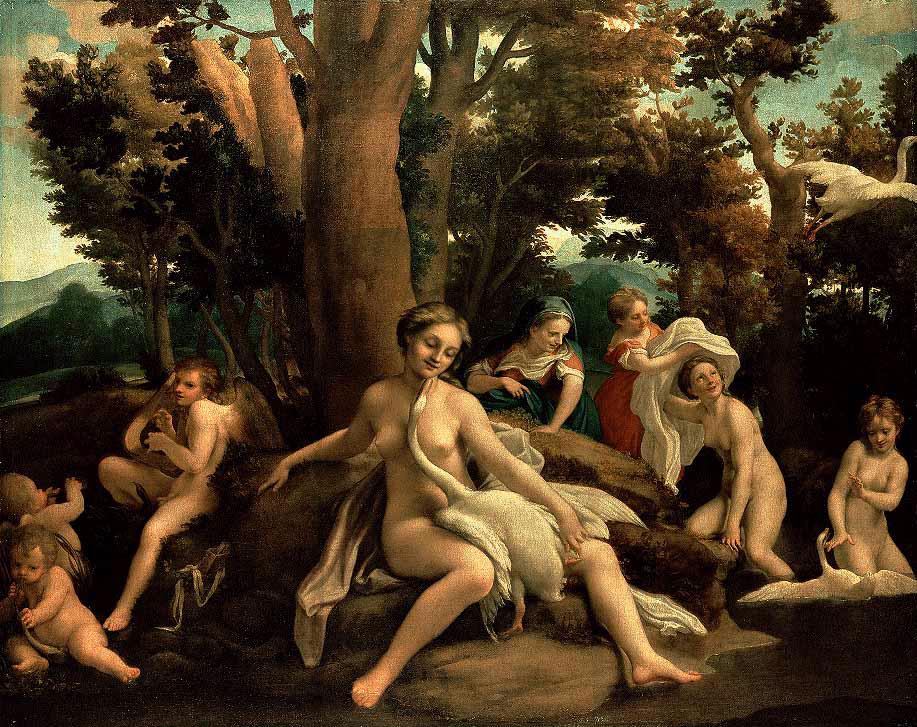
Correggio. Leda and the Swan. The sensuality of these paintings proved a bit too much for one of their later owners, Louis d'Orleans, who in a fit of temper gouged out Leda's head from the canvas. But soon afterward a contemporary artist gave her a new one that, with a few later restorations, has survived to the present day.
Unfortunately, Christina soon showed that she was not quite the earnest daughter of the church envisaged by the pope when he first welcomed her to the vatican. Her strange habits and outspoken tongue scandalized a Rome that for all its ostentation and splendor , proved in some respects to be as straight laced as Stockholm. The Roman Church was not, after all, that haven of free thought which Christina had fondly imagined it to be. In fact, she changed a quarter for a quarter give or take. She visited monasteries and churches, she surrounded herself with artists and scholars, but somehow the old restlessness and wanderlust began to bubble beneath the surface.
There were constant financial worries, for the pension she was receiving from Sweden was not paid in a regular fashion. Above all, she found it difficult to bear this new isolation from the realm of public affairs which had occupied her attention as Queen for so long. She began to toy again with thoughts of a crown; Naples possibly or Poland, or perhaps even the old homeland, Sweden. In 1656, she suddenly surprised Rome by announcing that she was leaving Italy for a season.

From a Perugian mannery Christina brought five altarpiece panels by Raphael, who was her favorite artist. Above is The Procession to Calvary
Nominally, the queen’s journey was designed to make possible a meeting with Charles X of Sweden, with whom she hoped to settle her financial affairs, but it was also intended as an occasion to explore with cardinal Mazarin the possibility of securing French help to make her queen of Naples. The visit to France however, ended in disaster. Discussions with Mazarin continued over a long period and appeared to be aiming towards a satisfactory conclusion. However, somehow, the secret details of the plan to place her on the Neapolitan throne were leaked. Christina had been betrayed, and the suspect was her own master of the horse Neapolitan Marquis Monaldesco.
On November 10, 1657, she summoned Monaldesco to her presence in the Galerie des Cerfs at the French royal castle of Fontainbleu, where she was at the time residing, and had him interrogated for two hours. Monaldesco confessed to the charges and threw himself at the queen’s feet, begging for mercy; but Christina was unmoved.
Then and there she sentenced him to death, and when the priest who was in attendance followed her out of the room to remonstrate at this somewhat unusual behavior in a royal castle, on foreign soil, she replied that ” she owned the right of a ruler to execute justice among her subjects at all times and in all places; she was answerable fro her actions before God and none other”. Treason was unforgivable , mercy unthinkable. Back in the Galerie des Cerfs, three armed men cut down the wretched Monaldesco, but the heavy mail shirt under his clothes prevented their swords from striking home, and like a cosa-nostra hit job gone awry, it took more than a quarter of an hour or more to complete the bloody business and put their resilient, wailing victim out of his misery.

Christina also owned Guiseppe A
boldo's The Gardener, a fantasy of fruits and flowers transformed into a human beingThe barbarous butchering of Monaldesco may have seemed to Christina no more than an act of common justice, but to most of Europe it appeared in a somewhat different light. it was a piece of extravagant and unnecessary and messy revenge for unknown, and undoubtedly sinister motives which implicated the credibility and transparency of the Vatican as well. From this moment, the queen’s political credit was totally destroyed as well as any aspirations for a comeback as Catholic torchbearer on the European stage. A private life was all that remained available to her, and she duly, head bowed, returned to Rome.
Here, in 1659, she acquired the palace which was to be her home for the remaining thirty years of her life. This was the Palazzo Riario, a fine Renaissance building with superb gardens, on the vatican side of the Tiber. She furnished the palace with great splendor and filled it with her collections which she was continually enlarging. She fitted out an observatory and worked at alchemy and scientific experiments while receiving an endless stream of connoisseurs and academics; she entertained her guests at brilliant spectacles and at concerts and operas with specially commissioned music by Scarlatti.

Mars and venus United by Love was one of ten Veroneses Christina's armies looted from Prague.
Yet, there was still something missing. Reduced to her own resources, she found that she was not quite so self-sufficient as she had formerly believed and humiliatingly she fell in love with an elegant member of the College of Cardinals, Decio Azzolino. Her tastes in the past had run as much to women as to men , but she had always prided herself on her ability to dominate the passions which affected lesser mortals. The cardinal did not return her advances and her extravagant letter fell on deaf ears. Perhaps, she could have afforded to fall in love, with a love that was impossible from the start. In any event, Christina had been thwarted and defeated.

Bernini. Cardinal Azzolino
Perhaps it was wounded pride and shame which now made her abandon her previously held philosophy of Stoicism, but turning to its opposite extreme, the newly fashionable quietism of the Spanish priest Miguel de Molinos. Not activity, but resignation and surrender , became the order of the day; and, for a time, she seems to have found a certain peace in this gently mystical movement.

While other guests stand around hungry, Christina dines sumptuously with Pope Clement IX under his canopy. But she had to sit at a lower table.
But her reactions, which she always cherished to be original, were actually very conventional for the intellectual world, which she had so tirelessly worked to be part of, had also turned its back on stoicism by the mid seventeenth-century. The queen who had always aspired to be ”not a copy but an original” actually conformed in an orthodox manner to the successive fashions of her time. One of the many paradoxes of her life was the self styled ”century of queen Christina” was a century of a sprightly, shallow, dilettantish, slightly pathetic figure, deliberately insensitive to the world around her, and yet at heart too sensitive to the currents of her age.
As the years passed, it became clear that there was something about Christina which neither time nor fashion could really subdue. Old at sixty-two , and very ill, she had little time to live. But furious at finding that she had been deceived by a servant, she rose up from her chair on April 14, 1689, in a desperate attempt to seize him. The effort proved too much and she collapsed unconscious on the floor. Five days later she died in a fitting, somewhat grotesque conclusion to an unstable, tempestuous life.


 COMMENTS