
Certain quotations from Ludwig Wittgenstein’s ”On Certainty” seem to imply that we can doubt everything: each statement that might be true still has some aspects that might make it possible to doubt it. Certainly, the issue of Goldman-Sachs and our understanding of financial systems, and our fear of their collapse and what it might entail has spawned a wide variety of opinion from the conspiracy to the comic, with many assertions of certainty and authority on the subject of which the truth has proved to be a very tricky animal to capture; an elusive shapeshifting creature apparently capable of dematerialization on the faintest of whims. The axiom that investors like ”certainty” is also up for reevaluation; given the collapse of over-leveraged financial titans doing a Goliath and the success of Goldman-Sachs, there is an equally strong argument that chaos and uncertainty can be equally important, perhaps essential in the creation of wealth.
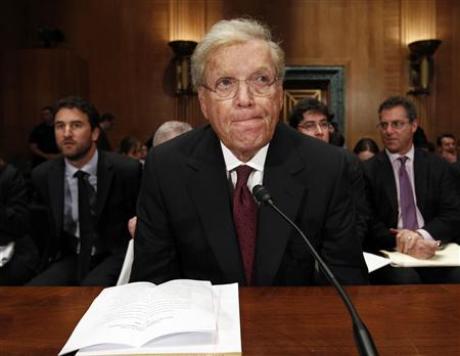
''The 76-year-old showed little emotion at the hearing, giving no hint of his reputation for profane and hot-headed outbursts during nearly 15 years at the helm of the company before stepping down in January of 2008. Commission Chairman Phil Angelides said Bear Stearns seemed to have taken on an extraordinary level of risk involving high leverage, a concentration in mortgage-backed securities and short-term funding of its operations. "There's a form of financial Russian roulette that Bear Stearns was playing along with other investment banks," said Angelides.
It is like the old aphorism like this one from an edition available on line: aphorisms in this book, which I quote now from an edition that I have found on line: “From its seeming to me – or to everyone – to be so, it doesn’t follow that it is so.” It implies the idea that everything that we might hold true might be different, not only in the sense that it has implications that may make it false ,for instance that our statement about an object is only true as long as we look at it. It may also be possible that our statement is false if we look at it from another viewpoint, for instance from the viewpoint of another person. Everything might be different, so it seems, and this is basically the position of a sceptic; the point of departure when deciding whether to send the banking system to the gallows and display their CEO’s in a public square like Benito Mussolini strung up like a quartered beef.
Though the aesthetic artistic attributes of whether a slow painful death, a quick assassination, or a long public process followed by inevitable death by some means is inherently appealing on grounds that the God’s should appeased occasionally by human sacrifice based on the ”people’s choice”, it might be more meritorious based on the possibility of the Gods of Karma that we put down our knife sharpening gear and take off our black hoods before rushing to judgement, despite the obvious temptation; the post appeasement period may result in more cognitive dissonance than had been foreseen.
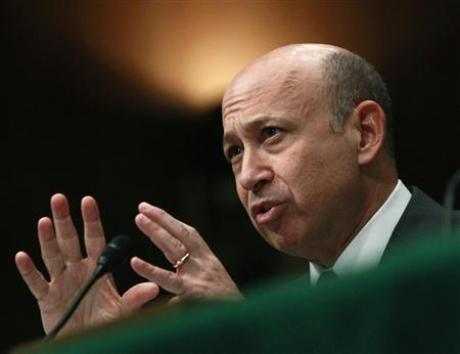
''Blankfein, addressing a friendlier audience than the U.S. Senate panel before which he testified on April 27, told well-known shareholder gadfly Evelyn Davis that he was staying in his job after she asked him to resign.''
The anti Goldman-Sachs movement has a fervor of religious fundamentalism that is a bit unsettling. Fire and brimstone seems to have a defintive need to create an Armageddon and destruction of the banking system as a harbinger of the apocalypse seems to be the secular means of choice to realize a nihilism and human suffering so that the Messiah can finally wake up, put on his/her bathrobe and slippers and come down from the heights or up from the cellar and make a hearty breakfast for us all. An example of this willful demagoguery has been the normally respectable Matt Taibbi of Rolling Stone magazine ran describing Goldman as “a great vampire squid wrapped around the face of humanity, relentlessly jamming its blood funnel into anything that smells like money”.
The truth is not linear, but rather something without a known shape or recognizable algorithm. There is always the factor of uncertainty. Markets are imperfect, despite the myth that they are perfect as reflections of all known information.

Ms. Gladstone's parody, "How Do You Solve a Problem Like Lloyd Blankfein?" captured the investment bank's current image problems and was described by many attendees as the evening's highlight. "He trades metal from the mines. He'd steal swine flu from the swines Unless that rare vaccine goes to the schools. He is little, he is bald, His plane's late when Obama calls. He's a headache, he's a handful, he's a squid."
Wittgenstein would have been an interesting choice as head of a company like Goldman-Sachs or as head of the Federal Reserve, since his basis of analysis is complementary with the decision making process of a Lloyd Blankfein. It is true, much can be doubted, in financial information but Blankfein like Wittgenstein make decisions based on a doubt of endless doubt based on the necessity for the belief of certaintly; something to mollify shareholders that there is a holy grail, or that life can exist on Mars. Both would pose the same quaestion that he doubts this endless doubt: “What we can ask is whether it can make sense to doubt it”. As Wittgenstein shows later in his On Certainty, in order to doubt we always need a frame of reference from which it is possible to doubt: “If you tried to doubt everything you would not get as far as doubting anything. The game of doubting itself presupposes certainty” This is a circular argument and it is not for nothing that the ”wheels of finance” , metaphorically have to be greased to keep spinning. Squeaky wheels get the grease in the form of TARP money, which helps maintain the allusion of circularity which ultimately is as doubtful as other geometric shapes. ”I doubt whether doubt will ever bring us to certainty, but I’m certain that certainty is in doubt” ( Hune Margulies )

In a recent interview, Goldman Sachs Chief Executive Officer Lloyd Blankfein justified his firm's huge profits by saying the bank was "doing God's work," the Times said.
For according to him the sceptic cannot be engaging in doubt at all. Our bedrock certainties are not susceptible of doubt. The sceptic is therefore under an illusion of doubt. It is not that the skeptical doubts are unnatural doubts and hence unlivable outside the unnatural conditions of philosophical reflections, but they are artificial, as in, not real, not doubts at all , but a mere simulacrum of doubt. For Wittgenstein, philosophical skepticism is in fact only doubt behavior. That is, when all these synthetic financial products were devised, whether designed to work, fail, self implode, timed explode, investor erode, or incommode, there was a period of conception and gestation when there was no doubt. The attainment of perfection Blankfein alluded to.
”Indeed, on ”On Certainty” , Wittgenstein discredits some formulations of doubt, referring to them as doubt behavior. He does not mean by this that the doubt in question is spurious or deceitful, only that it is not real doubt- it is not what we mean by
bt. We doubt whan we have reason to doubt, not because we have leisure to doubt. ”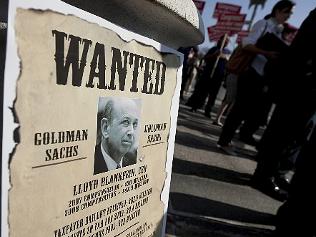
Lloyd Blankfein
We are always entitled to doubt. Like hypocrisy it is a luxury good, gold plated and value added, the sum of the collective antipathy towards Goldman and the others is a self-doubt about our own adventures into the proverbial cookie jar of these accessible and highly addictive beliefs that began as wants and evolved throughout history as ”needs”. It is likely though that questioning and doubt are two different animals, though in the Goldman case, doubt seems to the the prevalent theme, since all economic/financial choices cannot escape the issue of doubt.
It’s a free country and we have the right to doubt, there must be a doubter’s amendment somewhere in a footnote to the constitution; however, it is precisely in this that the skeptics doubt is not real doubt: ”A doubt that doubted everything would not be a doubt. If you tried to doubt everything you would not get as far as doubting anything. The game of doubting itself presupposes certainty. There is here then, the implication that the skeptic is in the grips of a category mistake, he is putting something in the category of doubt which does not belong there. ”
”But there’s another powerful motivator: doubt. There may be arrogance at 85 Broad Street — behind closed doors, Blankfein likes to joke (but not really) that he has “attained perfection” — but behind the bravado, Goldmanites, curiously, question their ability. “There is a deep and constant paranoia about everything we do,” says Sherwood. It applies to an individual’s performance and the prospects for the firm as a whole.
![''here is Lloyd on Charlie Rose last night. More of the same: "We did well because we had the disciplined hedging [on housing]." Paraphrase: "Thank you Paulson for letting us steal your idea and have our prop book go $10 billion short two months before HSBC and New Century went tits up. Also thank you for reminding us to short hundreds of millions worth of Bear stock." Also, the amount of money put into Goldman by the government was not important for us. Ok Lloyd, please refund all the $2 billion in CDS profits you made by shorting AIG immediately.''](http://www.google.ca/imgres?imgurl=http://cdn.picapp.com/ftp/Images/2/6/6/f/Record_Earnings_Lead_0c67.jpg&imgrefurl=http://www.philstockworld.com/tag/lloyd-blankfein/&usg=__o8ASXXhr90u7k4t2KYGOQdwmXkw=&h=384&w=594&sz=46&hl=en&start=18&um=1&itbs=1&tbnid=hWKVYLE-MruShM:&tbnh=87&tbnw=135&prev=/images%3Fq%3Dlloyd%2Bblankfein%2Bannual%2Bmeeting%2B2010%2Bpictures%26um%3D1%26hl%3Den%26client%3Dsafari%26rls%3Den%26tbs%3Disch:1 "72863983MT006_Record_Earnin")
''here is Lloyd on Charlie Rose last night. More of the same: "We did well because we had the disciplined hedging [on housing
What Allan Greenspan and others have termed ”the irrational exuberance” of markets is a clear indication of the business cycle being driven by doubt, and skepticism as the only certainties on the trail to capture the elusive certainty; like the mythical unicorn or a rare white tiger of Bengal in Central Park. Last week the former CEO of Bear Stearns, James Cayne blamed ”the market” for his firm’s demise. The market representing doubt, and manic-depressive and psychopathic tendencies that list perilously close to criminality according to the apparent logic of his argument; the bogeyman in this case was ”some very unnatural trades” in the bank’s shares before its demise. All trades are inherently unnatural. Like watching Chinese peasants placing calls and puts for $25 of shares which they bought on margin to hope to enhance their income from the Chinese Stock Exhange.Yet the market is supposed to reflect their ”perfect information”
Doubt and uncertainty are plausible scapegoats, a well played hand by drunks looking for some rationale to have one more drink before staggering home and finding a bed; in this case Bear Stearns got hit by the beer truck. Alan Schwartz who succeeded Mr. Cayne as chief executive in January 2008, offered similar excuses for Bear Stearn’s sudden demise: ”In my heart, I think there was stuff ( ?) going on,” Schwartz testified to describe the sudden burst of doubt expressed by spooked investors, ” When everyone is running from a crowded theatre, its hard to figure out who yelled fire,” he added.
Luckily for Lloyd Blankfein and his firm, he’s a damn good salesman, or at least a much better song and dance man than the two wooden stiffs mentioned above. Not that he’s any better, he just used the corrupted credit agencies and other scapegoats to his advantage, while claiming there is a silver lining, perhpas with gold plated buttons regarding the civil fraud charges against his firm.
” He starts with a little humility. He understands that “people are pissed off, mad, and bent out of shape” at bankers’ actions. Goldman played its part in the meltdown that almost destroyed the global financial system. It, like most other banks, lent too much money, made its first quarterly loss for more than a decade last year and ended up taking bail-out cash from Washington. “I know I could slit my wrists and people would cheer,” he says. But then, he slowly begins to argue the case for modern banking. “We’re very important,” he says, abandoning self-flagellation. “We help companies to grow by helping them to raise capital. Companies that grow create wealth. This, in turn, allows people to have jobs that create more growth and more wealth. It’s a virtuous cycle.” To drive home his point, he makes a remarkably bold claim. “We have a social purpose.”
So far, so lucrative. But isn’t it simply unfair? Isn’t Goldman acting as the modern equivalent of war-time profiteer, taking advantage of global crisis and emergency government action to mint millions? Even the veteran financier George Soros says the big profits made by Wall Street banks are “hidden gifts” from the state.’ ”


 COMMENTS