

Philip the Bold, youngest of King John II’s four brothers and his father’s favorite, was robust, but dark complexioned and certanly not handsome. He had marked features and a jutting chin, which persisted among his distant descendants as the Hapsburg jaw. He was shrewd and longsighted, affable and charming, and very much the ”grand seigneur”. he enjoyed sports and hunting, dice playing and tennis; he lost enormous sums of money at the latter game. He was also extremely fastidious; he bathed in essence of violets or of damask.
( Image below from Robina Barson. robinabarson.com):
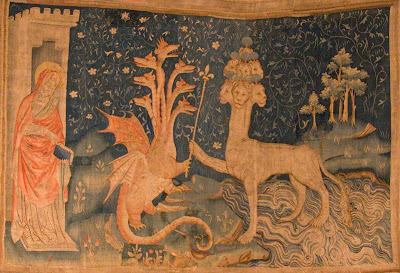
A seven headed beast appears in a detail from the Angers Apocalypse tapestry . Illustrating scenes from the Book of Revelation, these works were begun in 1376 for Louis, Duke of Anjou.
His father had named him Duke of Burgundy, a semi-independent principality on the eastern edge of France with its capitol in Dijon. Feudal wars and prudent marriages had added to it scattered territories within the empire. In 1369 he married Margaret of Flanders, the richest heiress in Europe , who brought to him the prosperous industrial region extending to the mouths of the Rhine on the North Sea. Hence his realm was part French, part Germanic, although its interests made it cleave rather to England and Germany than to France.
Philip’s bride was purse-proud, imperious, and ill-humored, to go with her ill-looks. But Philip was always devoted to her, there is no report of those supplemental loves so readily forgiven a monarch. He celebrated his marriage with such sumptuousness that four days afterward he was forced to pawn his last jewels. But he soon re-established his financial position. As a dominant member of the council of regency during the minority and lunacies of Charles VI he diverted enormous revenues to his own use.

''The most popular picture-books of the thirteenth century were those that illustrated St John's vision of the Apocalypse. The standard Apocalypse cycle, containing numerous scenes, was first developed in England. Those scenes were later used in creating other art forms, like the monumental tapestry woven in Paris for Louis d'Anjou. One element that was increasingly emphasized in both manuscript and monumental versions was St John himself, standing as a spectator within each of the scenes. He served to mediate the visionary experience for the beholder, sometimes looking through a window onto the action, but always registering an active response to what he is seeing.''
He loved magnificence. For every event of importance he wore a completely new costume. At the coronation of Charles VI’s queen, in 1389, he donned a velvet doublet decorated with forty sheep wearing bells of pearls at their necks and forty swans with pearls in their beaks. On a mission to the Duke of Lancaster he dazzled the assembly with his long-skirted tunic of black velvet embroidered with a rose branch bearing twenty-two begemmed roses. He liked to wear cloth of gold, despite the scratchiness factor, elaborately jeweled hats, and ruby bracelets. He had a portable clock, which hung, like a camera, from a black silk ribbon around his neck.
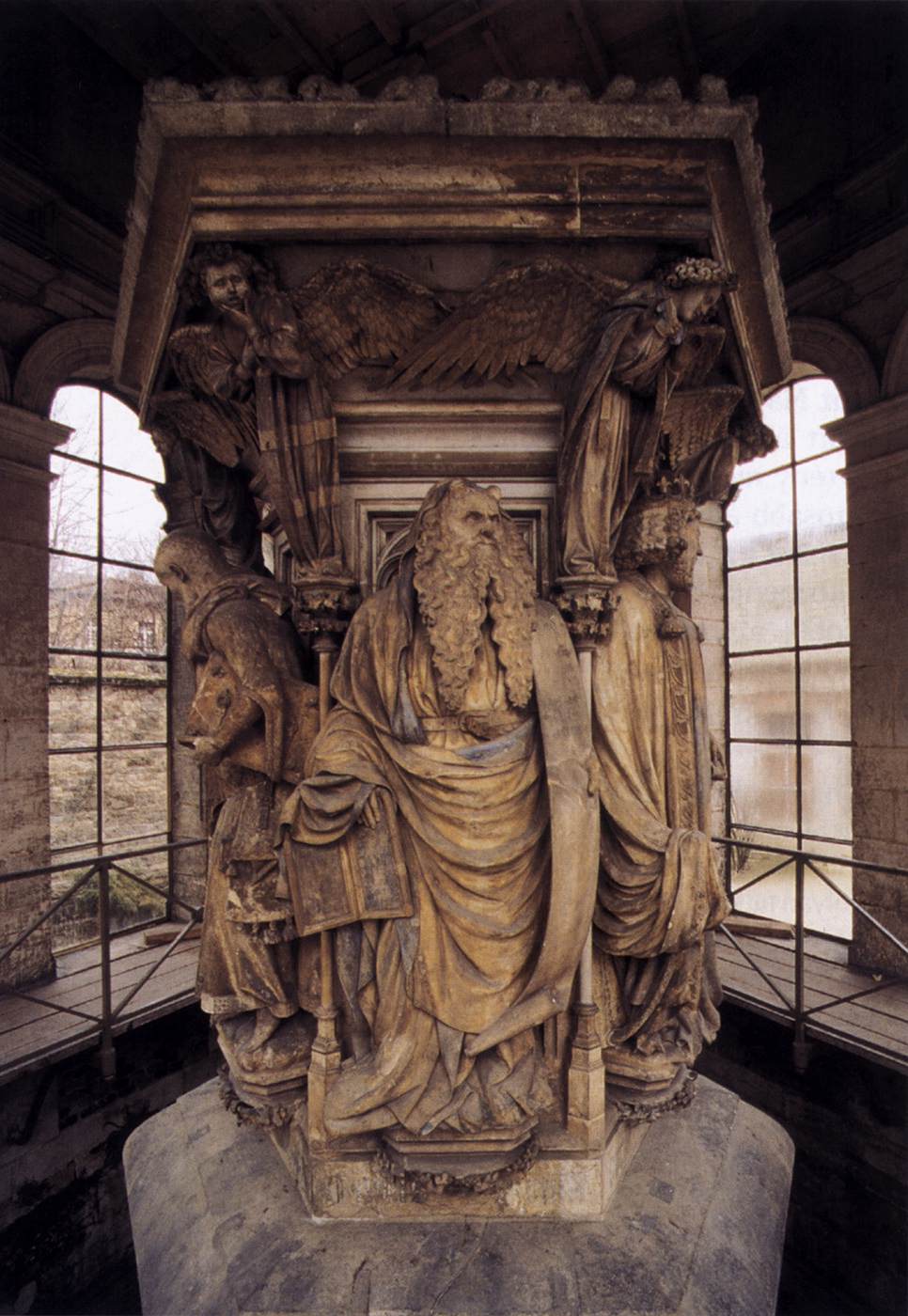
Claus Sluter. Well of Moses
In one six month period, Philip and his son wore 217 pars of gloves. He collected the skins of 9,408 ermines to line a dozen tunics and mantles. His duchess reflected his glorious sparkle. Her inventory lists 5 fine jeweled gold crowns, 30 necklaces, some 150 gold clasps, and gold belts studded with pearls, together with rings, garters, etc. etc.
Philip’s insistence on magnificence sometimes defeated his more practical purposes. The French planned an invasion of England in 1386. The nobles vied with one another in decorating their ships. Philip, naturally, outdid them all. His flagship was painted gold and blue and bore nine great banners. The sails were stitched with his device, ”Il me Tarde” ( I can’t wait ) , surrounded by daisies in honor of his wife Margaret. His expeditionary force was supplied with three thousand banners proclaiming ”I can’t wait” . But the decorations and other arrangements took so long that winter came and the invasion was called off.

The dazzlingly ornate tomb of Philip
Bold was begun by Charles Sluter in 1383, some twenty years before the Duke's death.Ten years later Philip helped organize a crusade against the Turks, who were advancing in what is now Bulgaria. He equipped his son and his army with dazzling armor and costumes, harnesses mounted with silver and gold, and twenty-four cartloads of green satin tents. But military competence was scanted, and the crusade ended in the disaster of Nicopolis, where the flower of Western chivalry was massacred by the Turks.
Magnificence wins no wars; it should stay at home. Philip adorned his realm with splendid structures and had them beautified by the greatest artists of his time. One of these at least, the sculptor Claus Sluter of Haarlem , deserves to be called a genius. Conscious of mortality, Philip erected in Dijon a chartreuse, or charterhouse, for twenty-four Carthusian monks, whose duty was to pray unceasingly, day and night, for his soul in the belief that the great would carry their privileges even into the next world. Claus Sluter supervised the work and began the sculptures, with the aid of his able assistant Claus de Werve. Only the portal, the winding stair, and the extraordinary well of Moses remain.

Angers Tapestry detail. ''And he cried mightily with a strong voice , saying, Babylon the Great is fallen, and is become the habitation of devils, and the hold of every foul spirit, and a cage of every unclean and hateful bird. For all nations have drunk of the wine of the wrath of her fornication...''
About Sluter’s well, stand six prophets, semi-detached from the structure, seeming to pose before it. They are vivid human portraits, executed with a realism still novel in their time. The prophet Jeremiah was originally equipped with a pair of copper spectacles. Jeremiah was, of course, commanded to write the words of the Lord in a book, but perhaps Sluter was making a glancing reference to his master, Philip, who was constantly withdrawing his gold-rimmed spectacles from their silver case.
The other great extant masterpiece of Claus Sluter is the tomb of Philip, begun long before his death. It stands now in the Dijon Museum. It is a pompous full-length recumbent figure resting on a slab of balck marble , surrounded by forty-figures, thirty of them ”pleurants”, or professional graveside lamentors, dressed in the conventional gowns of mutes. The figures are evidently not portraits but types, of courtiers, commoners and monks. In expression and attitude, in the very droop of their robes, they communicate their grief to the observer.

Wall-hanging. Work in progress on a painted version of a panel from the thirteenth-century 'Apocalypse' tapestry at Angers, France. Emulsion on unprimed canvas, 2.5m x 3.3m. Collection of Professor Michael Slater.
”…brought to Dijon his nephew Claus de Werve and sculptors from Brussels to assist in his numerous ducal commissions. The architectural portion of the duke’s tomb had been completed by 1389, but only two mourning figures of the sculptural composition were ready when the duke died in 1404. Philip’s son, Duke John the Fearless, contracted in 1404 for the completion of his father’s tomb within four years, but Sluter’s nephew did not finish it until 1410, and he used it as the model for Duke John’s own tomb. (Many of the mourning figures around the base are copies of what must be Sluter’s work, though the problem of establishing his exact contribution is difficult because the two tombs were disassembled in the French Revolution and extensively restored from 1818 to 1823.)
Sluter, an innovator in art, moved beyond the prevailing French taste for graceful figures, delicate and elegant movement, and fluid falls of drapery. In his handling of mass, he also moved beyond the concern with expressive volumes visible in the sculptures of André Beauneveu, an eminent contemporary who worked for Philip’s brother Jean, Duke de Berry. The grandeur of Sluter’s forms can only be paralleled in Flemish painting (by the van Eycks and Robert Campin) or in Italian sculpture (by Jacopo della Quercia and Donatello) several decades later.”
In addition to sculptures, tapestries were Philip’s particular delight. In the Middle Ages frescoes, though common in churches, were rare in castles, where the walls were rough, smoke begrimed, and likely to exude damp. The rich preferred hangings, which gave some illusion of warmth and could be painted, embroidered or woven to represent historical scenes or passages from the romances. The rich changed their tapestries with the seasons, or out of mere boredom. it was the fashion to use a tapestry as a background for the total decor of a room. King John the Good had an Easter set consisting of six green wall tapestries with the arms of France in the corners, bed curtains and counterpane and bedside mat of green silk lined with blue linen, green serge window curtains, and chair cushions of blue and green silk.


 COMMENTS