
Someone told me
It’s all happening at the zoo.
I do believe it,
I do believe it’s true.
Mmmmm. Mmmmm. Whoooa. Mmmmm.
The monkeys stand for honesty,
Giraffes are insincere,
And the elephants are kindly but
They’re dumb.
Orangutans are skeptical
Of changes in their cages,
And the zookeeper is very fond of rum.
Zebras are reactionaries,
Antelopes are missionaries,
Pigeons plot in secrecy,
And hamsters turn on frequently.
What a gas! You gotta come and see
At the zoo.
At the zoo.
At the zoo. ( Simon and Garfunkel )
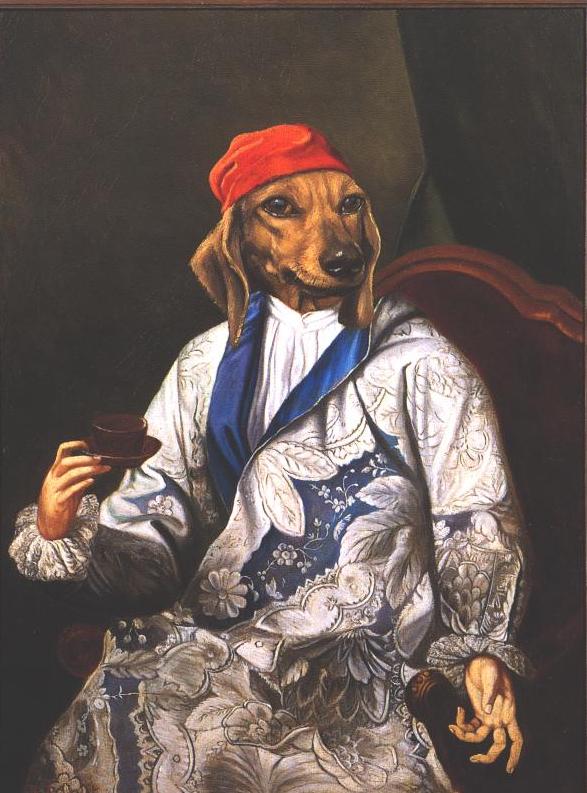
Thierry Poncelet
If the person beside you resembles a parrot, Charles Le Brun would suggest that that you move. The notion that the face is the mirror to the soul is of enduring quality, and as result, dies hard. Modern science may tell you that human intelligence depends not upon the configuration of a person’s head but upon the convolutions in their brain. You are thoroughly convinced that human behavior is determined by heredity and environment and not by outside appearances.

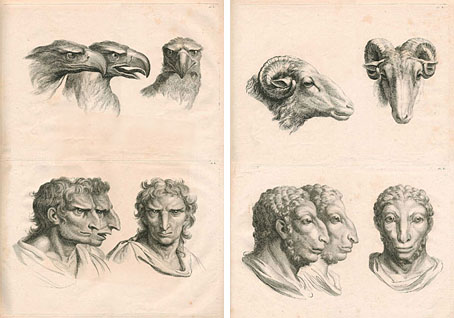
L: Relationship of the Human Figure with that of the Eagle. R: Relationship of the Human Figure with that of the Ram. From Dissertation sur un Traité de Charles Lebrun concernant le apport de la Physionomie Humaine avec Celle des Animaux (1806), in which the First Painter to Louis XIV attempted to demonstrate a correlation between the souls of men and the appearances of animals. See the complete set of engravings (by L-J-M Morel d’Arleux)
Yet, at the next Happy Hour or company party, just stumple upon a man who looks like a wart hog, or a girl with a face like a vixen, and you will think that the one is dull, grumpy, and a messy feeder, and the other kind of fun, but not to be trusted. How much stronger was the notion before Freud and Darwin, when it was believed that people’s nature had distinctly beastly and angelic sides, and nearly everyone felt certain, in the earliest days of scientific inquiry, anyhow, that much was to be learned simply by looking hard at the surfaces of things and classifying the results.
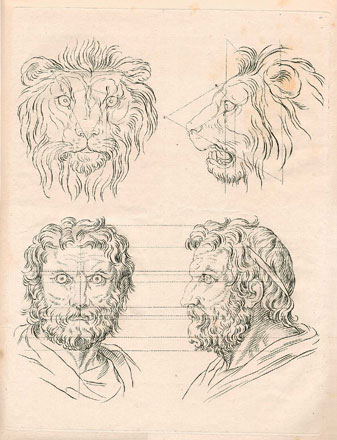
Observe the aquiline nose, the regular facial features mapped out geometrically: all are signs of courage, virtue and intelligence in the king of beasts and his counterpart, Jupiter. So thought Charles Le Brun, court painter to Louis XIV, and he made these portraits for a definitive study of physiognomy to prove it.
Aristotle, for instance, estimated that the look of a man’s nose was an index to his character. Depending on whether it resembled a beak or a snout, or a muzzle it would reveal the impudence of a crow, the insensitivity of a pig, or the magnanimity of a lion; qualities of character Aristotle was certain these creatures possessed.
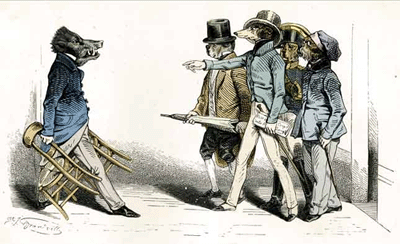
J.J. Granville. Seven of Wands
Physiognomy, the pseudoscience of telling character by appearance, has flourished on and off ever since. In physiognomical comparisons between people and animal, especially after the Christian concept of the Great Chain of Being, animals customarily came off second best. It was, not after all by chance, that the Devil was portrayed with hairy legs and cloven hoofs, or referred to as ”The Beaste”. If man was seen as a divided creature, standing somewhere between animal and nature on the ladder leading up to God, his duty, and perhaps his only salvation, clearly lies in struggling to suppress his beastly nature.
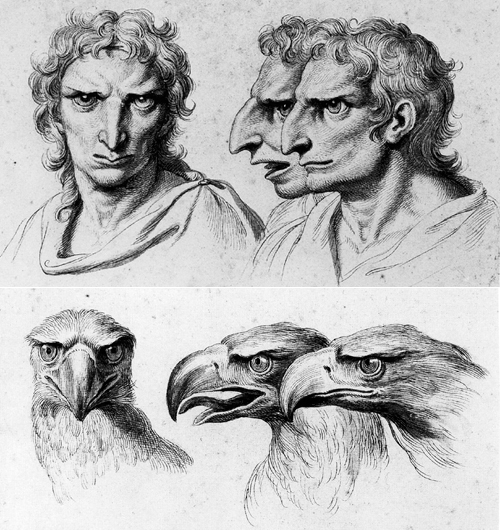
“The goal of physiognomy is to judge character according to features of the face. LeBrun studied the lines linking different points of the head in a complex geometry which revealed the faculties of the spirit or character. Thus, the angle formed by the axis of the eyes and the eyesbrows could lead to various conclusions, depending upon whether or not this angle rose toward the forehead to join the soul or descented toward the nose and mouth, which were considered to be animal features.”
Pursuing a theory about the relations between animal character and animal features, a Neapolitan savant named Giovanni Battista della Porta created a series of pictures in the late sixteenth century showing men with animal expressions, and vice-versa, among them ambitious eagles, salacious rabbits, envious owls, jealous hedgehogs, and sharks with faces like usurers. In the eighteenth century a Dutch professor, Petrus Camper, worked on a theory of facial construction and human passions, using a sequene of drawings to trace the deterioration of the face of the ”Apollo Belvedere” to that of a frog. All this had a marvelously antique sound.
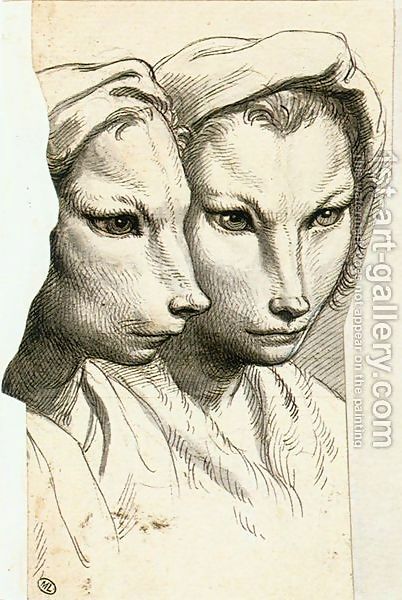
Handmade oil painting reproduction of Physiognomic Heads Inspired by a Weasel c. 1670, a painting by Charles Le Brun.
Yet, one can easily cite the nineteenth-century’s fondness for the science of phrenology or Cesare Lombroso’s theory of the criminal types, which hypothesized that certain men with dome-shaped heads, faces like birds, or sharp incisor teeth like rodents were likely to have criminal tendencies; an idea that was widely accepted by police experts up into the twentieth century.
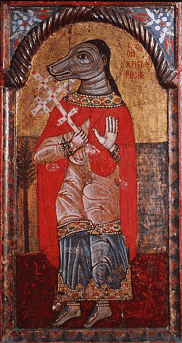
''Speaking of dogs and saints, today is also another feast of the martyr St. Christopher, who is said, according to some rather dubious legends, to have belonged to a race of men with dog's heads instead of human ones. Though perhaps this is a garbled version of another account which reduces this rather fabulous image to merely being a facial deformity (at least according to the Orthodox Ecumenical Patriarchate's website,...''
Over the centuries, however, of all the savants, psychologists, and simple crackpots who addressed themselves to this heady subject, none produced a more attractive and compelling commentary upon manly beasts, or beastly men, than a seventeenth-century Frenchman named Charles Le Brun. Le Brun didn’t think better than anyone else, but he did draw better. In addition to fragments of a complicated physiognomic thesis, he left dozens of splendid drawings and diagrams in which the faces of many different kinds of beasts and birds, from lynxes to hoot owls, are devastatingly juxtaposed with human faces that mightily resemble them.

The smug goat in the lithograph above is pretty unenticing; lazy, probably dishonest, and in any case unkempt.
Le Brun borrowed heavily from the ideas of della Porta. At their best his caricatures are so convincing that the viewer is persuaded they have often encountered people who look like hoot owls, parrots, lynxes, and even wart hogs. Although some of the pictures are grotesque, they impress nonetheless as careful portraits drawn from life, rather than bizarre exaggerations of a misanthropic cartoonist.
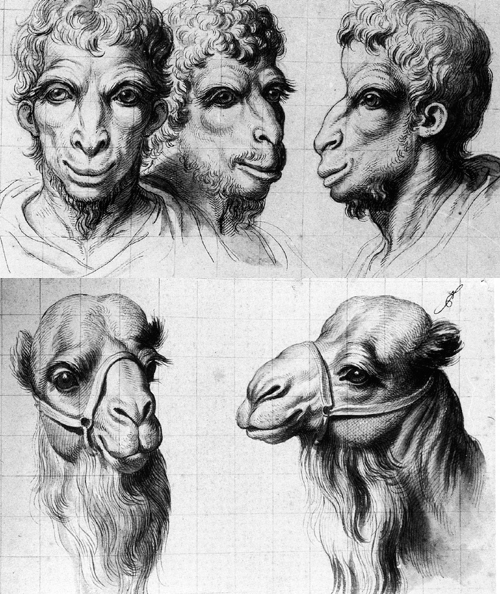
''The drawings of human heads are extremely well qualified examples of how humans would look with animal characteristics. Although they are not distinct illustrations of animal-human hybrids, they can be used as references.''
Charles Le Brun was the leading painter and art director of the court of Louis XIV. He had studies in Rome with Nicolas Poussin and was a classicist who reorganized the French Royal Academy and ran it authoritatively along rigid classical lines. It was Le Brun who presided over the decoration of the Palace of Versailles, and it was he who painted the vast ceiling of the famous Hall of Mirrors, as well as the lofty representations in the Louvre of Alexander the Great’s battles.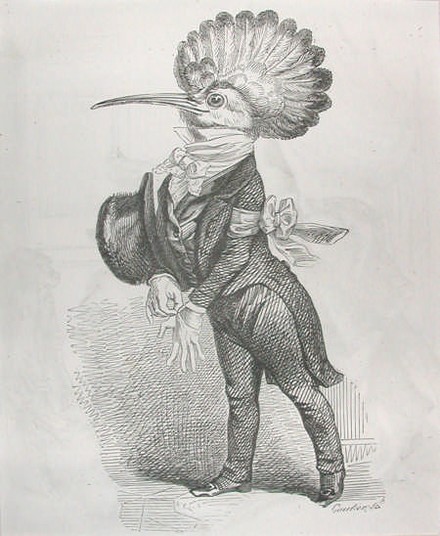
Le Brun was, moreover, one of the chief portraitists of the court. From 1665 until his death in 1690 he turned out stately, flattering likenesses of nearly everyone of note, from Pierre Corneille and Jean Racine to the king’s brother, the duc d’Orleans, and Louise de La Valliere, one of the king’s pretty favorites.
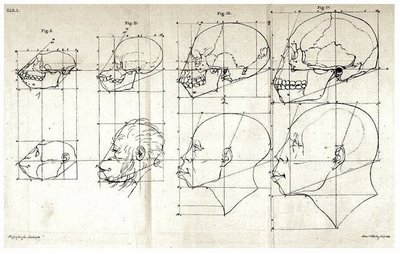
''With the publication of the Origin of the Species the polygenic theory seemed to have been refuted definitively, though many monogenists still relied on the biblical account of creation as the authoritative source for that view. The notion that humanity shared a common source did nothing to undermine the belief that the races were inherently unequal in their difference and thus inequality flourished, from the persistence of phrenology and Peter Campers’ “facial angle” which divided physiognomy into the orthagnous and prognathous categories, a system resurrected by congressmen debating the 15th amendment, to the study of differences in the size and texture of brains or the distinction between the properties of hair. The project for the measurement of human difference was almost always undertaken in the service of hierarchizing various groups. The failure to establish any clear-cut distinctions that withstood the demands of scientific method did little to impede the search for some definitive means of justifying racial hierarchy and if some methods such as phrenology became the object of satire and charges of quackery, new methods were being developed which would prove even more resilient.''
As virtual artistic director of France, Le Brun was rich as well as powerful. Still, there were a number of reasons why he decided, as one of his biographers put it, ” to abandon the broad alleys of parks whose spendors he had organized, in order to enter, albeit at a majestic pace, the more capricious pathways of satiric fantasy”. He had a certain ”faiblesse” for the baroque. More important, he was hoping to create a style book and a system to guide younger artists, ”to make them capable of catching with a sure and knowing hand features appropriate to the characterization of both virtuous and evil men”.
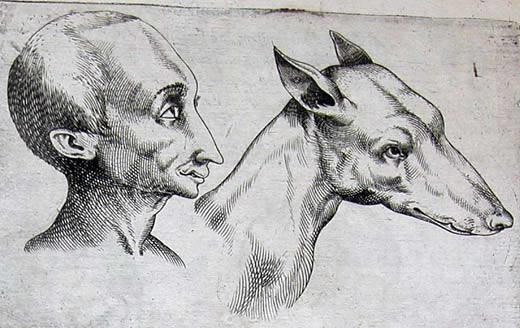
Giovanni Battista della Porta. late sixteenth century
Just possibly too, after years of idealizing the features of Louis’s court, he simply wanted to study physical grotesquery, and chose a courtier’s inevitably roundabout way to do it. Le Brun’s study of physiognomy was part of his broader and equally well illustrated dissertation on pathognomy, or the way the feelings that rise from the soul cause visible changes in the body. The first reference to Le Brun’s physiognomical drawings appears in the official proceedings of the Royal Academy, on march 28,1671, when the painter was fifty-two years old. The record reads: ”Monsieur Le Brun gave a dissertation on physiognomy and presented all the various demonstratioons which he has drawn, now heads of animals, now heads of men, calling attention to the features which mark their natural inclinations. Upon which Seigneur Colbert showed great satisfaction and withdrew”.


 COMMENTS
FYI, I’m almost certain the image of the hoopoe-headed man is not by Le Brun. The style of the image, as well as the style worn by the subject, is much more 19th century. It looks like a wood engraving, which was not even around in the 17th century when Le Brun was working. (It may be an etching, however, which was available to artists in either period.) Although the name in the bottom right corner is not Grandville, it looks very much to be in the style of J.J. Grandville’s work.
I defer to your expertise. Thanks for clarifying and reading! Best