

”Shakespeare’s plays mirror the debate of his time between those who believed that the macrocosm of the stars influenced the microcosm of human life, and those who dismissed astrology as “excellent foppery.” The phrase comes from Edmund in King Lear, who comments on his father’s tendency to blame human evil on the stars. But Edmund is a villain, and his father a foolish old man–so (as usual) it is impossible to locate Shakespeare’s own position in the debate.The young lovers in Romeo and Juliet are described as “star-crossed” in the Prologue, and they are certainly unlucky, but they also contribute to their own deaths through their haste to consummate their love.”
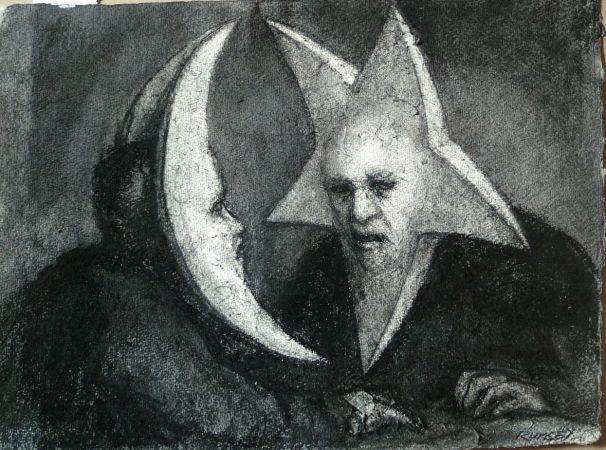
Astrologers. ''Paul Rumsey's work stems from the tradition of the fantastic and grotesque. He draws both on mythology and fairytale and on contemporary items from the news. Some ideas come from dreams, when half asleep.''
The stars may impel, but they certainly don’t compel. Are you a Taurus or Gemini, Pisces or Capricorn? Does your eye glance furtively at the column headed ”The Stars and You” , and are you relieved when you read that you could have a ”speculative benefit” or worried when you see ”changeability” in relationships may pose problems”. It likely strikes few readers that the silly astrological columns are the sad end of an extraordinary human enterprise. The beliefs that the movements of the stars are related to humanity’s destiny dates back to the very earliest days of the neolithic revolution if not before. And the fact that news services continue to publish astrological columns day in and day out, indicates the persistence of that belief.

Medieval Astrology. “The fault, dear Brutus, is not in our stars, But in ourselves, that we are underlings.” (W.Shakespeare, Julius Caesar, Act 1, Scene 2)
In addition to the pop astrologers, high priests/priestesses of the cult still exist and flourish. They are masters of intricate calculations who cast horoscopes and predict the fate of individuals with the conviction of scientists, men and women who believe as intensely in the stars as did the astrologer-magicians of ancient China.
Before the arrival of the industrial and scientific revolution its power in the West was considerable. Both Cagliostro and Casanova cast horoscopes and interpreted the stars in order to bamboozle aristocrats, merchants and attractive women. And a century before that the stars were playing a truly vital part in human affairs, although historians rarely pay any attention to this aspect of seventeenth-century belief.

Abraham Teaching Astrology to the Egyptians 1665. Antonio Zanchi ''The subject, fairly rare in seventeenth-century paining, was described by Josephus in his Early History of the Jews. The episode relates that Abraham came to know God not through reading the Scriptures but by studying the stars.''
The Earl of Shaftesbury , the violent Whig who nearly toppled Charles II from his throne by exploiting the hysteria of the Popish Plot in 1678-79, believed absolutely in astrology. John Locke, the rationalist philosopher, lived in his household but apparently had no impact on this belief of Shaftesbury’s. A Dutch doctor who dabbled in the occult had cast the earl’s horoscope and so, Shaftesbury thought, foretold all that would happen to him. Nor was Shaftesbury an isolated believer. The great Hapsburg general Wallenstein, a leader in the Thirty Years’ War, took no action, military or political, without consulting the stars, and no one though him either eccentric or pagan.

Barbieri ( Guercino ) English: Personification of Astrology Italiano: Personificazione dell'astrologia Year circa 1650-1655
In the centuries before the Enlightenment astrology lived quite comfortably with Christianity. Many kings kept astrologers at court and consulted them regularly. Dr. John Dee, the Elizabethan mathematician and astrologer, consulted the spirits in a polished obsidian mirror that he had somehow or other acquired from Aztec Mexico via Spain; and he, too, used the stars to predict the future. He created a sense of fear with his activities, but the most prominent Elizabethans consulted him, and he died comfortably enough in his bed and not at the stake.
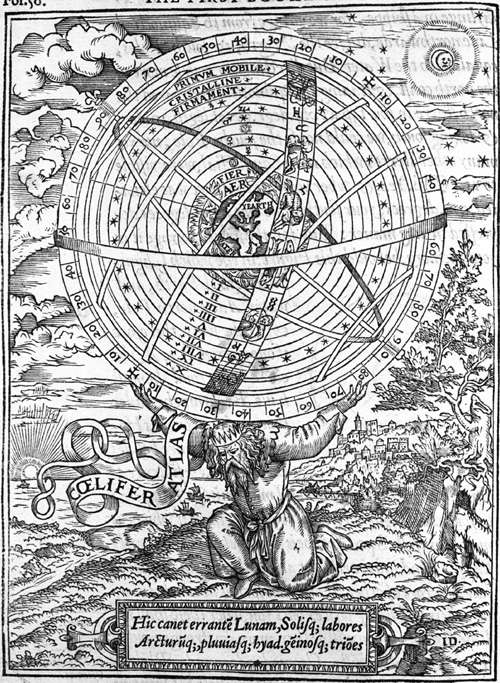
Atlas bearing the heavens in the form of an armillary sphere from William Cunningham, The Cosmographicall Glasse, London 1559. The verse at the bottom of the engraving is
Book I of Virgil's Aeneid, in which Atlas is referred to as a teacher of astronomy.He might practice magic, but even in that age, terrified as it was by witchcraft, he survived. The stars were beyond the Devil and his handiwork. They belonged to the mechanism of the universe, a piece of God’s creation, therefore good and open to interpretation. A belief in astrology permeated all heresies and all creeds, and in this respect , at least, they were at one with Hindus and Chinese and with the civilizations of the Middle East. The stars influenced the lives of Sumerians, Akkadians, Babylonians and Egyptians.
The ancient Egyptians studied the stars too, and believed in their benevolent or malign influence. Nor was belief in astrology derived from a single center. For without any contact with Europe, the Mayas in the Yucatan and Guatemala built huge observatories and watched the stars. From China to Peru, throughout many millenniums, people’s lives were star haunted, and the heaven wrote in cryptic symbols the fate of nations and the destiny of men.

Flemish tapestry (Doornik?, c. 1500-1515) depicting the muse Astronomia with an astronomer (Claudius Ptolemy?), a scribe and shepherds gazing in awe at the heavens
So the columns in the tabloids have a long, long, history; a history heaving with portent. The stars have frightened men, made them jubilant, and, above all, strengthened a sense of unalterable fate not only in the hearts of the peasant and craftsman but also in emperors and kings, priests and soldiers. But, beyond the need to predict agriculture , even assisted by human sacrifice and religious observance, periods of apparent harmony were punctuated by bouts of discord. The will of the gods and the stars were interconnected, but not in any obvious way; they needed to be studied with minute care ; only then could they be used safely for prediction.

''Hendrix and Cobain are remembered not only for their music, but also for their significance to the larger cultural context of the time. Hendrix is associated with the psychedelic 60’s, a brief period where an entire sub-culture fled the dark reality of social unrest and reached for an idealized worldview too beautiful to resist. Cobain will always be linked with the post-punk/metal hybrid style that emerged as the so-called "grunge" period of the early 90's: an era when the indie rock scene that had sparked from the ashes of independent post-punk bands of the 1980's, including Black Flag, peaked with Nirvana’s enormous success just following their departure from Seattle’s Sub Pop label. Astrologically, what is special about the mid-sixties and the early nineties is that they were the only two periods in the twentieth-century during which there were conjunctions being made by two of the three outer planets.''
But humanity’s need for the stars goes deeper than the need to discern the changing seasons or the coming of rain and water, deeper than the need to foretell the fate of kings. There appears to be a need in people to know and to rationalize their universe through magic and through very precise and detailed knowledge. The aim has always been both to control the environment and to banish anxiety.

Zodiac Man' from 'Très Riches Heures', painted by the Limbourg brothers for Jean Duc de Berry, circa 1400s
Magicians and astrologers were but mankind’s first scientists. They were men of great intelligence and keen observation, no different in quality from Newton or Rutherford, and essentially dedicated to the same task. Many of their facts were right and beautifully observed; their pursuits led them to invent instruments of great ingenuity. What was wrong was their set of premises. And in the vaporings of popular newspaper and paperback astrologers, one sees the pathetic end of a once majestic and comprehensive study of destiny; a science that for thousands of years interpreted men’s hopes and fears and that seemed to give them a chance of evading disaster and controlling their fate.
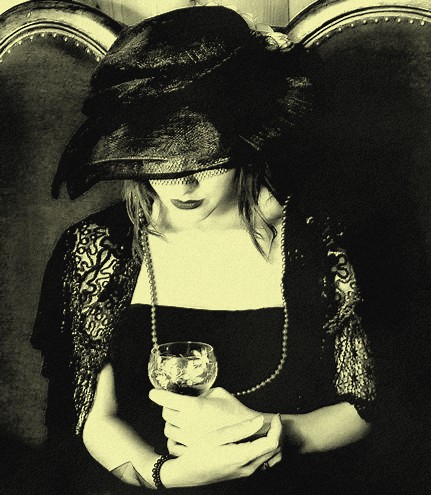
“I saw the days of the year stretching ahead like a series of bright, white boxes, and separating one box from another was sleep, like a black shade. Only for me, the long perspective of shades that set off one box from the next day had suddenly snapped up, and I could see day after day after day glaring ahead of me like a white, broad, infinitely desolate avenue. ” The Bell Jar – Sylvia Plath
”Sylvia Plath’s final days were a true tale of peregrinated Moon in Libra cast down. Her isolation was complete, the reigning need of her life, to be loved, to be the wife, to be exalted by her union of love was broken and the distress of her lost father and her intellectual self-doubt crowded in on her. She died just as Saturn (husband and father) applied by Solar Arc to her Ascendant whilst simultaneously squaring Chiron. The pain of the men in her life and the great weight of disappointment seems somehow to be born at that point, brought into the light for all the world to see as Saturn crossed ponderously into the first while Venus also squared Pluto by Solar Arc at this exact juncture, love and death configured in with the burden of isolation; loss and loneliness. ”Or in the words of her final poem:
Edge
The woman is perfected.
Her dead
Body wears the smile of accomplishment,
The illusion of a Greek necessity
Flows in the scrolls of her toga,
Her bare
Feet seem to be saying:
We have come so far, it is over.
Each dead child coiled, a white serpent,
One at each little
Pitcher of milk, now empty.
She has folded
Them back into her body as petals
Of a rose close when the garden
Stiffens and odors bleed
From the sweet, deep throats of the night flower.
The moon has nothing to be sad about,
Staring from her hood of bone.
She is used to this sort of thing.
Her blacks crackle and drag.
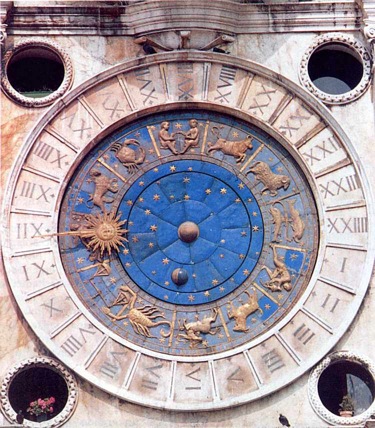
Clock. Venice. ''The clock was first installed 500 years ago, and has seen many changes and restorations in its time. In the 1850s an illuminated digital display was added for telling the time at night. ''
”Peregrine Moon always tells a story and intimates something of a dissociation complex. These people disconnect according to the nature of sign and house. In Plath’s case a romantic reverie is implied, and she may have dreamt long and often about the perfection of her great love. In Libra too there is an overwhelming need to be considered attractive, fair (in all senses) and interesting, which gels not at all well with the reality of her marriage to Hughes who was often considered to be something of a brute (his subsequent wife whom he left Plath for also committed suicide incidentally, and many consider it no coincidence that he is a common denominator in the relationships.) Peregrine Moon too often tells of a feeling of emptiness and isolation which seems to permeate her poetry too: “Empty, I echo to the least footfall,/ Museum without statues, grand with pillars, porticoes, rotundas./ In my courtyard a fountain leaps and sinks back into itself,/ Nun-hearted and blind to the world.” (From “Barren Woman”)…”
a


 COMMENTS
I read astrologers in the magazines and inmediately forget them; once one of them chased me by e-mail, but nothing came as predicted; but many astrologers made a lot of money everywhere nowadays, I have read: New York, London, Paris, etc.
Sylvia Plath was depressed, without a support group of friends, family, according to the Gwyneth Paltrow`s film; many japanese women commit suicide with their kids; children avoid many women`s suicides, the fear to leave them in a cruel world without a mother`s love and support, but it did not work in her case.
thanks for the comment. Its obviously a complex issue that should not be trivialized by astrology