
Wearing a hat can make you a bit mad. Or so tradition has it, and British royalty are known to be sticklers for tradition. The felt hat industry has been traced to the mid seventeenth- century in France, and it likely migrated into England around 1830. The upper crust of British society has long been assumed to be a bit looney… A story passed down in the hat industry gives this account of how mercury came to be used in the process of making hats : In Turkey camel hair was used for felt material, and it was discovered that the felting process was speeded up if the fibers were moistened with camel urine. It is said that in France,in the absence of camels, workmen used their own urine, but one particular workman seemed consistently to produce a superior felt.
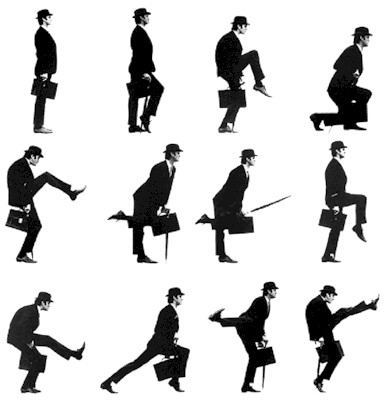
Monty Python. The Silly Walk. John Cleese
This craftsman had an active sex life, even promiscuous, was being treated with a mercury compound for a serious case of syphilis. An association was then established between mercury treatment of the fibers and an improved felt. Eventually the use of solutions of mercuric nitrate was widespread in the felt industry, and mercury poisoning became endemic, particularly linked to the toxic vapors. Dementia and erethism were indeed a common ailment among nineteenth century hatmakers.

Charles Pachter. Dressage. 1988
The crazy Mad Hatter of Lewis Carroll’s Alice in Wonderland is becoming widely associated with the effects of Mercury on behavior as well as physiology. Mercury use was pervasive in processnig the felt hats used in England around Lewis’ time. Erratic, flamboyant behavior was one of the most evident alterations caused by mercury; others included excessive drooling, mood swings, and spasmodic movements among other less endearing characteristics.
But Lewis Carroll did not invent the phrase, although he did create the character. The phrases ‘mad as a hatter’ and “mad as a March hare” were common at the time Lewis Carroll wrote the first publication of Alice in 1865. The phrase had been in common use in 1837, almost 30 years earlier.
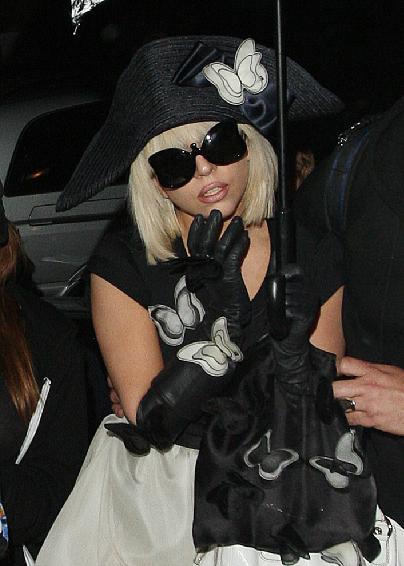
''What we must retain here is the symbolism Monarch project engendered and its use in mass media. Monarch is a type of butterfly and became the ultimate “insider’s”symbol of mind control. Symbolism surrounding Lady Gaga, in her pictures and videos, mixes those symbols with occultism of secret societies.. Her vacuous, robotic and slightly degenerate persona embodies all the “symptoms” of a mind control victim.''
The earliest mention of a ‘mad hatter’ appears to refer to one Robert Crab, a seventeenth-century , highly eccentric noble living at Chesham, England. He gave all his goods to the poor and lived on dock leaves and grass. Carroll, however, seems to have based his mad hatter not on Robert Crab, but on a certain Theophilus Carter, not a hatter but a furniture dealer, who was known locally as the Mad Hatter, partly because he always wore a top hat, and partly because he was eccentric, eclectic and produced some wacky inventions.

Guests at the Royal Ascot ''This is what not to wear or do, in front of Her Majesty... No miniskirts No bare legs No strapless dresses No shoulder straps less than inch wide No bosoms falling out of dresses No trousers unless they match the jacket ( no jeans in other words ! ) No streaky fake tans No chewing of gum No swigging out of champagne bottles No chatting on mobiles No generally Chavvy behaviour... and last but definitely not least, ( and this one gave me a laugh)... Knickers must be worn but not seen !!''
” Makers of felt hats would inexplicably often drool, tremble, talk to themselves and have bouts of severe paranoia, for reasons that only became clear later.Clinical tests showed victims developed severe and uncontrollable muscular tremors and twitching limbs, called ‘hatter’s shakes'; other symptoms included distorted vision and confused speech. Advanced cases developed hallucinations and other psychotic symptoms. Both in Europe and North America they were the eccentrics and madmen of the clothing trades, which gave rise to the phrase as used today.”
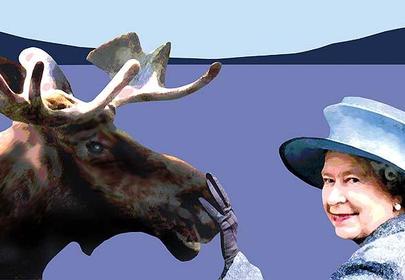
Charles Pachter.
Lewis Carroll frequently used common expressions, songs,& nursery rhymes, to reflect some of the insanity of the Mad Hatter. Ever since the Queen of Hearts sentenced The Hatter to death for murdering time, the March Hare, who is every bit as mad as The Hatter, has been behaving as though it’s teatime all the time. In the famous tea party scene, Alice has tea with The Hatter and the March Hare in the March Hare’s garden. The two Wonderland creatures make cutting remarks at Alice, ask riddles that have no answers and recite poetry that doesn’t make any sense.
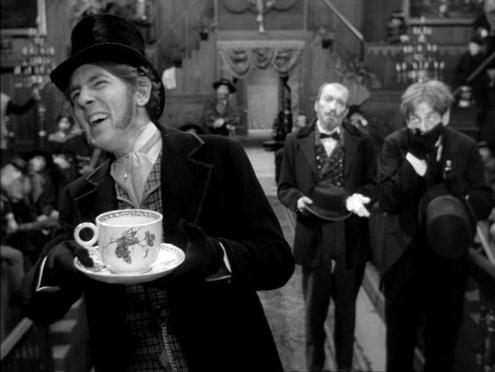
The Mad Hatter. 1966. Peter Cook
The table was a large one, but the three were all crowded together at one corner of it:
`No room! No room!’ they cried out when they saw Alice coming.
`There’s plenty of room!’ said Alice indignantly, and she sat down in a large arm-chair at one end of the table.
`Have some wine,’ the March Hare said in an encouraging tone.
Alice looked all round the table, but there was nothing on it but tea. `I don’t see any wine,’ she remarked.
`There isn’t any,’ said the March Hare.
`Then it wasn’t very civil of you to offer it,’ said Alice angrily.
`It wasn’t very civil of you to sit down without being invited,’ said the March Hare.
`I didn’t know it was your table,’ said Alice; `it’s laid for a great many more than three.’
`Your hair wants cutting,’ said the Hatter. He had been looking at Alice for some time with great curiosity, and this was his first speech.
`You should learn not to make personal remarks,’ Alice said with some severity; `it’s very rude.’
The Hatter opened his eyes very wide on hearing this; but all he said was, `Why is a raven like a writing-desk?’
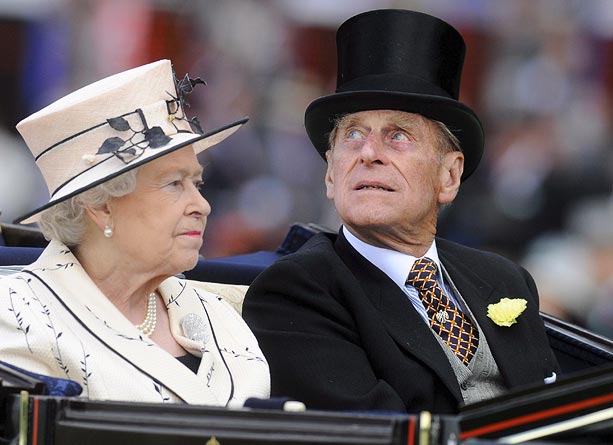
The Queen and the Duke of Edinburgh arrived for the first day's racing at a sunny Royal Ascot in a traditional horse drawn carriage
Queen Elizabeth II has made a tradition of wearing a hat whenever she appears in public,and wether her trademark hat has been spiked or vaporized is strictly conjecture. She frequently wears a hat with a high crown, a good idea for any short woman to add a bit of height. All the hats Queen Elizabeth wears at Royal Ascot have high crowns. Besides etiquette, There’s a royal reason behind her headgear. They give her visibility, allowing observers far away to spot Her Majesty, and are a practical surrogate for the crown. A royal hat must tread a fine line. It must be memorable without being absurd, brightly coloured when the event is happy and sober when the occasion is not. Others, well…:

''Don’t call Philip Treacy a milliner. The 43-year-old Irish-born designer may craft extraordinary headwear for everyone, from the late Alexander McQueen to Lady Gaga to the Queen of Thailand. He may have exhibited his designs in London and Hong Kong and received the Queen’s highest honours. He may be the most famed what-you-might-call-milliner in the world. But Treacy knows that, long ago, millinery meant trimming lots of things, not just hats. And Treacy is very much just hats. ''
Yet, when it comes to what to wear on your own head to meet the Queen, Rideau Hall has scant advice, except to say that the royal family doesn’t wish to put anyone to unnecessary expense and that it is not usually known in advance what colours the Queen will be wearing.

The Rainbow Portrait of Queen Elizabeth I. Attributed to Isaac Oliver or Marcus Gheeraerts
”I can barely bring myself to cover this doll :| I just find her so incredibly depressing, I kind of hoped people might pick up on her dirty as fuck and MK suggestive lyrics her songs have and her obviously programmed demeanor; but alas she is apparently “original”, “inventive” and with “her own sense of style”. Riiight….After sporting a variety of inventive hairstyles in recent months, the eccentric New Yorker decided to give her locks a rest and showed off her new fashion fetish for hats. Arriving at the Radio 1 studios this morning to perform during Jo Whiley’s Live Lounge, GaGa looked like she was going to a wedding or Ascot in her white suit and hat combination:

Lady Gaga
”At today/yesterday’s Royal Ascot (“elite” event for the Queen and the ruling class to “get their top hats out” [top hats are phallic symbolism/ritual; dominance over lesser society who don’t wear them, and over their female counterparts] with their wives/kittens in various symbolic hats [+ average people who need to feel like they’re part of that society so go along with their ritual], Louis Mariette designed many of the hats on show ; ‘mad hatters’ the lot of them [batshit insane “elite”, wtf is the deal with horse racing anyway; the horses are essentially multigenerational abuse victims as their bloodline is ‘trained’ over many generations ((horses from a predigious bloodline are sold for millions)), very analogous to Monarch programming as I’ve gone into before… it’s all in the bloodline]) ”
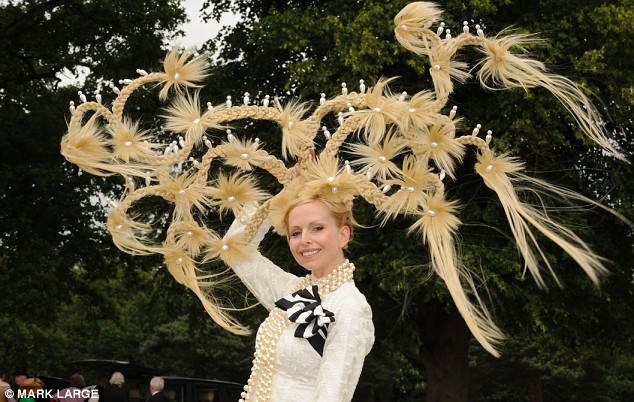
''Hairum scarum! Racegoer Anneka Tanaka-Svenska sports an outlandish hair headpiece, created by milliner Louis Mariette, judge on the panel of Britain's Next Top Model Read more: http://www.dailymail.co.uk/
Lisa showed up in a very purple (royal/”elite” symbolic colour [+ other things such as mixture of red/blue gone into a while back]) in a mini pirate hat + birdcage veil (note the statues/mannequin figure things behind her).
”The name ‘Louis’ is a common name (loads of monarchs/saints and such), ‘Mariette’ implying a shortened version of ‘Marionette’, working in the fashion industry this is very significant (fashion is all about MK/transformation/manipulation/mental puppetry). Here are a few examples of his occult themed/symbolic works (one above from a magazine article on him to illustrate ‘Mad Hatter’/usual one eye/feathers), the mad hatter working for the “fashion elite” that he is, obviously this is not surprising.”:
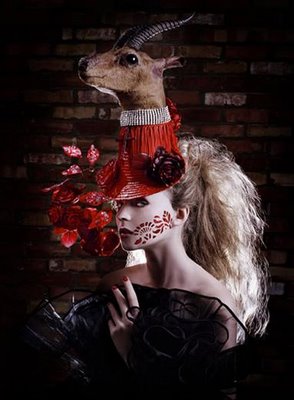
''More ram worship on a black-eyed, deathly white model. And another 'horned beast beast' head below (female antelope I think). ''
Hats, as a substitute for crowns, have been associated with coronation and death; a history rich with violence, fear, holy relics,debt, reverence, superstition, avarice, frivolity, and pomp. With royal hats, even though obliquely, there is something of European, economic, social and constitutional history; implacable wealth and sometimes revolution as a perfectly logical conclusion.

Great Imperial Crown. Catherine the II. Russia
Looking at Catherine II’s staggeringly opulent and beautiful Imperial Crown of Russia, with its two climbing rows of giant pearls, its thick frost of diamonds, and its triumphant top most spinel, one suddenly thinks of Alice, who reached the Eighth Square, found that a golden crown had materialized on her head as promised, and then ”got up and walked about- rather stiffly at first, as she was afraid that the crown might come off”’. Eventually crowns fall off, no matter how stiffly their regular owners walk about.
a
aa


 COMMENTS