
Piet Mondrian ( 1872-1944 ) had a profound belief in progress, the key to which he believed lay in man’s innate dissatisfaction with the merely “natural” world. He disliked classical representational art, for example, because he felt it simply reproduced what that world looked like, rather than seeking to go beyond it to a higher truth. For Mondrian, the “essence” of life was to be found in the perception of the fundamental structures that govern it. The pattern of his work throughout his life had, accordingly, been one of ever-increasing abstraction. He had begun his career as a painter of natural forms – trees, or the ocean, seen from the shores of his native Holland – but had gradually transformed such motifs into what he believed was a kind of universal grammar of form and colour.

"...With additional experimentation, a sense of structure began to assert itself through his paintings. More horizontal and vertical lines appeared, with the occasional curves and diagonals. Later on, of course, Mondrian wouldn’t have anything to do with lines that weren’t straight."
With a degree of idealism almost unimaginable on the part of any artist today, Mondrian saw such pictures as blueprints, admittedly somewhat opaque , for all of the structures of man, whether they be political, urban or moral. One day, he believed, everything in the world would be conceived and shaped with the same care and attention to higher realities, the same due attention to balance, measure and construction that he had demonstrated in his pictures.
This is only the the beginning, a first step towards answering one of the most pressing questions historians have asked Mondrian’s work. How did he arrive at the stunning abstraction that his well known paintings depict?
“Mondrian was a very able landscape artist, but to paint in Van Gogh’s expressive semi-abstract style is another matter. I hypothesize that Mondrian was overtaxed. The “Grey Tree” represents the limit (now in a cubist style) of how far Mondrian could go in creating a composition that is “spontaneously” painted, with semi-improvised brush-strokes.It has been suggested that Mondrian pursued an abstract style to break with his domineering father, who was a draftsman and strict naturalist. One can always come up with some kind of Neo-Freudian speculation on another man’s mind; it seems more sensible to look for an artistic explanation, which there is, in my opinion.”

"An experience of space, movement, life … For Bridget Riley, a great admirer of the American Mondrian, the creative impulse arises from the “need to share experiences” and it is in this “transmission”, that Benjamin wanted to be “by word of mouth”, in that place where artist and spectator come together, that the work of art is accomplished. Mondrian compared his compositions to the rhythm of breathing; Riley saw them as living organisms. From the heartbeat in Mondrian’s works to Riley’s vibrant surfaces or Cristina Silván’s dizzy swinging, there is a tradition that understands painting as a space in which things happen, as a “field of events”, as Eco says."
From his earliest years there was little doubt , at least in his own mind, that he would become an artist. “Born in Holland in 1872, at Amersfoort”, so begins a draft of an autobiographical statement written in Mondrian’s uncertain English. “I early did painting , conducted by my father ( amateur ) and my uncle ( painter ) and became diplomas for school and high-school drawing teaching.” These laconic phrases suppress a serious domestic conflict. Mondrian’s father, a talented draftsman, was a schoolteacher who put his artistic gifts to use in the classroom, drawing biblical scenes on the blackboard for the edification of his pupils. He wanted his son to be a schoolteacher too, but Mondrian secured two diplomas, one in 1889, the other in 1892, that entitled him to teach drawing in elementary and in secondary schools. He would teach, but he would teach art.
The compromise between art and education soon proved unworkable, but his academic training would later provide Mondrian with some unexpected gratification. His friend and biographer , Michel Seuphor, recalle seeing the two Dutch diplomas, “yellow with age and carefully folded,” in New York; Mondrian had preserved them “to prove that he also knew how to draw academically.”

"What was revealed to him there, that “shock that makes things start”, was not found on the canvases, nor even in the painter himself, but on “the walls painted white and divided by black lines into brightly coloured rectangles, like his paintings”, which covered the apartment. Calder glimpsed the beginning of a movement in those coloured shapes set free by the immaculate white space of the studio; he sensed an explosion of life in the contained silence of the neoplastic order. It would appear that, in the frenzy of his rapture, Calder went as far as suggesting to him that it might be fun to make these rectangles oscillate, to which the circumspect Mondrian replied indignantly: “No, it is not necessary: my painting is already very fast”. Much later, having lived through the war and his exile to New York, Mondrian – a tireless dancer – was eventually to shed the static rigorism of his Paris compositions, to allow himself be carried away by the furious urban pace in “Broadway Boogie-Woogie”.
His early landscapes and drawings of flowers amply demonstrate his technical competence in line and color. They also demonstrate his dependence on other painters. For years Mondrian was little more than a satellite, though a brilliant one. He made choices among available styles, from the beginning rejecting what he considered the sentiment of romanticism:
“I preferred to paint landscapes, houses, etc., by gray dampy weather or by very strong sunlight when the atmosphere by its dencity the particularitys of things and the great lines accentue them selves. I sketched by moonlight- cows lying down or staying immovable on Dutch’s flat meadows, & …
uses with their dead windows then. But not as romantist: I saw with realist eyes.”

Rhythm of Black Lines c. 1935/42 Oil on canvas 72.2 x 69.5 cm
But he did not as yet see the world wholly with his own eyes; his canvases bear the imprint of the realist school centered in the Hague, and, later, of the Amsterdam impressionists, notably George Hendrik Breitner. Even when he began to adopt pure colors and lay on his paint in broad, flat strokes, he took his inspiration from the fauves and late neoimpressionists. Between 1912 and 1917, the five years he was liberating himself from nature, Mondrian discarded his old masters and appealed to ones, using his art more and more to clarify his own thinking.
Mondrian was searching for purity, and for universal principles of beauty, and in this search he began to confront fellow painters as an equal. In retrospect, we recognize rthe steady, if glacial movement of his art in a single direction: toward simplification. But it would be a long time before he would find his own simplicity.

"Victory Boogie Woogie, Piet Mondrian's last work, left unfinished at his death in 1944, was recently given the once-over by Molab, a crack team of art conservation researchers. To establish how best to preserve the piece, Molab members had to study the picture in exhaustive detail, finding out which parts are painted, which consist of coloured card, and which are most at risk from the ravages of time – no mean feat, as Victory Boogie Woogie is made up of almost 600 different sections...."
In 1914, after he returned to the Netherlands from Paris, he came to know bart van der Leck and Theo van Doesburg, two artists who were battling their own way into abstraction and whose energetic, self-confident manifestoes greatly impressed him. Full of vitality, full of zeal for abstract art, sicerely appreciating Mondrian’s work, Van Doesburg asked him to collaborate on a review he intended to publish and which he wanted to call “Stijl”. “I was happy to be able to publish my ideas about art that I was then in process of committing to paper,” and happy to work with congenial artists.
“Van Doesburg brought together a group of artists that contributed to the magazine. They were of the opinion that artists, architects and sculptors should work together to create a new society that would be in tune with “the laws of the universe”. The art that went with it should be clear in form and spiritual, as opposed to earthly. Natural forms were earthly, straight lines and angles spiritual. Thus “it would not be impossible to create a paradise on Earth”, they said. Now De Stijl is known as an art movement, almost synonymous with the red, yellow and blue neo-plasticism paintings of Piet Mondrian.”
The early issues of “De Stijl” , pblished in 1917 and 1918 , introduced neoplasticism as a movement to simplify the formal components of art. But Mondrian made it plain that the program for modern art was also a program for modern man. The style he had so slowly evolved was more than a style; it was a diagnosis, a manifesto, perhaps a cure. The justification was that, in addition to being rational, it was also abstract, a quality that the twentieth century culture would find congenial, he claimed. ” The life of cultivated modern man,” Mondrian wrote, “is gradually turning away from the natural: it is growing more and more to be an ‘abstract’ life.”
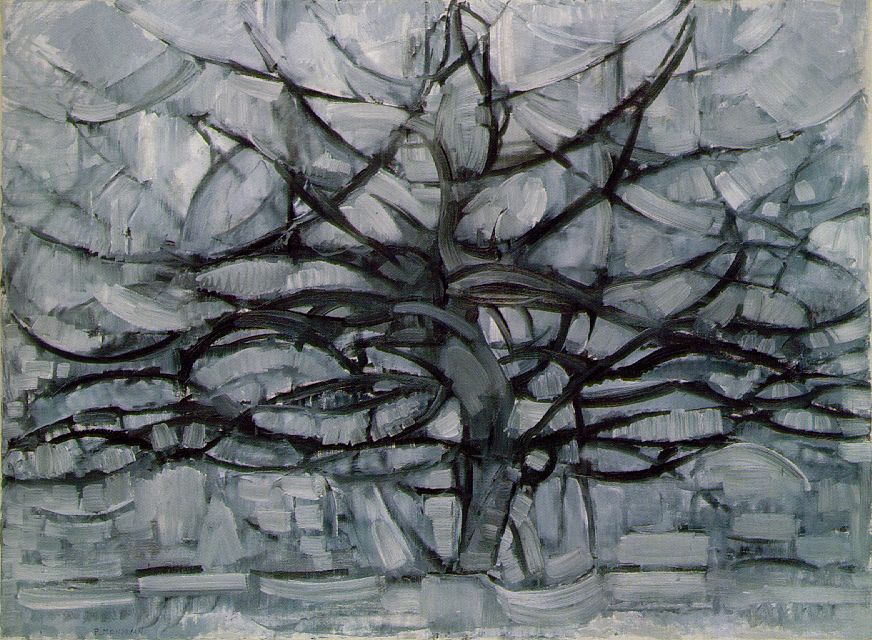
The Grey Tree. 1911. "Mondrian may be most famous for his later works, which epitomized the particular Dutch brand of modernism, De Stijl, but how he got there is particularly fascinating to trace because of its clear step-by-step development. There is a short period (roughly 1911-14) where you can see him discovering Cubism and then using it as a stepping stone to make the leap towards total abstraction."
Mondrian had a very self-exalted self-appraisal; the artist appears as a liberator, a worthy companion to the physicist and the philosopher. Together they will free mankind from subjectivity, from confusion, from the oppression of time. His pretensions cry out for criticism. They beg all the questions they purport to settle, and offend the lucidity they promise to provide. they are as abstract and opaque as the art they celebrate. Yet, almost despite himself, Mondrian lapses into concrete reality. He is far from hostile to science and technology. For Mondrian the city, especially the metropolitan capital, constitutes the vital center for the new, rational, abstract society that he wanted “plastic art” to help bring into being.
The city corrects the essential disorderliness of raw nature: “The truly modern artist,” he wrote in the first volume of “De Stijl” ,”sees the metropolis as the supreme form of abstract life; it stands closer to him than nature,” and is more likely to give him a sense of beauty. “In the metropolis, nature has already been set right, reduced to order by the human spirit.” “Broadway Boogie-Woogie, the last painting Mondrian completed, is an exuberant tribute to New York; and his writing, his conversation, and the titles of some of his paintings, are touching tributes to paris and London.

Trafalgar Square. Mondrian
Mondrian was, not commercially or socially, but artistically ambitious. He wanted to paint like the great, but ran into the limits of his ability. Mondrian could draw very well, he was well-trained and his drawings do not should show any signs of insecurity. “The whims of nature” can be captured with a pencil on paper, but painting adds other dimensions, such as color and the texture of the paint. Whether his presumed inability to render nature as he wanted is responsible for his growing dislike of nature, that developed during his life is an open question. Abstract painting however, has the advantage that it’s a more controlled environment. The abstract artist has a greater freedom to define his own artistic and technical parameters than the naturalist. Mondrian’s earlier neo-plastic works are compositionally quite simple, with carefully arranged rectangles, but with few details. In New York however, he created his “Boogie Woogie” paintings, which to my mind are among the best compositions of the 20th century. And thus Mondrian achieved his goal: to become one of the greatest painters in history.
While he had stretched his talent to the limit 20 years earlier, in the subsequent period he cleverly and intelligently developed a style that enabled him to circumvent his limitations and turn his career into an absolute success.

"At first glance, Trevor Winkfield’s paintings, with their competing colors and high level of activity, seem quite jolly—in fact they’re full of wit, but the humor is dark. The colors, upon inspection, are a bit faded. The world is two-dimensional and topsy-turvy. The ceremonially dressed figures are caught off-guard in their attempts to perform mysterious tasks; they’re ambushed by objects and hampered by anatomies gone haywire—legs end in hands, a human head is set on an animal’s body, a torso is actually popsicle sticks. Many of Winkfield’s figures have the faces of classical sculpture; their expressions are pained or dazed. It’s a funny but unsettling universe . . . similar to our own."
Trevor Winkfield: “You know, Mondrian only did a few rough sketches, using the back of cigarette packets to plan his compositions. But if you study X-rays of his actual paintings, he was manipulating things all the time. I’m fastidious, everything has to be settled beforehand. Mondrian, by the way, was a great inspiration when I first started, because he painted very flat and yet very sensuously. If you scrutinize his surfaces, you immediately fall in love with his caressing brushstrokes, the way they go right up to the edge of the next element. It’s delicious. Likewise with Malevich. In reproductions, my paintings can look quite dispassionate. But I try to put as much feeling into my application of paint as possible, just like those two.”


 COMMENTS