

A cursed libretto is not your typical campfire ghost story.Its not a joking anecdote to be easily dismissed either. Its one helluva an imp who has displayed wildly inconsistent behavior over the years. The specific association of music and madness seemed to begin in romantic literature, and it has had ramifications for theories of aesthetics, representation, and linguistics. During the late eighteenth and nineteenth centuries there existed an autobiographical impulse that influenced the direction of literary, philosophical, and psychological treatments of music and madness.
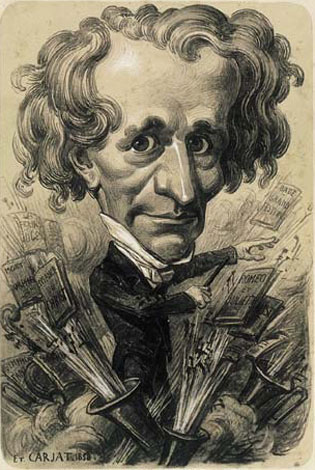
Hector Berlioz
The subject’s loss of rational control during the experience of music and the rise of unexpected passions is a transcultural, transhistorical phenomenon whose origins are not easily determined. Even today, scientists remain intrigued by the intricacies of the apparent relationships between creativity and mental illness, yet it is in the romantic period, that the deepest and most prolonged reflection on the coupling of music and madness occurred; associating mental disturbance with sound, and a trend toward intermingling literary and clinical discourses, assisted in shaping the direction of in particular, the western European cultural and literary imagination. Music was presented sometimes as essentially beneficial and therapeutic in nature, but also as a detrimental and pathogenic force. Yet both of these standpoints pointed toward a recognition of the emotional force and influence of music that nurtured and stimulated an ongoing debate within music, literature, medicine, and philosophy.
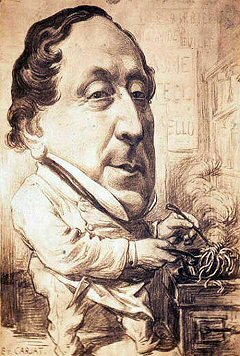
Gioacchino Rossini (1792–1868) lived to be 76, yet he had composed all of his 37 operas by the time he was 37. He had already achieved fame by the time he wrote Il barbiere di Siviglia (“The Barber of Seville”) in 1816, yet the premiere of what would become his most famous opera of all remains as one of the great fiascos in the history of opera. This was largely due to the heckling of the supporters of Giovanni Paisiello, who had died a few months before, and whose own version of the Beaumarchais play had held the boards for over three decades.
That winter he was still in Milan, and in a cruel paradox he was working on his first comedy opera ” A Day’ s Reign” when his wife suddenly following the death of their small and only son who passed away before his first opera a year earlier. Verdi was staying in obscure lodgings staring at four walls. He thought his career was over and he didn’t care; a young musician broken by professional failure and personal tragedy.He was near suicide. One evening as snow was falling he was walking through the streets with his head down and literally ran into Merelli, the head of La Scala. Merelli , somewhat of a conniving schemer started spinning a yarn about a composer who had refused a libretto and wanted something else or else.Verdi kept asking to released from his contract, but Merelli managed to weasel Verdi into his office and took out the rejected manuscript and suggested Verdi take it along with him. In addition, he slipped a second one into his coat pocket.
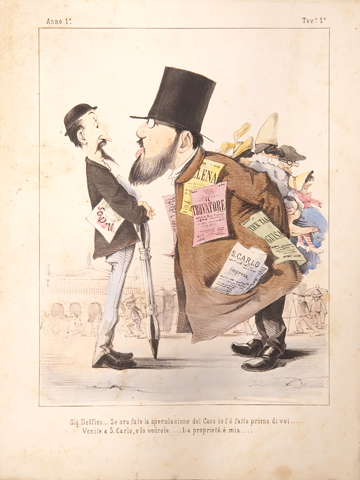
Melchiorre Delfico caricature of Verdi
Verdi trudged back home and flung the manuscript on the table; it bounced between the cutlery and glasses and tumbled onto the floor at an open page: ” Va, pensiero sull’ ali dorate” — “Go thought, on golden wings”. It is the first line of the chorus of exiled Jews in Nabucco. Though he made another effort to return the libretto, Verdi was hooked. Sixty years later, at Verdi’s funeral, the immense crowd spontaneously began to sing that chorus of exiled Jews; singing at the very end of his giant career, the lines that had brought him back to music.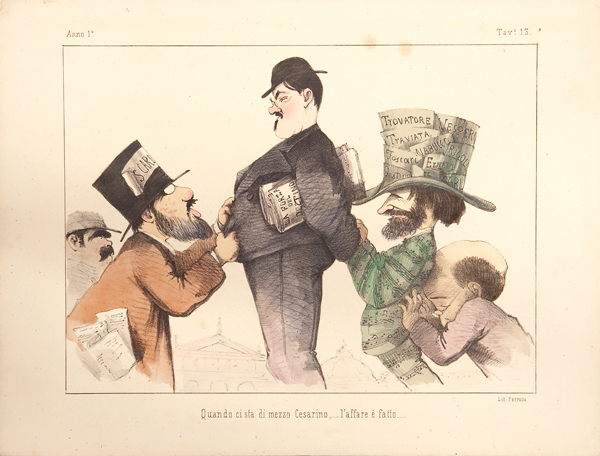
“Hamilton argues that both music and madness marked out a conceptual border where language could not reach. Romantically, they were conceived as abstract spheres that challenged the norms of denotation and signification, defining the upper and lower limits of language. The rational working of language was thought to be a mechanism that distinguished mankind from beast. Hence, speechlessness became conceptualized as a symptom of imminent insanity and a signifier of a psychically disturbed state that threatened individual identity. Madness dissolved the boundaries between man and the savage, while music might override the division separating humanity from the divine.”
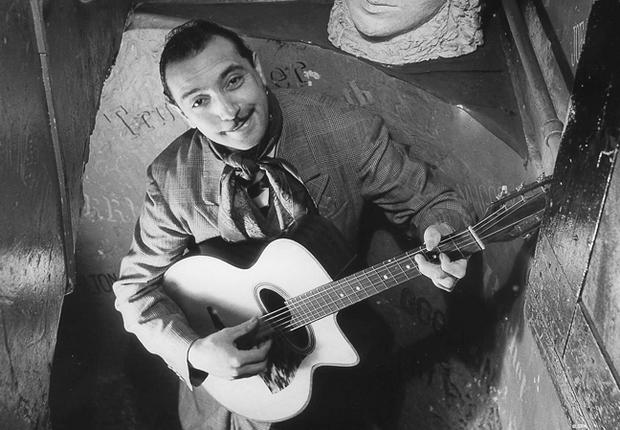
“Django Reinhardt was arguably the greatest guitarist who ever lived, an important influence on Les Paul, Charlie Christian, B.B. King, Jerry Garcia, Chet Atkins, and many others. Handsome, charismatic, childlike, and unpredictable, Reinhardt was a character out of a picaresque novel. Born in a gypsy caravan at a crossroads in Belgium, he was almost killed in a freak fire that burned half of his body and left his left hand twisted into a claw. But with this maimed left hand flying over the frets and his right hand plucking at dizzying speed, Django became Europe’s most famous jazz musician, commanding exorbitant fees—and spending the money as fast as he made it.”
Nabucco was an overwhelming success, and Verdi’s career from that point went up and up, though not invariably so. But that to that second manuscript, the mysterious libretto that seems to have its origins shrouded in an impenetrable mist. The question always arises, and whether there was a missing sheet to the manuscript or whether Verdi hid it. The legend has it, that this libretto has been passed down through time to different musicians, who have used pieces of or been inspired by it; the problem is that every time it has changed ownership it has sold for less money than was paid for it. Curiously, its previous owners have had to rebuild their lives after their painful relationship with the manuscript.
 12" height="248" />
Robert Louis Stevenson. The Bottle Imp
“One of the most profound and practical manifestations of this was the contemporary acknowledgement that music might be essentially violent in nature, a concern that pressed upon eighteenth-century aestheticians. Verbal language was commonly deemed necessary to maintain art’s mimetic principle and acted as a safeguard against its potential to evoke irrational emotionalism. Hamilton describes polyphony, as represented by the burgeoning popularity of instrumental forms including the sonata and the symphony, as becoming perceived in some intellectual circles as a threat to the individual. Without words, music might be free to exert its violence upon the listener. Yet to its advocates, instrumental power had the potential to present human truths that evaded the rigid concepts of syntax.”
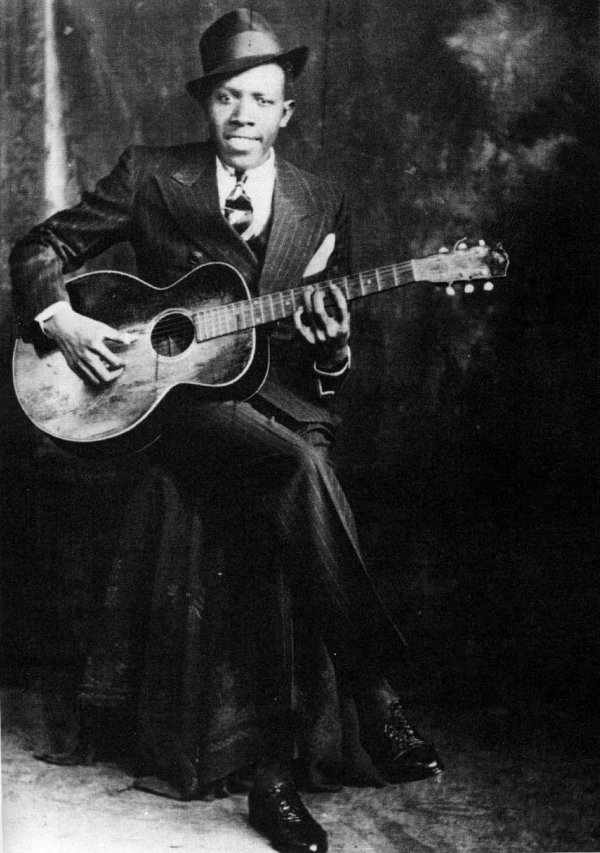
"He closely guarded his guitar playing. If he felt someone was watching him too closely so they could play like him, he’d pick-up and leave right in the middle of the show. He was always on the move. It’s said that Robert Johnson could play any song after only hearing it just once — and not just the Blues, but any music. His story is shrouded in mystery and legends. Only two photographs are known to exist of him, and he recorded only 29 songs before his mysterious death in 1938 at 27 yrs old. Many of his Blues peers believed that Robert Johnson had sold his soul to the Devil at the crossroads at midnight in exchange for becoming the greatest Blues musician of all time."
Verdi’s cursed libretto has been somewhat like the bottle in Robert Louis Stevenson’s story “The Bottle Imp” where whoever possesses the libretto achieves greatness and sometimes comes into a sizable fortune, but experiences crushing personal tragedy and, on pain of having his immortal soul burn in hell, he must, as a condition of sale, agree to resell the manuscript for less than what he paid for it. That libretto may have been brought to earth by the devil, and owned by various musicians- explaining all of their various successes.
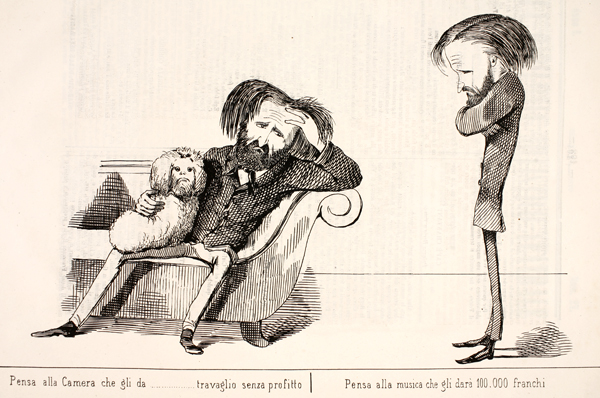
Verdi. Melchiorre Delfico caricature
Phil Spector is one who has felt the full force of the curse of the libretto;A case of the imp crawling over the his trademark Wall of Sound and wreaking havoc. An example of the tightrope between genius and insanity, creativity and madness. Vikram Jayanti’s new documentary profile of the legendary pop music master and convicted murderer is likely to place people into taking sides with two ambiguous and not totally disconnected positions: those who think he’s eccentrically crazy and belongs in jail, and those convinced he’s a troubled genius who was framed by the woman he allegedly did in.
There is a musical engagement with the theories of Foucault who aligned his discussion of musicology with the emergence of madness from invisibility and silence throughout the romantic period. Music became perceived as having immediate access to the volatile life of the emotions which rendered it morally problematic. The listener became viewed as having little choice but to submit to music’s intoxicating power, which caused music to be regarded as an exemplary case of the sublime, as something that eluded definition, comprehension, or representation. Foucault drew on Diderot’s Neveu de Rameau, and Jean-Jacques Rousseau’s reflections on the voice and the burgeoning discipline of musical aesthetics. Diderot’s employment of the literary figure of the mad musician in this work was determined as providing a literary place for a group banished in a period that arguably witnessed a great confinement of the mad.
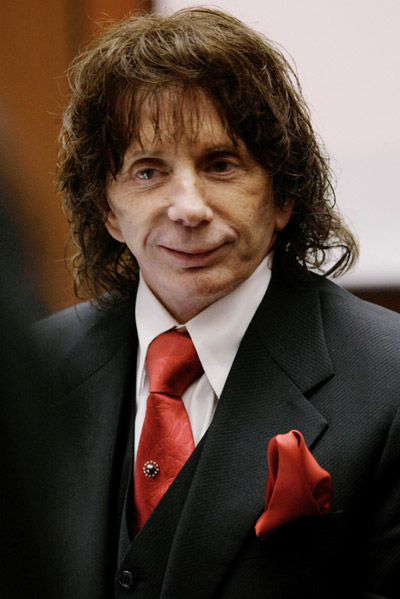
Daniel Kreps RS: Spector vividly recalls his lifetime in music, but many of his memories are exaggerated reinterpretations of his past. The producer is infamous for overstating his role in some of his greatest works, from his contributions to Let It Be to allegations he added co-writing credits to songs he had no hand in crafting. "He says in the film basically 'my father blew his head off' and he was five or six at the time. In fact, his father gassed himself with a hose in the garage, and Phil was nine or 10 at the time," Jayanti says. "People say to me, 'Why didn't you correct him at all these misstatements?' I keep saying, that's not my interest. I wanted to see what happens if I let Phil be Phil, and I think the result was I got a very accurate psychological profile, a very intimate one."
Jayanti juxtaposes archival material and trial footage resulting from the 2003 shooting death of forty-year-old actress Lana Clarkson in Spector’s L.A. mansion, with the only substantial interview he has given in a fifty-year career as the Tycoon of Teen, creator of the Wall of Sound, and writer-producer of some of rock ‘n’ roll’s most enduring classics. It is difficult to conceive of pop without Be My Baby, Spanish Harlem, Da Doo Ron Ron, You’ve Lost That Lovin’ Feeling or River Deep-Mountain High. Imagine John Lennon’s Imagine, as Spector talks in front of the white piano they bought together for the recording of that iconic composition.
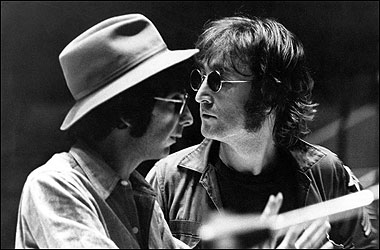
Kreps:In the end, The Ecstasy and the Agony of Phil Spector is a rise-and-fall tale fitting of one of the greatest and innovative producers of all time. "The film amply demonstrates the megalomania, and grandiosity and ego but at the same time, inside each of those things there's a kernel of quite insightful truth. He did do an extraordinary thing, he was the birth of the revolution and he was a big, big part of it. Although he overstates it a great deal, that's because of the quirks of his personality," Jayanti says.
There has also been a linkage between music and madness through analysis of the work of Johann Gottfried von Herder, Georg Wilhelm Friedrich Hegel, Wilhelm Heinrich Wackenroder, and Heinrich von Kleist. The latter’s haunting tale of music and madness, St Cecelia, or the Power of Music (1810) was a deft rehearsal of the major motifs of the sublime. E.T.A. Hoffman explicitly theorized music to exist before and after the abstract forms established by language. Hegel was led to recognize that the musician’s derangement was a sign of modern man’s necessary self-alienation, acknowledging music’s inherent inwardness….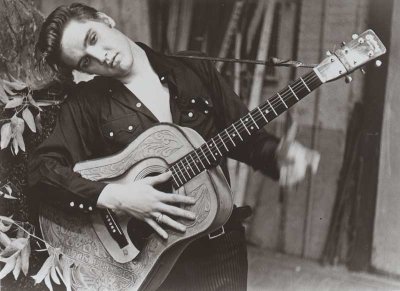
Spector looks back over the years, from writer-producer-member of The Teddy Bears and their hit To Know Him Is To Love Him in 1958, to his “retirement” in 1966 after the failure of Ike and Tina Turner’s epic River Deep-Mountain High to climb the American charts.He is credited by John Lennon with keeping “rock ‘n’ roll alive for the two-and-a-half years that Elvis was in the army.” Spector remains haunted by the father he hardly knew -a suicide when he was five years old. To Know Him Is To Love Him, are the words written on his headstone. He was bullied in school, harbours a lifelong persecution complex, and compares himself to Da Vinci for his creation of “little symphonies for the kids” from a blank canvas. He tells a great story about Martin Scorsese’s breakout Mean Streets, and his Be My Baby, a song Phil says drove Brian Wilson crazy trying to figure out.
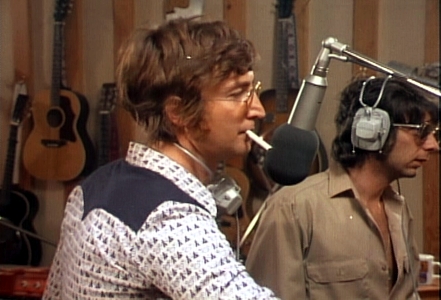
BBC:He says working on the album was a nightmare. “The Long and Winding Road was a terrible recording when I first heard it. John was playing bass on it with all the wrong notes. There was no snare drum on it – I had to get Ringo in to play. It was really awful. Paul was singing like he didn’t believe it, he was kinda mocking it. And John didn’t like the song. That’s why he played bass on it, and he didn’t know the chord changes so he was guessing. It was a farce and I had to do everything I could to cover up the mistakes.” “I worked with strangers in a hostile environment, hostile press, hostile people, all Beatle lovers who thought I was taking their Beatles away,” he says. “It was not an enviable task. But I wanted "Let It Be" to be a great farewell album. I knew they were breaking up, I knew there wouldn’t be a reunion – the public didn’t." “I don’t think McCartney is very secure that I went there in a few months and did what they couldn’t do in two years with those tapes. John was thrilled with what I did and George was thrilled with what I did, and Paul said he loved "The Long and Winding Road" when it was done."
He offers insights into the Beatles, for whom he is credited with, or savaged for, salvaging Let It Be. He describes working with John Lennon on the elemental Plastic Ono Band album in the morning, then going off to add layers to George Harrison’s faith-driven My Sweet Lord. They are all in a day’s work. Despite Jayanti’s frankly sympathetic position, there can be little doubt Spector fails most of the criteria for what is considered normal behaviour. He’s a loner, has a violent history with women, and a love of guns.
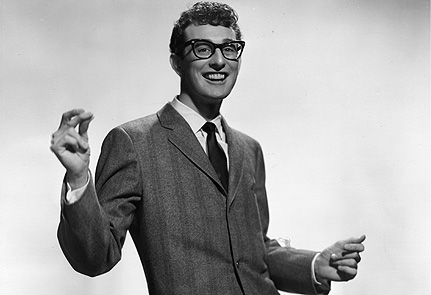
"Holly, born Charles Hardin Holley, was a member of the first group of inductees into the Rock and Roll Hall of Fame in 1986. Despite only being commercially successful for a year and a half before his untimely death at age 22, Holly has been called "the single most influential creative force in early rock and roll," by critic Bruce Elder." Echo Lamb
After decades holed up in his castle, his idea of a joke doesn’t play with judge and jury when he comes to court with exaggerated hairdos. What he thinks is funny is disrespectful to them, and destructive to his case. After one hung jury trial -they could not align prosecution’s stand he shot Clarkson in the mouth with the lack of evidence on his clothes -he was convicted in 2009 and has good odds of kicking the bucket behind bars. Those conditioned by decades of gossip about Spector’s mental state will say he got what he deserved. Those unconvinced by the evidence of his show trial, or inclined to cut him slack for his eccentric genius and place in history, may quietly mourn his fate.
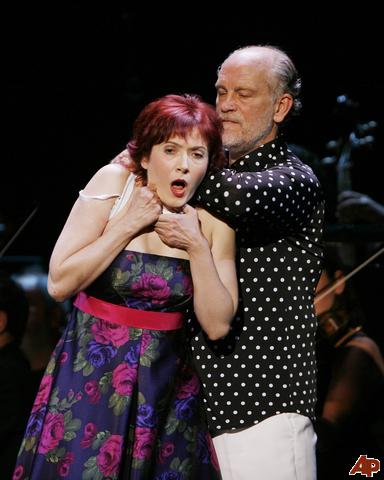
"Malkovich, who 10 years ago began a project to make a film about Unterweger, was drawn to the subject after being struck by the similarities between the Austrian and Jack Henry Abbott, who turned into a prison literary sensation after the 1981 publication of In the Belly of the Beast, his account of life in a US penitentiary where he was serving a sentence for murder. Just as Unterweger was championed by myriad writers such as the Nobel prizewinners Elfriede Jelinek and Günter Grass, Abbott was lauded by his country's literati, including Norman Mailer and Kurt Vonnegut, whose support of him also led to his early release. Six weeks later he bludgeoned a man to death."
This past summer John Malkovich brought a famously vile serial killer back to life in “The Infernal Comedy: Confessions of a Serial Killer” Malkovich affected the mannerisms of a psychopath, touring his role as a resurrected Jack Unterweger, the famous Austrian writer and notorious murderer of prostitutes. He is another prime suspect in the chain of purchasing the cursed manuscript. Malkovich’s challenge was in portraying Unterweger’s sweeter, charismatic side; the kind of gentle humor that would flash in between the serial killing. The Austrian was popular with women and had many followers, fans and supporters ; won over by his intellect and apparent reformation during a fifteen-year prison stint. The play even begins with a musical excerpt from Christoph Willibald Gluck’s “Don Juan ”
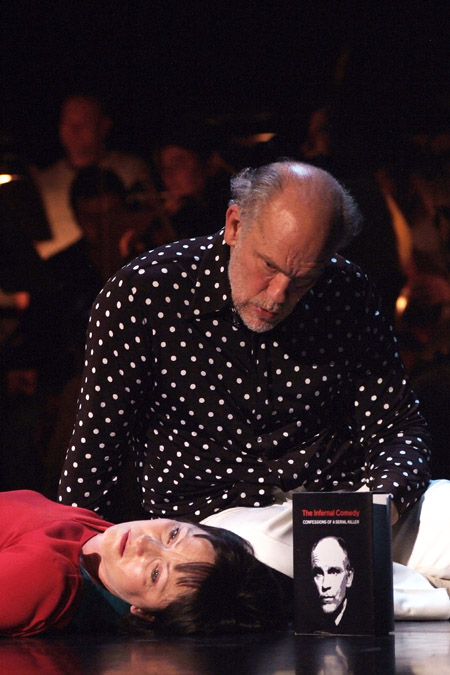
Kate Connolly:Martin Haselböck, musical director of The Infernal Comedy, who met Unterweger during one of his prison readings, explained the murderer's acceptance into the establishment as a sign of the times. "It epitomised the thinking at the time that art is stronger than crime and the far too liberal idea that everybody can be changed." He said he expected the audience to be made up of a "strange mix" of Unterweger admirers, fans of Malkovich and opera lovers: "There are the Unterweger fans who are still out there, mainly women, many of whom still claim his innocence." The Infernal Comedy, which is due to transfer to Spain, France and next year to London, concludes with Unterweger's declaration: "I'm longing for the truth as much as you are," followed by his suicide.
The opera-play features Malkovich as an already dead Unterweger, decked out in a white suit and black-with-white-polka-dots shirt, returning to give a talk about his new autobiography to the assembled audience; Malkovich’s monologues are interwoven with music by Mozart, Beethoven and Haydn, among others.
The work, written and directed by Michael Sturminger, veers from darkly comic to just plain dark as Unterweger charms his victims with humor; a questionable charm, that is fascinatingly alluring at the same time. Unterweger claimed his mother was a prostitute who left him to be raised by his grandfather, who he described as a violent womanizer. After a degenerate and destitute adolescence punctuated by episodes of violent behaviour, he was sentenced to life in prison in 1976 for murdering a teenage girl by strangling her with her own bra.
Unterweger’s studies in the prison library led him to pen a series of poems, plays and short stories, as well as a 1984 autobiography called “Purgatory” which made him a literary star of the tabloid variety. Prison psychiatrists deemed him to have been rehabilitated by the time he was paroled in 1990, after serving the minimum possible sentence, and became a public figure, appearing in television debates dressed like a dandy. But he returned to old habits within months of his release, murdering as many as eleven more women in Austria, Czech Republic and Los Angeles, and then brazenly investigating the murders as a journalist interested in the dangers faced by prostitutes. He was eventually recaptured, only to commit suicide in his cell.
Malkovich, who is used to playing film characters that are menacing and alluring, said he found Unterweger “haunting and tragic. I can find him so touching that I can’t even talk when I get on stage,” he said. Describing The Infernal Comedy as a “lesson in being careful about what you wish for”, Malkovich added: “It is a cautionary tale about where our projected fantasies of redemption hurl themselves, out into the night, not knowing if the ground is 10 inches below or 200 storeys. I’d be shocked if those who supported him haven’t shown some remorse.” ( Kate Connolly, Guardian )


 COMMENTS