

After generations of trial and error, mostly error, man’s age old dream of flying was realized near the end of the eighteenth century in the form of the hot air balloon. This was followed by several decades where daring aeronauts gave play to their imaginations by constructing ever more fanciful contraptions and performing increasingly startling feats before gaping audiences.

"While some were dreaming of flying like a bird, others preferred to take it one step at a time and simply try to lift into the air. The idea of using Archimedes’ buoyancy principle to rise in the atmosphere by creating an object lighter than the air it displaces had been introduced in 1670 by a Jesuit priest, Father Francesco de Lana of Brescia, Italy. De Lana suggested (in print) that copper could be used to create spheres thin enough to be light- weight yet strong enough to be evacuated of all air, thereby making the total sphere lighter than the air the sphere displaced. The theory was sound, but producing sufficiently light spheres that would not collapse under the pressure of the air proved too difficult."
On a November afternoon in 1783, two spirited young Frenchmen departed this planet from the Bois de Boulogne. Their twenty-five minute feat was unprecedented; it ushered in the age of space travel. Joy, gaiety and spontaneous enthusiasm reigned. Hundreds of thousands had witnessed the marvel: some wept in an agony of apprehension, while the two aeronauts yet floated in their balloon; some fell to their knees in prayer; all, as the ballon glided grandly to its landing, cheered themselves hoarse. The American envoy, Benjamin Franklin, was there. Later, someone asked him of what use was a balloon. ” Of what use,” Franklin retorted, “is a new-born baby”.
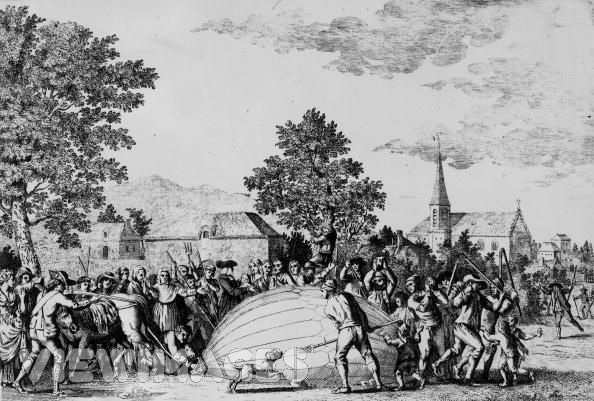
"Upon pouring our grape juice, we were regaled with a story that when balloons were newly invented in France, some peasants had attacked one when it landed, thinking it was an intruder from another world. From then on, we were told, balloonists started carrying champagne to show farmers that they were actually from Earth, and even France, and therefore not Dangerous Aliens. From there the legend grew into a tradition, and balloonists apparently now celebrate a successful flight with champagne, and give some to the property owners to thank them for use of the landing spot."
The hang-up, in the past, that stymied Roger Bacon, Leonardo da Vinci and Swedenborg, was their stubbornness in clinging to mechanical devices with flapping wings; over the centuries this led to dozens of men, endowed with more pluck than logic, plunging to their death, martyrs to the principle of wings. Even those who deprecated the notion of flight, like the essayist Joseph Addison, protested, because they argued, the skill would entail a bird brain and, as well, the alleged promiscuity of a bird. “it would fill the world with innumerable immoralities,” Addison wrote, “The cuppola of Saint Paul’s would be covered with both sexes like the outside of a pigeon house”.
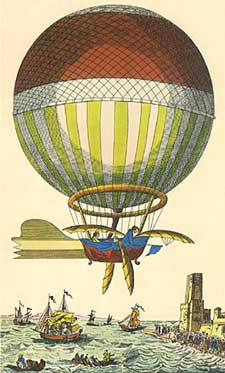
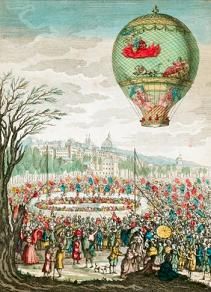
"For such an experiment to take place required the permission of the King himself and Louis, concerned by the possible risk to one of his subjects, decreed that two convicts should make the ascent. (If they survived they would be granted a royal pardon, and if they didn't...) The Montgolfier brothers were dismayed by this proposal and after much discussion with the court officials persuaded the king to relent and on 21 November 1783 a brightly decorated balloon rose above an ecstatic Parisian crowd bearing aloft the first aeronauts — the first humans to fly — Pilatre de Rozier and the Marquis d'Arlandes."
The balloon’s inventor was Joseph Montgolfier, elder son of a paper manufacturer. Both Joseph and his brother Etienne had grapled for some time with the mystery of flying. They were familiar with Joseph Priestley’s ” Experiments and Observations on Different Kinds of Air” , and Joseph had tinkered with parachutes, successfully dropping a sheep from a tower under a rig designed like a parasol. But it was looking at an engraving showing the French and Spanish besieging the British at Gibralter that gave him the idea of storing smoke; an observation that could be made in the age of reason.
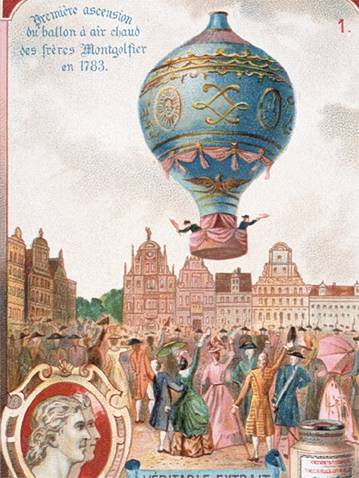
"Hot air balloons were invented in 1783 by two French brothers, Jacques and Joseph Montgolfier. They were very wealthy paper makers. When they how paper rose with the hot air in a chimney, they thought that a paper balloon filled with hot air might also fly."
Their first test of a linen and paper balloon proved air worthy, at least for ten minutes. The physicist Charles thought that hydrogen, a recent discovery of Henry Cavendish would prove more adequate than Montgolfier’s straw and wool blend that fed their fire. Unlike the open necked Montgolfiere, the first Charliére was closed by a valve to contain the gas. Word of Charles’s strange undertaking swept over the city: when the ballon was transported by night through the streets to the Champs des mars, the people bared their heads and knelt in wonder as it went by under armed guard.
Next afternoon cannon boomed, heralding the ascension, and all Paris exulted. The ballon rose and sailed away, out of sight. Somewhere aloft, the expanding hydrogen tore a rent in the taffeta. It floated down in farm country, scaring the peasants out of their wits. They summoned the parish priest to exorcise ” the writhing demon from the clouds” with bell, book and candle; when this recipe was unavaling, they dispatched it with scythe, flail, and blunderbuss.
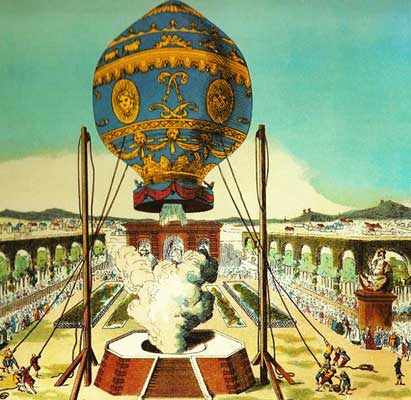
November. 1783. Pilatre de Rozier and the Ma
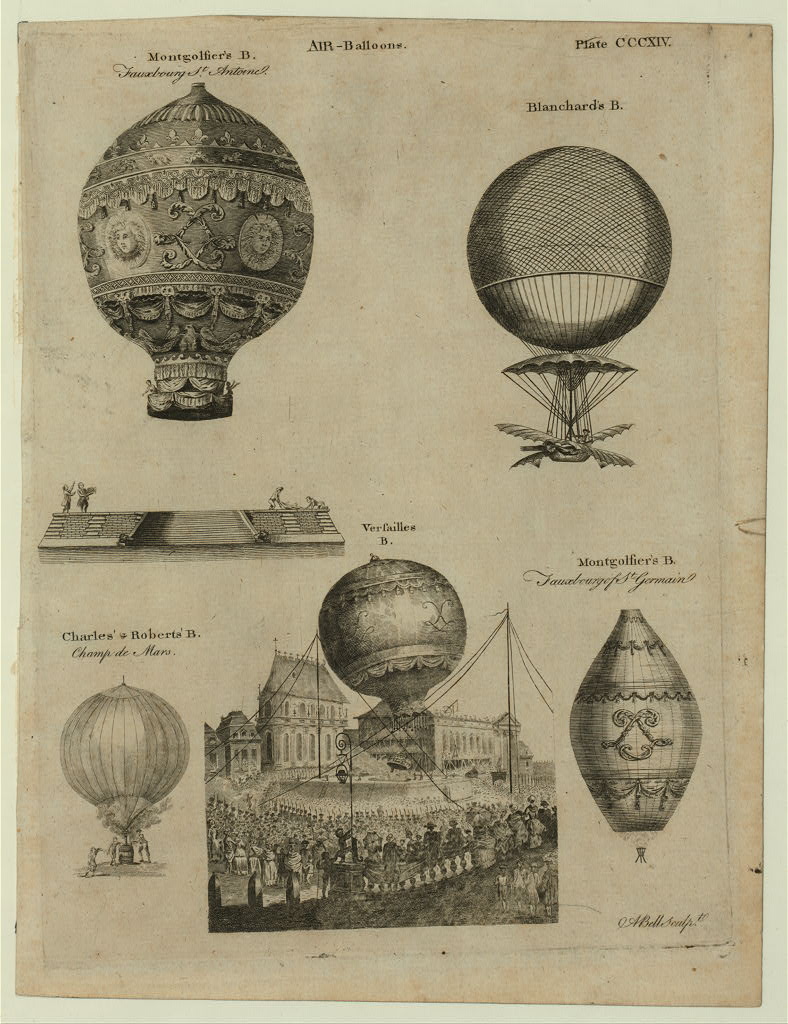
s d'Arlandes wave from the gallery of their montgolfiere as they set out from Paris.By now Etienne Montgolfier had arrived in Paris. Joseph was deemed a trifle uncouth for court society. He set about the construction of his “globe volant” . Aware that he was among the quality, Etienne created a magnificent blue aerostat seventy-four feet highht, girdled it with scarlet swags, and decorated it with zodiacal signs, wreaths, portraits of Apollo and royal ciphers all in gold. The handsome creation was tested in free flight by three passengers: a sheep, a cock, and a duck; suspended in a wicker basket under the balloon’s open neck. All three having weathered their trip satisfactorially, thought was now given to the concept of human flight.
The dream of being able to fly was shared by the 13th century English scientist Roger Bacon and German philosopher Albertus Magnus. Both men proposed hypothetical ideas of a flying machine based on the principle where force could be applied to lift them in the sky.
There were volunteers aplenty, some of them quite clamorous, even fanatic; but word came from His August Majesty, Louis XVI, that no human life was to be imperiled by such fool nonsense except it be that of a convict. It was intolerable. Happily, it was rescinded, and the volunteers could be heeded. Of these the most importunate was the physician Francois Pilatre de Rozier who was lifted successively from 84 feet to 330 feet in four trials. All proved that the air “up there” was not poisonous.
"The 34-year-old Blanchard was an experienced flyer by the time he came to America. He would not be making the very first ascension; honors for that feat had been claimed by the 13-year-old Edward Warren, who volunteered in June 1784 to go aloft in a tethered hot-air balloon constructed by Peter Carnes, a Bladensburg, Maryland, lawyer and tavern owner whose weight kept him from going up himself. But Blanchard would make the first unanchored air journey. He chose the yard of Walnut Street Prison as his takeoff point so that he could sell tickets at $5.00 and $2.00 each. Many Philadelphians chose to wait outside the walls and view the ascent for free. The event was a financial bust. Secretary of State Thomas Jefferson (who upon hearing of the Montgolfiers’ work had cried that now mankind could reach the Pole), Vice President John Adams, Congressman James Madison, and other luminaries were most likely on hand for the takeoff."
Ten days later, the rival Professor Charles, having sling a “car” under the first bib hydrogen balloon, soared up from the Tuileries together with an assistant and sailed away to the northwest. They landed twenty-sen miles away, and promptly took off again rising to 9,000 feet.
Here then, all at once, humanity found itself with two splendid new toys. They were simplicity to make; they were reasonably safe to operate; they were a joy to behold not only for their vivid gores and gay adornments but for their round , plump shape; even more they were exhilarating to ride in. Was it any wonder that overnight an aerostatic craze was touched off. The balloon was a godsend to people with all sorts of notions: to statemen pondering power; to lover pondering elopements; to rascals scheming of great smuggling coups; to romancers, puzzling how to extricate their heroes from desperate dilemmas; to political cartoonists, blissful as they contemplated the possibilities offered by gas and hot air; but most of all to designers and craftsman.

"Airships and balloons have been with us for many centuries. Initially balloons were unpowered and at the mercy of the wind and weather. Both hot air and gas-filled balloons were developed at the same time. The Montgolfier brothers demonstrated their first hot air balloon in 1783, with the first human flight following a few months later. "
From the ateliers of these folk poured a bewildering profusion of items. Glazed pottery from Delft, porcelain from Sevres, faience from Moustiers, mirrors and clocks, chair backs and bird cages, snuff boxes and fans. The “couturiers” and hairdressers jostled their way into the act too, with the customary outrageous results.
In all the ferment of joyous activity, only the soldiers stood glumly apart. They failed to see how the balloon would appreciably assist them in their task of killing larger numbers of people. The same consideration, but from a different angle of vision, had already occurred to Horace Walpole: “I hope, that these new mechanic meteors will prove only playthings for the learned and the idle, and not be converted into new engines of destruction to the human race, as is so often the case of refinements or discoveries in science”. But to the military, the doleful fact was that the direction of a balloon could not be controlled, save up or down.
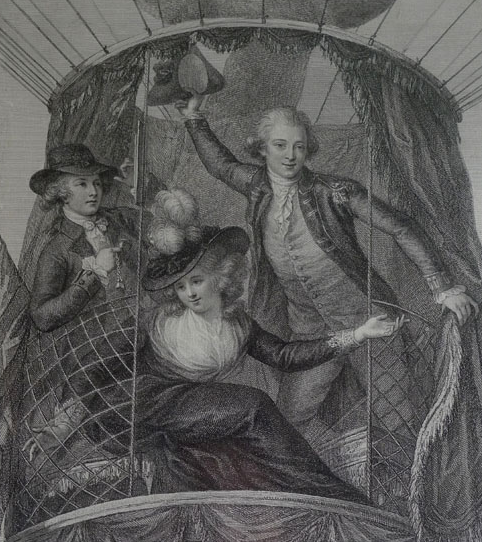
"Vincenzo, or Vincent Lunardi came to England as a diplomat, but was more interested in flying. He was 22 and dashing and determined to gain Royal permission to 'demonstrate' a manned balloon flight with the help of his 'partner' George Biggin, which was to take place on the Artillery Ground near Moorfields in September 1784. It is recorded that more than 200,000 people turned out to see this demonstration - an almost impossible number, but safe to say the open ground was packed, and included Royals, a healthy chunk of the nobility and apparently a quarter of London. Lunardi, a great showman made everything very dramatic, and also packed his cat and dog into the basket with him for company before releasing the tethers, whereupon the balloon rose 'with slow and gradual majesty into the air' to the disappointment of 'the splenetic' suggesting Lunardi had his detractors. 'He appeared composed, and as the balloon went up, bowed most gracefully, and calmly waved his flag to the admiring and wonder-struck spectators'. "
The limitation of movement was also vexing some of the aeronauts too. Of these, the most persistent was Jean-Pierre Blanchard, a small, stubborn, disagreeable man who nevertheless did more than any other to popularize aerostation. In a sense he did this reluctantly, for he was committed to heavier than air flight. Between 1781 and 1783 he had designed a “vaisseau volant” on the ornithopter principle; it was almost completely hidden under a cloudbank of rudders, sails, propellors, rudders, fins, and even great winged oars. All this paraphernalia he now attached to a parachute under a balloon and gravely set about to row through the air. More important, as a professional aeronaut he attracted great crowds to one launching after another, which he conducted under a slogan taken from Vergil, “Sic Itur ad astra” – this way the road to the stars- and to which he charged a stiff admission fee.


 COMMENTS