
It’s been said, oversimplistically but sympathetically, that “he didn’t know the rules well enough to break them”. But of course there are no rules in the kingdom of the imagination.He knew he was a babe in the woods of high art but sought to exploit his very naivete, and gradually, splitting open rules like coconuts, he stumbled on to a whole new way of looking at things. Henri Rousseau, “the very-good-very-bad painter”, remains enigmatic nearly a century after his death….
The myth of Exoticism captivated the minds of many avant-garde artists and writers as the 19th century drew to a close. It represented an escape from bourgeois society, with its declining spiritual values, and an urge to travel to distant lands uncontaminated by progress in order to pursue a more natural, “savage” lifestyle. Following in the wake of Gauguin’s move to Tahiti, Kandinsky travelled around north Africa, Nolde sailed to New Guinea, Pechstein explored China, and Klee and Macke spent time in Tunisia.

Rousseau. Storm in the Forest. ( Tiger in a Tropical Storm )"Rousseau's dual personality made him at once kindly and childish, roguish and intolerably malevolent, and inscrutable to a degree that suggests an inner life of suffering. Indeed, his life resembled a game of hide-and-seek. He served as a toll collector for the City of Paris for twenty-two years before retiring early in 1893; he never commented on the fictitious inspector's title "Douanier" which the public bestowed on him. He encouraged the persistent legend that he had been a member of the overseas forces helping to bring about the coronation of the Hapsburg Maximilian of Austria in Mexico, and that he had saved the city of Dreux from civil unrest during the Franco-Prussian war. The fact is that at the time in question, in 1863, he was serving a juvenile sentence for stealing the paltry sum of twenty francs from his employer in Angers, the advocate Fillon,"
The French painter Henri Rousseau (1844-1910) pursued this same ideal in his quest to capture a spirit of innocence. While still very much rooted in French city life, and for many-years a conventional man, he nevertheless projected images of an exotic world of magic and freshness. Known as “Le Douanier” because he worked for the Paris customs service until 1893, he was an untrained painter. However, amid much criticism and controversy, the exclusive intellectual elite of late 19th-century Paris at the end of the century claimed to understand the “hedonistic mystifications” of symbolism in his work. ( Cornelia Stabenow )
We shall probably never know exactly when or why or under what circumstances this unsophisticated and relatively uneducated man, whose life to the age of forty had been so humdrum; felt impelled to take up painting. The answers might resolve many of the contradictions about Rousseau’s isolated and enigmatic genius. Presumably, his interest began as a hobby sometime during the late 1870’s. Rousseau taught himself to paint- as he said, “alone and without any master but nature.”
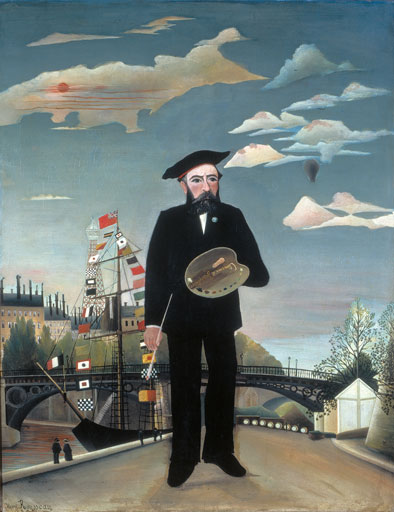
Tate:Rousseau claimed to have invented the 'portrait-landscape' genre, in which a subject is defined by their surroundings. In Myself, Portrait-Landscape (1890), he presents himself on a monumental scale against the backdrop of Paris, using symbols of technological progress such as the Eiffel Tower and a hot air balloon to celebrate the city's modernity. The artist's poise, dress and context announce his ambition as an Academic painter worthy of paying tribute to this modern Republic.
As the obsession took hold, Rousseau began to sneak off to paint during his working hours. The suburbs of Paris, where he was stationed, were still rural then- goats and cows grazed on the slopes of Montmartre, for that matter, and it seems a safe enough guess that many of his early scenes of Seine quays and outlying villages were done on stolen time. He did not retire from the toll service until 1893. One early painting, “The Tollhouse” ( 1890) , stands as a monument to his bureaucratic career and his dreamy estrangement from it. The iron gate with its spiked top, the lampposts, the high brick walls- so far the painting adheres to the actual place as we know it from photographs.
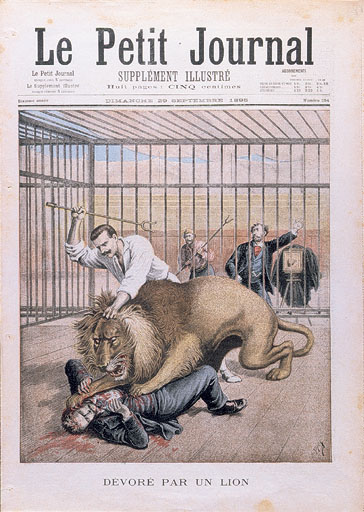
Tate:Le Petit Journal was a popular magazine in Rousseau’s day. He drew heavily on its illustrations of animals and exotic scenes.
“Almost everything about them is a fanciful concoction, whether he was painting jungles of plants and trees that barely belong in the same hemispheres, let alone latitudes or climate, or scenes of suburban Paris which, although sometimes begun as faithful topography, took on an aspect entirely derived from the artist’s imagination. He is regarded as a kind of collagist – equally happy cribbing a tiger’s pose from Delacroix or a lion from an illustration in Le Petit Journal, for which he briefly worked as a sales representative. Academic sculptures, postcards, a book of wildlife pictures and his lone expeditions to the Jardin des Plantes provided his material.” ( Adrian Searle )

Rousseau. The Toll House.
But Rousseau has replaced dreary proletarian suburbs with a background of wooded hills. What is the odd figure on the top of the wall looking at? Why is he on top of the wall? Where
s the gate lead? The tollhouse has been transported into the landscape of hallucination.Rousseau first attempted to exhibit two of his paintings at the official Salon des Champs-Elyséées in 1885. One was slashed by a penknife, and they were removed. So it happened that Rousseau, whose naive ideal was the “truth” of the camera and who wanted nothing more than to be accepted by the academicians, had to cast his lot, “faute de mieux” , with the avant-garde. For it was at this time that other refusé, refused artists, such as Seurat, Signac,and Redon founded the Société des Artistes Indépendants, whose membership was open to all. Its first major exhibition was held in 1886; Rousseau showed up, pushing four canvases through the streets in a handcart. One of them was “Carnival Evening” . Along with Seurat’s “La Grande Jatte” , also exhibited at the Indépendents that year, it has become one of the standard masterpieces of modern art.

Henri Rousseau. Carnival Evening
Year after year he continued to exhibit at the Indépendents. After his wife died in 1888, he immersed himself in his art. But it was another five years before he could bring himself to leave the “Octroi”. The decision could not have been easy; his pension of fifty francs per month was barely enough to keep him alive. We have only glimpses of Rousseau in the next decade, and the reason is understandable. Who bothers recording the days of a pensioner? History has no place for its “refusés”.
He was seen painting shop signs or playing his violin at public concerts in the Tuileries Gardens. For a few years he taught music and drawing at a philanthropically sponsored night school- but without pay. In really hard times he went on the street and played for a few sous. Occasionally, he received a commission from someone in the neighborhood to paint a portrait. He exchanged canvases for laundry and groceries. But through it all he continued to work. He was possessed of a fortitude amounting to madness.
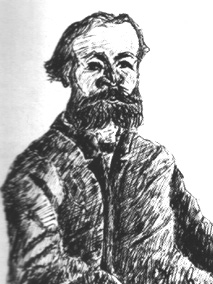
Stabenov: "...but behind the good-humoured clown's mask there was another face. In 1895 Rousseau presented to the publishers Gerard et Coutances a biographical notice and a self-portrait in pen and ink as a contribution to the projected second volume of "Portraits of the Next Century". The drawing is of an apparently unremarkable old man, shabbily dressed, who turns to face the observer with faun-like features reminiscent of Paul Verlaine's. His eyes are in sharp contrast to the wearily sagging shoulders. His gaze is keenly perceptive but also mistrustful, fearful, kind, manically ecstatic and introspective, alternating between tragedy and comedy, a physiognomy divided in two. At this time Rousseau was fifty-one years old, but the psychographic portrait matches the descriptions given by contemporaries such as Gustave Coquiot, Arsene Alexandre, Robert Delaunay, Wilhelm Uhde and even the police records of 1907."
Every moment counted; he slept in his clothes to save time. Only in 1889 and 1900 did he fail to exhibit. This gap may be somehow connected with his second marriage in 1899; at any event, there is an indication of some sort of upheaval, personal or financial, that kept him from painting. After little more than three years, his new wife died of cancer and he was alone again.
In spite of the hardships, it had been a remarkable decade of production. Many of Rousseau’s best paintings come out of these years, and the scope of their subject matter is breathtaking. These include “Storm in the Forset” , with its tiger skulking through a rain-swept jungle; the first of his exotic paintings and one of the most beautifully composed. There are the first of his “portrait landscapes” of which he proclaimed, “I am the inventor” . These are characterized by their stylized and often crude depictions of the human face that have been much criticized.
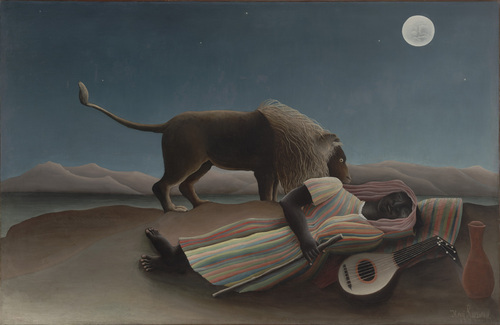
The Sleeping Gypsy. 1897. "When he was prosecuted in 1909 as accomplice to a certain Louis Sauvaget on a charge of embezzlement and forgery, and given a two-year suspended prison sentence and fined one hundred francs, lie strove for recognition as a respectable citizen. He presented himself as a patriot, as "father of the poor", as honorary drawing teacher at the Association Philotechnique, a philanthropic institution for education of the people founded in 1848, and stressed his earlier role as father of the family, who had cared for the sick in addition to working a sixty-hour week. Above all he insisted on his pressing obligation to paint, and it was in this connection that he made a point which touches his life's deepest complexities: "If my parents had recognised my gift for painting . . . today I would have been the greatest and wealthiest painter in France." In the biographical notes of 1895 he had written: "... since his parents were not well-to-do, he was compelled at first to follow another path, rather than the one to "which his artistic disposition inclined him. It was only in 1885 that he began to work as an artist, after many disappointments, alone, with no teacher except nature, and with occasional advice from Gerome and Clement." These pronouncements suggest that throughout his life Rousseau suffered from a feeling of inferiority - afraid that without academic training he was bound to remain an amateur painter. "
But Rousseau’s portraits were less psychological studies than records of events in which detail of the scene identify character. And, above all, we have his riddle of riddles, “The Sleeping Gypsy” ( 1897) . Why the lion? Why the woman sleeping in the desert? The interpretation of Jean Cocteau is tempting: “Perhaps, in fact, the lion and this river are the dream of the sleeper… it is probably unintentional that the painter, who never forgot a detail, has put no imprints in the sand around those sleeping feet. The gypsy did not come there. She is there. She is not there. She is in no human place…”

Eclaireurs Attacqués Par un Tigre. " Since it was Rousseau's intention to match what he saw with the facts as he knew them, there was no cause for him to seek to impose the spatial rationality of linear perspective which had prevailed since the Renaissance. It was equally impossible for him to establish an individual style which lessened the importance of what he saw and knew to be the nature of things. Mysteriously, Rousseau must have been able to produce conies of nicrures such as the Lion and Tmer minted bv Eugene Delacroix in 1828/29, since one was hung in the Ecole des Beaux-Arts retrospective in 1885. The moderately successful copy is accurate and professional in the use of materials and perspective, which suggests that the painter may have made a deliberate choice in not conforming to convention - a consideration which would make the so-called "naivité" of his art even more of an enigma. If there was a deliberate choice, then it was taken on intuitive rather than on theoretical grounds."
Rousseau would use the device again. It was, of course, the idea behind the last and most famous jungle painting, “The Dream” ( 1910). As he explained it: “This woman asleep on the couch dreams that she has been transported into the forest, listening to the sounds of the enchanter’s instrument. This is the reason why the couch is in the picture.” For his surrealist descendants, the couch in the jungle would become the couch of Freud.
At the 1897 salon of the Indépendants, “The Sleeping Gypsy” became, as one witness remembered, “the target of the Show.” As his paintings began to draw more notice, Rousseau took a lacerating punishment from critics and the public alike: “Monsier Rousseau paints with his feet with his eyes closed.” He was the “annual aberration” of the Indépendants” , the scarificial offering of modern art.
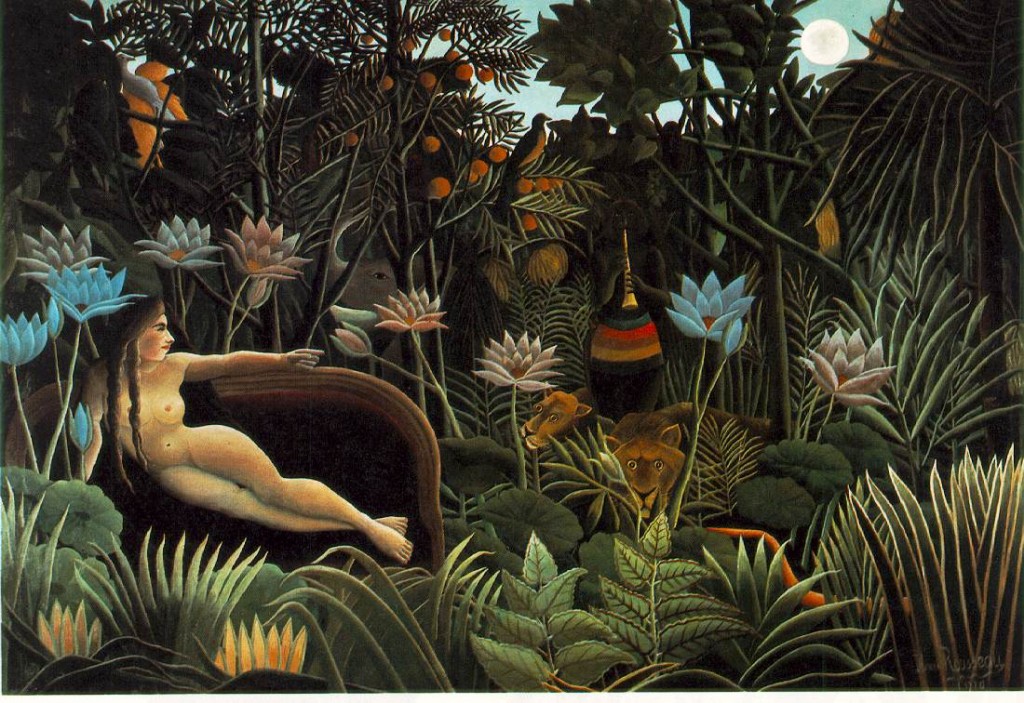
The Dream. Stabenow:This tightrope walk between optical impression and visionary outcome explains why both traditionalists and avant-garde agreed, albeit for different reasons, on the label "naive" for the creator of this magical other world. Both used the picture in their reflections on what was possible in the realm of painting, and on the historical development of aesthetic theory. In the face of such theorising it is indeed tempting to see Rousseau as the embodiment of the grass-roots artist unencumbered by cultural baggage. His interest is always directed immediately and impartially to the object before him. Method, style, his own distinctive mark are subordinated to his perceptions. His concern is with precision, with the meaningfulness of detail rightly observed.
At last, even the Indépendants debated excluding Rousseau, and it was Toulouse-Lautrec who successfully defended him. The avante-garde were beginning to pay attention to his work. This association is the singular fact of his last years; it is through the artists and writers who came to know him that he begins to emerge from the shadows. The “farceur” Alfred Jarry, who was also born in Laval, was the first to recognize his extraordinary talent. Barely twenty, Jarry had just arrived in Paris, and he briefly lived near Rousseau in 1893; one supposes that their common background and Rousseau’s local notoriety brought them together. Jarry, the image of the bohemian poet with his shoulder length hair and drooping mustache, publicized the old “gabelou’s” work, most notably “War” , and introduced him into Paris intellectual society.
ADDENDUM:
Rousseau walks on trumpet paths
Safaris to the heart of all that jazz
Through I-bars and girders, through wires and pipes
The mathematic circuits of the modern nights
Through huts through Harlem through jails and gospel pews
Through the class on Park and the trash on Vine
Through Europe and the deep deep heart of Dixie blue
Through savage progress cuts the jungle line
In a low-cut blouse she brings the beer
Rousseau paints a jungle flower behind her ear
Those cannibals of shuck and jive
They’ll eat a working girl like her alive
With his hard-edged eye and his steady hand
He paints the cellar full of ferns and orchid vines
And he hangs a moon above a five-piece band
He hangs it up above the jungle line… ( Joni Mitchell. The Jungle Line )


 COMMENTS