

Isabella Stewart Gardner. “Mrs. Jack” startled staid Boston society by erecting a Venetian pleasure dome in the Back Bay and filling it with masterpieces for the public to enjoy…
In Seville, in 1888, Mrs. Gardner bought her first old master-a Zurbaran Madonna which hung in her Beacon Street bedroom until she moved to Fenway Court. Eventually placed in the Spanish Cloister, it served as a kind of altar piece when her body lay awaiting burial in 1924 in a room dominated by one of John Singer Sargent’s undoubted early masterpieces, the swirling El Jaleo, a present to Mrs. Jack from Thomas Jefferson Coolidge. Maintaining that this huge dramatic picture of a dancer in a Spanish cafe had never been properly lit when lent to various exhibitions, Mrs. Gardner tore out the music room at Fenway to build the Spanish cloister as a special setting for El Jaleo. Now, as in her lifetime, it is lit from below to correspond to the illumination within the cafe which Sargent pictured.
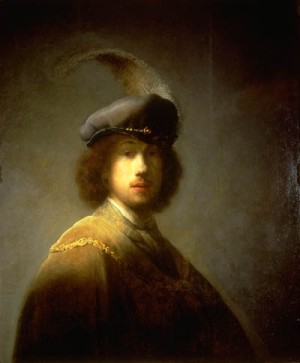
---What sticks with me right now is not two Raphaels, a fragment by Piero della Francesca, Titian's Rape of Europa, or the empty frame that once held a now-stolen Vermeer, among so many others. I keep returning to an early Rembrandt because of what I overheard. A man, not much older than Rembrandt in that self-portrait, was passing with his mother. She noticed the painter's right side thrust forward, the light helping to outline a gold chain, much as on a Rembrandt portrait in the Dulwich Picture Gallery. No way around it: that painterly relief looks careful and vivid, but his face is hardly a blur. Oh, she told her son, some painters are good at some things, like portraiture, some at others. I doubt she knew whom she was calling a lousy face painter.---Read More:http://www.haberarts.com/blur.htm
Mrs. Gardner called Rembrandt’s self-portrait at the age of twenty-three- stolen in 1990- the cornerstone of the collection, because it was the first picture she bought with public exhibition of her treasures in mind. Also coveted by the National Gallery in London, this Rembrandt cost Mrs. Gardner a mere $15,000, plus a fee to Bernard Berenson, who had described it as one of the most precious pictures in existence. She was less lucky with another Rembrandt that she coveted, The Old Mill, which was eventually acquired by P.A.B. Widener in Philadelphia. Berenson managed to get her the fine Landscape with Obelisk as a kind of consolation prize for missing out on the Rembrandt.
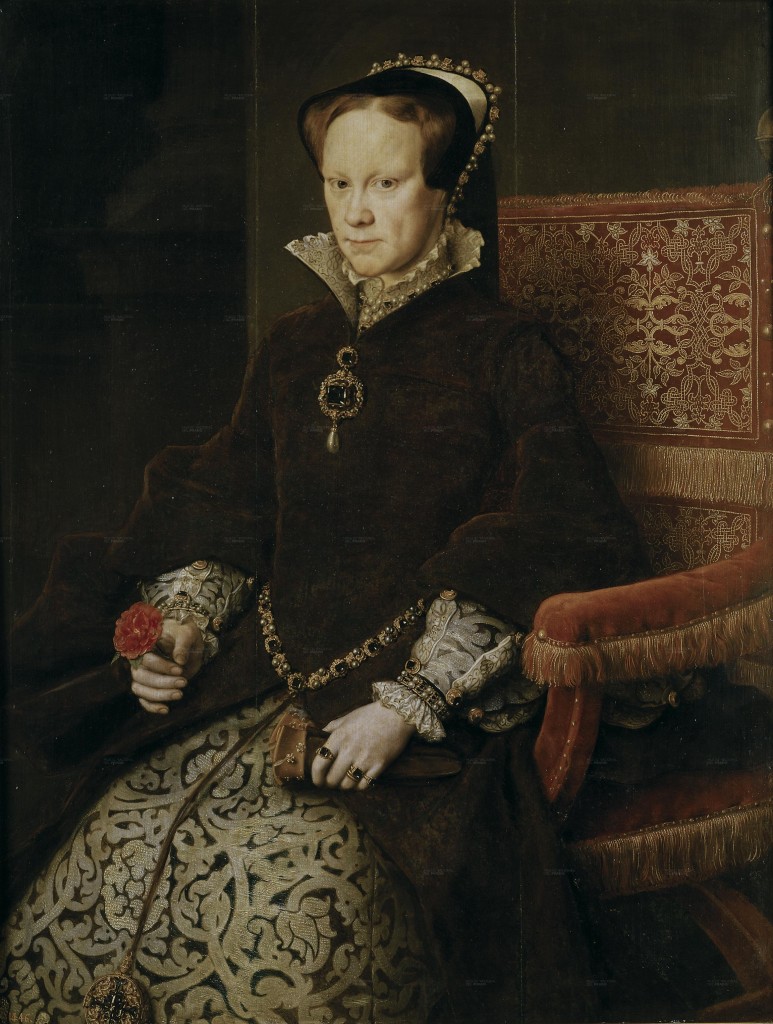
---Don't mess with this Mary! Queen Mary I, the poster child for separating church and state, wears a gown with puffed lower sleeves and a triangular French hood, both very English, in this portrait by Anthonis Mor.---Read More:http://www.gogmsite.net/the_middle_1500s_-_1550_to_/minialbum_queen_mary_i_of_e/1554_mary_tudor_by_anthonis.html
In Paris a drop of her hankerchief outsmarted both the National Gallery of London and the Louvre when she purchased Vermeer’s The Concert for a piffling $6,000, also stolen in the infamous 1990 heist. One of only thirty-six works by this master, The Concert had already mounted in value by ten times by 1900. Today, if it is ever found, the value at market may exceed a hundred million.

Mrs. Gardner’s most celebrated old master is Titian’s The rape of Europa. Finished for Philip II of Spain in 1562, when Titian was pat eighty-five, it was the foremost Titian in America. Rubens, who made the copy of it now in Madrid’s Prado, apparently called it the greatest picture in the world. His pupil, Van Dyck copied the copy; and Mrs. Gardner has that as well.
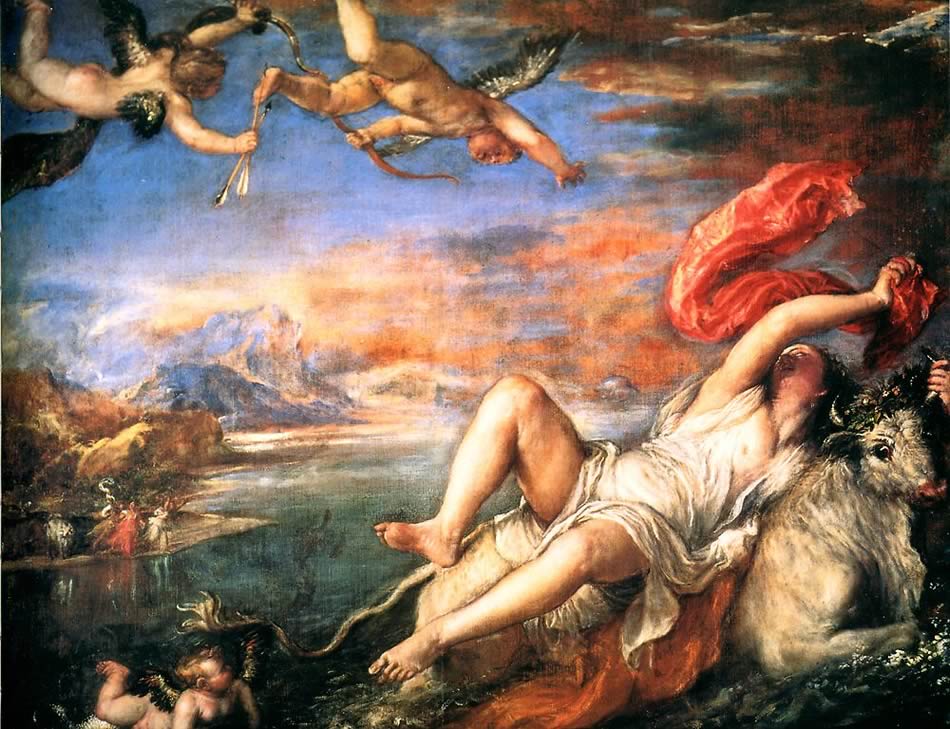
Titian. Rape of Europa. It represents the Greek myth in which Europa is carried off by Zeus in the disguise of a bull to become the mother of his children, and Titian's treatment of the subject fired the imaginations of Rubens and Van Dyck. Image:http://www.lyons.co.uk/Titian/bigh2/Europa.htm
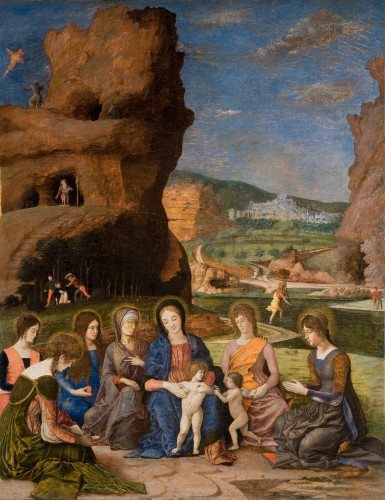
And Europa is by no means the only Gardner picture with royal associations. The Mantegna Holy Conversation belonged to Charles I of England and later to Philip IV of Spain, who in turn is represented by a Velazquez portrait. Richard Norton, son of Charles Eliot Norton a former director of the American Academy in Rome, got the Mantegna for her, along with a Roman sarcophagus.
At Fenway Court also hangs the Antonio Moro portrait of Mary Tudor, queen of England, which figured in the preliminaries of Mary’s marriage to the future Philip II of Spain. The little Raphael, Pieta, originally formed part of the predella of an altarpiece J.P. Morgan gave the Metropolitan; it once belonged to Queen Christina of Sweden, later to the Duc D’Orleans, and finally to a minor member of the nobility of art, Sir Thomas Lawrence. The Pesellino wedding chests were probably made for the marriage of Piero de Medici, the father of Lorenzo, who ruled Florence in his day.

idth="385" height="500" />
---Virgin and Child with John the Baptist and Saints (Sacra Conversazione) about 1495 Andrea Mantegna, Italian, about 1431–1506 Tempera on wood, 55.88 cm x 42.55 cm Genre: European Art, Paintings Location: Early Italian Room---Read More:http://www.gardnermuseum.org/collection/browse?filter=artist:3292
ADDENDUM:
Isabella Stewart Gardner amassed the bulk of her collection in a remarkably short period of time. Like many wealthy Americans, the Gardners bought paintings and objects to decorate their home. In the 1880s, Isabella Stewart Gardner attended lectures on art history and readings of Dante given by Charles Eliot Norton at Harvard College. This sparked a passion for Dante, and Isabella Gardner began to buy rare editions by the writer. She became a serious collector of Dutch and Italian pictures in the 1890s. Beginning in 1894, Bernard Berenson, then a young art historian, started to recommend Italian paintings for acquisition. He was just as new at this as Gardner was, but within two years he had guided her towards a collection that included Botticelli’s Lucretia, Titian’s Europa, Vermeer’s The Concert, and Rembrandt’s Self-Portrait. Berenson acted as a conduit for paintings that Colnaghi, a London dealer, had for sale; however, Isabella Gardner made her own decisions about what to buy. In 1896, Berenson facilitated the purchase of Titian’s Europa, still heralded as the “most important work of art in Boston,” by Boston-area museum directors (The Boston Globe, July 27, 2002). Read More:http://www.gardnermuseum.org/about/history_and_architecture/


 COMMENTS