

A communist sea dog who stayed away from the starboard, or right wing side of the battleship Potemkin. Sergei Eisenstein‘s Potemkin was a film that proclaimed his faith as an artist of revolution and transcended it. It was a work of political fire that lives because it is a work of art. The Soviet revolution and its need for film, one might say made a genius of Sergei Eisenstein; crowned for a time as the king of the new proletarian cinema.
” There are two kinds of art, bourgeois art and proletarian art. The first is an attempt to compensate for unsatisfied desires. The second is a preparation for social change. In the perfect state there will be no bourgeois art because there will be no unsatisfied desires.There will also be no proletarian art because there will be no necessity for further social change. Therefore, since I am working for the perfect state, I am also attempting to destroy the motion picture”. ( Eisenstein, 1930 )
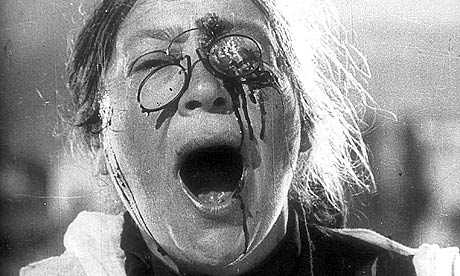
Ellipsis: the blow is not seen, but blood spurts from the face of a wounded woman
However, Eisenstein’s career as a whole is a sad story. He was born in Riga in 1898. He was an engineer by training, migrated to set design and theatre before moving quickly into film. Absolutely congruent with his bursting film energies was his fervor for the communist revolution and the establishment of the Soviet state. To think of him as a director who just happened to be Russian or who was subservient to a state-controlled industry and managed to get some good art into his films despite is subservience, is to miss the core of Eisenstein. His early works were exponents of his beliefs.
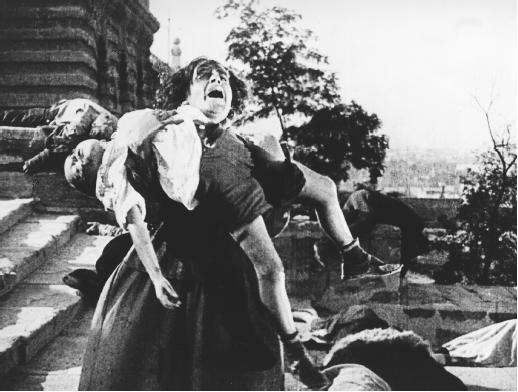
against the relentless downward drummingof the soldier's feet on the steps, Eisenstein opposes the slow pace of a stunned mother's agonized descent. An example of rhythmic montage.
The complications resulting from this amalgam of politics and art, ideology, theory and the reality of totalitarian government began with his follow up film, ”October” in 1928. Originally, the film had sequences showing Trotsky as part of the 1917 revolution, but while Eisenstein was editing, Stalin’s ascent forced Trotsky into disfavor, then exile. Eisenstein had to re-do the narrative and editing to take into account the emerging bias towards a view that history is a tool of control and truth must succumb to rewriting of the past to suit the circumstances of the present.
Like fascism in Germany, the theory of culture under communism became locked into a constant struggle between theoretical claims and the demands of reality. Art had to assume a functional character. As Eisenstein’s career stalled, the parallel reflex of Soviet cultural policy was to show that the individual must also, as a subject of art, surrender to the promise of collective renewal at the cost of moral autonomy and psychological interiority. Like Fascist art, to endeavor to convert recipients and embed them into a ritualistic community. In the films of Leni Riefenstahl, there is a distinctly fascist form of expression that not only endorses an aesthetic of submission, but disguises this ”sacrifice” in imagery of collective redemption. All her aesthetics lead towards an anticipation of warfare where death and violence is seen to supply the artistic gratification; propaganda films that captured viewers so strongly that they surrendered mindlessly to the Nazi ideology as seen in beautiful bodies, armor plated subjects, heroism,soil, blood and death. All to justify a group identity that would differentiate or exclude the other. What Eisenstein, in turn, would partially create with Alexander Nevsky.

'' For Eisenstein was the greatest of those early directors, one who understood the political power of film before the Nazis came to power and made such dreadful use of it. His Battleship Potemkin was once voted the greatest film ever made and it’s too bad we have only seven finished films to appreciate such an amazing director.''
In sum, the rest of his career, until his death in 1948, is a story of frustration and frequent abandonment of film projects; he completed only four more films. He was permitted to go to America in 1930, where his discussions with Hollywood studios resulted in quarreling and disagreement resulting in nothing being consummated. He shot a fortune of footage in Mexico, in part financed by Sinclair Lewis, for ” Que Viva mexico” which never saw the light. His later years were spent teaching at State Institute of Cinematography in Moscow. In sum, only six completed films and one almost completed film, ”Bezhin Meadow” apparently destroyed by the Soviet government in 1938, though they claimed German bombs as the guilty party. The U.S.S.R’s waste of Eisenstein, depressing in any view, is particualrly tragic when seen in the radiance of energy that blazes off the screen from ”Potemkin”
From its first screenings in America in 1926, it was hailed by many, including Douglas Fairbanks, as the best film that had yet been made. True or not, Potemkin , a short picture under ninety minutes, is nonetheless an experience that is shaking in itself and illuminates much of what followed in film history.
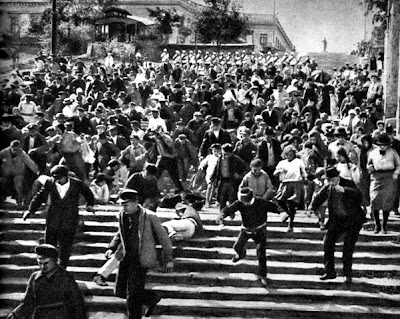
Potemkin, Odessa Staircase
By the mid 1920’s the Soviets looked to the arts to consolidate ideologically necessary illusions into national myths. Initially Potemkin was called ”The Year 1905”, which dealt with the events of the earlier, unsuccessful outbreak against Czarism, but it was, despite the footage shot on those events, the Ptemkin story alone which emerged.An oddity, and perhaps the element of genius inPotemkin is that Eisenstein inscribed poltical imperatives right into the heart of the work, yet stops short of destroying the film’s aesthetic integrity; the aesthetic form is not eroded by sub-text of converting the audience. Perhaps, unlike Wagner, he avoided a dictatorial mode of address which could sacrifice artistic authenticity. Wagner also appealed to emotions, but at the same time hit the audience over the head, denying an autonomous form of sense perception.
The story is simple enough. While the ship is anchored in the Black Sea near Odessa, there is a mutiny among the restive crew over their rations; the dissenters facing execution are joined by the firing squad, a leader is killed. The Potemki is given chase by a naval squadron and at the moment where the ship could be retaken, the fleet allows the mutineers to pass through. Eisenstein leaves the story opened ended, with the Potemkin sailing onward through the friendly squadron, bearing the seed of revolution that was to bloom in Russia twelve years later.
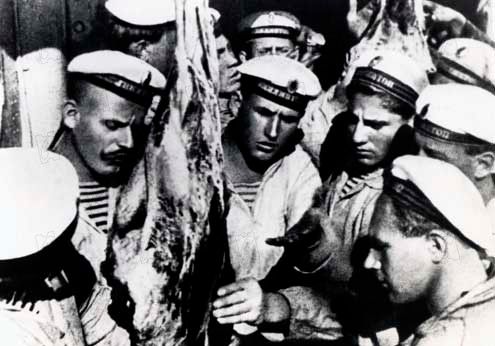
''We've had enough garbage to eat!'' protest the crewmen, which touches off the revolt.
The theatrical appeal of resistance to tyranny was evident, and the Potemkin story, per se, could have been turned into compelling cinema by many a competent director. But Eisenstein was essentially an artist of revolution and not merely good directo ad gifted propagandist. The revolution was central and generative for his art. The relationship between Eisenstein,s genius and soviet revolution powered the dynamic that drove him to make his art special. He appeared t take the ideas to heart found in Marx’s Communist Manifesto of 1848, as a form of utopia. He felt that a new society meant a new kind of vision and that the way people saw things must be altered. Eisenstein believed that it was his duty as a revolutionary artist to find an aesthetically revolutionary way to tell a politically revolutionary story and bases for this expression would be through choice of visual texture.

Potemkin
In Potemkin, Eisenstein sought to avoid historical drama and instead make a drama of history. He and his lifelong cameraman, Eduard Tisse, aimed a look that resembled newsreels with their touches of graininess that avoided a clean, antiseptic sheen. It was to convey the sensation of the accidental witness who lingers on the scene of activity. Eisenstein’s second resolve was to limit the use of professional actors, by using ordinary people whose faces and bodies he liked, for particular roles such as a gardener for the ship’s priest. Thus, a mosaic effect was achieved through a series of short performances; sequences Eisenstein could control easily and heighten with camera angles and editing.

Potemkin. ''Brothers!'' he will cry, and the mutiny is on
Eisenstein called the approach ”typage” which meant the casting of figures with striking features, accentuated often by intense close-ups, so that at first glance, the character is fully developed as an element in the mosaic. This ”typage” leads to the cinematic technique most closely associated with Eisenstein which was montage. In its most compact form, montage is editing. However, Eisenstein’s use of montage differed considerably, elevated to signature status, and claimed in his writings that it was the heart of cinema.
For Eisenstein, there were five kinds of montage: metric, rhythmic,tonal, overtonal, and intellectual which he regarded as the organs of the art. In intricate combinations, the five were integrated within Potemkin into a whole which turned most traditional perception on its ear. The five movements of the film were structured like acts in a play; each a structure unto itself with its unique stresses and tensions which contribute to the whole. Partially, Eisenstein his aesthetics of montage out of exigency since raw film stock was in short supply and what was available were relatively short snippets and irregular qualities forcing Eisenstein to work in short takes.
The key is Eisenstein’s understanding the difference between naturalism and realism. For example, the scen of the sleeping sailors is accurate enough, though he does not overlook the arabesques that the hammocks form. These graceful intersecting curves are used to contrast the turbulence of the waves seen earlier and to the muting that is to come. This is evident even in the confrontation between officers and men, where the actions is caught in flashes and shards that anatomize and yet unify. Eisenstein’s aim is to show things as they are, but make the viewer see them as never before. The effect of intensification is achieved by showing an action and then repeating it immediately from a slightly different angle.
Another favorite device of Eisenstein is ”synecdoche”. A emblematic example is before the fight, the ship’s priest lifts his crucifix and bids the men obey. During the struggle, when the priest is knocked down a flight of steps, we see a close up of the crucifix, an edge of its lateral bar stuck in the deck where it has fallen, like an axe plunged in wood; an axe that has missed the necks for which it was intended. Potemkin also contains one of the most noted sequences in film history which is the ”Odessa Steps”. Using hundreds of people, Eisenstein created a sense of immense, limitless upheaval. With the quick etching of a few killings, which are suggestive, oblique and never explicit, he creates a scene of intense savagery. With cross currents of perspective and tempo, he evokes the collision of status quo and inevitable protest. An effect of counter beat and contrapuntal effect; used to establish different political impulses and their related aesthetics.
The total effect of Potemkin is that of roaring tumult; partially from efforts in the silent era to create visually the effect of sound such as shots of train whistles and church bells. But in Potemkin, by counterpoising rhythms and faces, marching boots and guns and moving masses, Eisenstein draws from that silent screen a mounting and immense roar. Certainly, Potemkin was subjectively conceived as a celebration to the flock of communist faithful, but it was also intended as propaganda for the uninitiated. Emotionally and aesthetically, if not politically, the film has had an impact, but those who contolled the films distribution had far less faith than Eisenstein.
Potemkin was seriously tampered with with political messages being tacked onto some prints. As Stalin rewrote history, the film has followed a similar evolution, depending on the whims of the moment. Eisenstein’s career matches a curve that coincides with the rise, deception and fall of worldwide, radical hope for the unfulfilled promises and seductive rhetoric of Soviet communism. Potemkin, achieved at the height of his faith, was both a proclamation of his belief in the ideal, yet transcended his faith; a work of political fire that lives because it is a work of art.
In his cinema books, Deleuze proposed an immanent conception of the image. According to Deleuze an image has internal or immanent qualities that have certain effects on us. Images are not representations of absent Ideas or original models. By the same token, according to Deleuze we are not in front, or above images, but we are surrounded by images, we live in images and images live in us. Images can affect us and make us think.
”For Deleuze the two regimes of the image each produce a different spiritual automaton. Both produce thinking in the viewer through an experience of shock, but the nature of the ‘nooshock’ is different in the two image-regimes. He uses the writings of Eisenstein and of Artaud on cinema to illustrate the distinction he wants to make. Simply put, whereas Eisenstein’s shock is an intellectual shock which believes in the powers of rational and logical thought, for Artaud cinema confronts us with exactly the opposite: the impossibility to think, the powerlessness of thought, which, in Deleuze’s philosophy, lies at the heart of thought.
Eisenstein’s shock to thought comes from the conflict between two shots, which forces us to think its synthesis (in Strike for instance images of a bull being slaughtered are contrasted by images of a Cossack killing a child). It is the confrontation with the contrast between these two images that forces us to think the Whole, which is a unity, a truth. A dialectical truth in the case of Eisenstein, but classic continuity montage moves in a similar way from image to thought, producing a clear-cut concept or idea in the mind of the viewer about the image, but also about the relation of this particular image to the Whole of the film. The viewer himself simply has to receive the ideas that are given to him. But, this unidirectional idea of the shock to thought makes cinema a highly manipulative medium; and as history has learned us, is all too easily put to use for propaganda; ‘Hitler as filmmaker’ ” ( Deleuze and Cinema, Ils Huygens )


 COMMENTS