

In 1973, Rowland Emett( 1906-1990 ) created The Aqua Horological Tintinnabulator, more popularly known as the Victoria Centre clock, or the Emmet Clock. The unique water-powered structure is an icon of Nottingham and a popular meeting place for shoppers.Mr Emett also designed the whacky inventions of Dick Van Dyke’s character Caractacus Potts, in the 1968 movie Chitty Chitty Bang Bang. In the world of mechanical and artistic creations, the artist Frederick Roland Emett is an unavoidable; A mix of art and engineering to create kinetic marvels based on mechanical linkage. There are similarities to Rube Goldberg, who certainly deserves praise, but Frederick Roland Emett went beyond Goldberg by create actual prototypes within a range of diverse work.
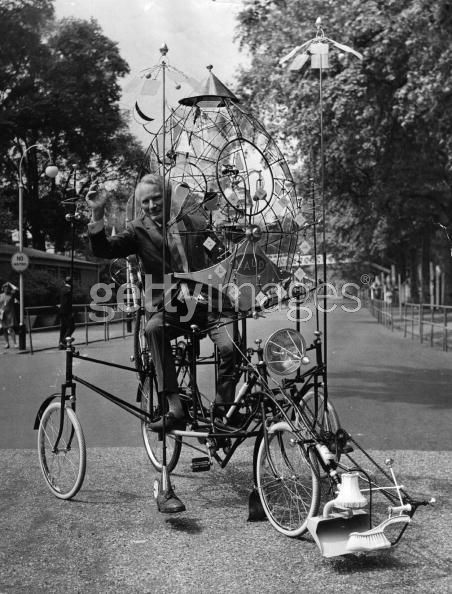
''Cartoonist and inventor Rowland Emett rides his "lunacycle" invention. The lunacycle's "scientific refinements" allow it to be soft landed on the moon. Its features include a cat for companionship and for catching moon mice, and a fly-swatter rig for keeping meteorites at bay and shielding the instruments from the rays of the sun. London, England, June 11, 1970.''
Not only are his illustrations wild, fanciful, and outrageous but he also created many insanely elaborate sculptures and creations. Looking like Willy Wonka’s hallucinations, or Dr. Suess’ nightmares, Emett’s sculptures have an entrancing craziness that’s dazzlingly hypnotic. Fantastical contraptions that actually work and reflect a certain eccentricity as British cultural trait that oscillates between the Victorian, the modern and the burlesque.
”Thingmaker Emett is that most insidious of subversives, a spoofer who makes existential sense. A nostalgic-romantic artist-humorist social commentator-engineer whose furbelows and feathery drawings are familiar to longtime readers of Punch and LIFE, he is a man with one hand at the controls of Nellie, “senior engine” of Far Tottering O.C.R.R., and the other outstretched for hot buttered crumpets on the moon. Though a satirist, Emett is a gentle one, with a high regard for human fallibilities and amenities, as well as for cats, birds, butterflies and flowers. What makes the Sussex Merlin all the more remarkable is that he can use a welding torch and glue. With tin, antique doorknobs, hip baths, umbrellas, bicycle parts, lamp shades, stained glass, saucepan lids, Victrola horns, ear trumpets, soup strainers, miles of wicker and wiring, he transforms cartoon fantasies into whispering, whistling, wheezing, whirring, gothic-kinetic machines that work, but mostly play. And mock. ( Time Magazine, 1976)
One hundred years ago the futurists were attempting to express in paint the sensation of motion, but later artists bypassed this problem and offered the spectator real motion in somewhat the same way as Picasso and Braque, realizing the futility of painting imitation wood and newspapers in their still lives, stuck pieces of wood patterned wallpaper and scraps of newspaper onto their canvases, and so pioneered what have become the elaborate arts of collage and contructivism. The desire for motion in art goes very deep, far beyond gimmicky publicity.

emett. bloghorn contraption

The development of moving sculpture, from the first mobiles of Alexander Calder thirty five years ago, and the development of light pictures, since the attempts still earlier in the twentieth century to create ”color music”,will be regarded by our era as the most important contributions made to art in the twentieth, not even excluding cubism. Its part of a desire to resolve a conflict between spirit and matter, through an art form of kinetic moving sculptures that articulated the utility of uselessness with an irresistable irony.
During his career,Emett had been a commercial draftsman, an aircraft designer, and a ”Punch” cartoonist. His most famous creation for ”Punch” was the Far Tottering and Oyster Creek Railway, an ingenious mode of transport that never, apparently, went anywhere at all. A request to design a full scale, functioning version of the railway for the Festival of Britain in 1951 did prompt him, however, to invent workable, if still fanciful, machines.

Emett. Little Dragon
Among the numerous delightful creations Emett had devised are the Animated Early Household Machines that appeared in the 1968 film ”Chitty Chitty Bang Bang”. One of these, The Little Dragon Carpet Cleaner, come complete with flapping wings and a head, equipped with electric eyes and a pair of spectacles, that snuffles from side to side ferreting out specks of dust. A later contrivance, the Honeywell-Emett Forget-Me-Not Computer, has a peripheral unit named F.R.E.D. , the fantastically Rapid Evaluator and Dispenser, which nonchalantly feeds information into the computer, looking perhaps a bit bored by the whole thing.

Another impressive piece was the Rythmical Time Fountain that was originally designed for the Smithsonian Institute, but ultimately not built there, found a home in Nottingham’s Victoria Centre. Most clocks, Emett realized, strike only on the hour or half hour, not doing much of anything in between; obviously, excuse the pun, a great waste of time. So Emetts fountain and its subsequent versions, the¨Pussiewillow” series, is in perpetual motion; the water wheel with its begemmed butterfly revolves.The large animal figures sail in a circular path and a giant sunflower opens to reveal animal musicians who whirl and twirl in time to their music. Call them contrivances with souls.

''"The Vintage Car of the Future", on display at Chicago's Museum of Science and Industry, photo courtesy Jeff Powell,''
Layers of fantasy transformed to a world of mechanized fantasy; that replaced paint and brushes as a means of expression. Emitt was a symptom of a revolution in art that is still being played out. Emett’s work, in spite of its lack of pretension, was a strong pointer to the fundamental way in which the art of the future will differ from that of the present. This world included contemporaries of Emitt’s such as electrically operated and uncanny mobile sculptures of the Pol Bury,the lumino- dynamic constructions of Nicolas Schoffer and the ”luminous pictures” of the English inventor John Healy. In all these things, it will be noted, the accent is on movement.
Emitts’s work was a type of environmental art that came with a vision of an everyday environment in which there are moving sculptures on every street corner, vast ever changing color abstractions projected on the sides of great buildings and other perpetual motion machines. A vision of art as Fernand Leger termed the ”New Babylon” that would be different from what we still accept as the staus quo today, the art and gallery industry. This idea, which won,t be coming for a long, long, time would involve the arts not being separate from each other or from science. Art, with a capital A, would be collectively created and designed for collective delectation.


 COMMENTS