

Are you a vampire? The vampire diaries stated that no one is to be abandoned and to take no prisoners, yet, to leave no one behind. The door in ” The Castle” leading where? Perhaps a trap door, followed by a precipitous drop to Dante’s Inferno. A world of grotesque illusion as in the writings of Marco Polo where animal and human shapes are distorted into strange beings, drawn from mythical archetypes, imagination and the perversions of medical science as practiced by Joseph Mengele. From Marco Polo ”The Description of the World:”

''Polo wrote of men with dogs’ features (a French illustration, c. 1412), among several other fantastic creatures. Bibliothèque Nationale/ ''
”Starting home by ship in 1291 or 1292, Polo was forced to spend five months on “Java the Less”—Sumatra—waiting for monsoon winds to shift so that he and his shipmates could sail northwestward toward Ceylon and India. Polo reported, accurately, that cannibals dwelled on Sumatra and, less accurately, that the island was home to some strange beasts, including enormous unicorns, in size “not at all by any means less than an elephant.”…”I tell you quite truly,” Polo continued about Sumatra, “that there are men who have tails more than a palm in size.” And on an island that he called Angaman—probably referring to the Andaman Islands in the Bay of Bengal—”all the men…have the crown of the head like a dog and teeth and eyes like dogs.” Tales of strange creatures abounded in Asia as well, and Polo…” ( Mike Edwards, Smithsonian )
.jpg "poe1")
Eric Woolfson, Poe
Franz Kafka, as generally understood, needs little preface. His very name has been transformed into an adjective of world wide currency; Kafkaesque. Without, perhaps, ever having read any of his works, modern people know that Franz Kafka is the poet laureate of the horrors of the dehumanized, mechanized world, the world of alienation and isolation from all time and all place. However, kafka did not know all times and all places. He knew well, in fact, only one place, Prague, a city where even the shadows on a wall could be endowed with life. His own life there began, one must suppose, on the same note that his book ”The Trial” begins. ”Someone must have slandered Josef K.,because without having done anything bad, he was arrested one fine morning.”
Kafka’s own trial began when he was born, as has often been pointed out,into a triple ghetto. He was a member of the Jewish minority, within the German minority, within the Czech minority of the Austro-Hungarian empire. He lived principally in two quarters of Prague. These were the Old Town area, including the ghetto, and the realm of the immense Hradcany Castle, the symbol for him of vast, unapproachable and incomprehensible authority, which contained a royal residence, the St. Vitus Cathedral and an administrative area staffed with government officials. It is the specter of Hradcany Hill that fills the settings of ”The Trial” and ”The Castle” and the spirit of the old ghetto that permeates the heroes thrust into those settings. The trial of the fictional Josef K. never truly ends;it simply becomes, inexplicably, a sentence. At the close of the novel K. is escorted to his place of execution, stopping for a moment on a bridge where he looks lingeringly down on a small island. The bridge might well be the Charles Bridge; the island that of the Kampa, where Kafka sometimes sought peace. In the book, a knife is plunged into K.’s heart and, as though it were a ritual performed without passion, the knife is turned twice.

Pablo Amaringo
Kafka probably had no notion of becoming a prophet. Yet his vision of Prague often seems to contain all the dark terrors that haunt today’s world. It was the theatrical setting of Hradcany Castle that became, in Kafka’s meticulous, lucid descriptions, so forbiddingly real. In ”The Castle”, his hero K., gazed up at the Castle and ”could not help trying to put his own small experiences in relation to it…” For K. did not exist of himself; he existed only insofar as he had some relationship to the Castle. He was, as one might say of a modern bureaucrat, ”defined by his function”.
But Kafka’s Prague was adjacent to Transylvania, which acted as a bedroom community for the fantastic and surreal to be imported into the urban centers. Legends of blood rituals, corpse transformations carried out by individuals of ambivalent passions passed into shamanistic folk legends that entered the thinly guarded fortresses of orthodox religion.Vampires, though not numerous, seemed to take their necessary space in the culture. Kafka’s own faith was well informed with the messianic neo-kabbalism of Sabbatai Zevi and its mystic visions of the supernatural, and propensity for clairvoyance and the occult. Kafka himself, seemed to incarnate the legend of the Wandering Jew,arts division, immortal and eternal like the thousand year old vampire in ”Twilight” , the rituals in his life undertaken with routine tepid fashion, and all personal relationship characterized as platonic. There is no rush, hurry or pressing need. When you are immortal time is on your side.
As Salvador Dali, was grasping for a simplicty of form, efforts at deconstruction that led him to the logarithmic cones he discovered in Vermeer’s ”The Lacemaker”, Kafka was also working on a deconstruction of language and a digging away at established literary contexts in much the same manner; approaching writing as a software creator would develop source code. Where Kafka was feeding his imagination from and creating the structural sequences in his work and only be conjectured, though it does seem to draw from deeply sourced belief systems, perhaps from the Kafirs; whose primitive , but powerful and haunting wooden sculptures that decorated cemeteries in which the coffins were laid to rest above ground.

And if that Castle or that function were to disappear? ”When K. looked at the Castle, often it seemed to him as if he were observing someone who sat quietly there in front of him gazing, not lost in thought and so oblivious of everything, but free and untroubled…the gaze of the observer could not remain concentrated there, but slid away. This impression today was strengthened still further by the early dusk; the longer he looked, the less he could make out and the deeper everything was lost in the twilight.” Kafka grew up in Prague’s Old Town, an area both splendid and dilapidated. Both extremes are expressed in his novels.
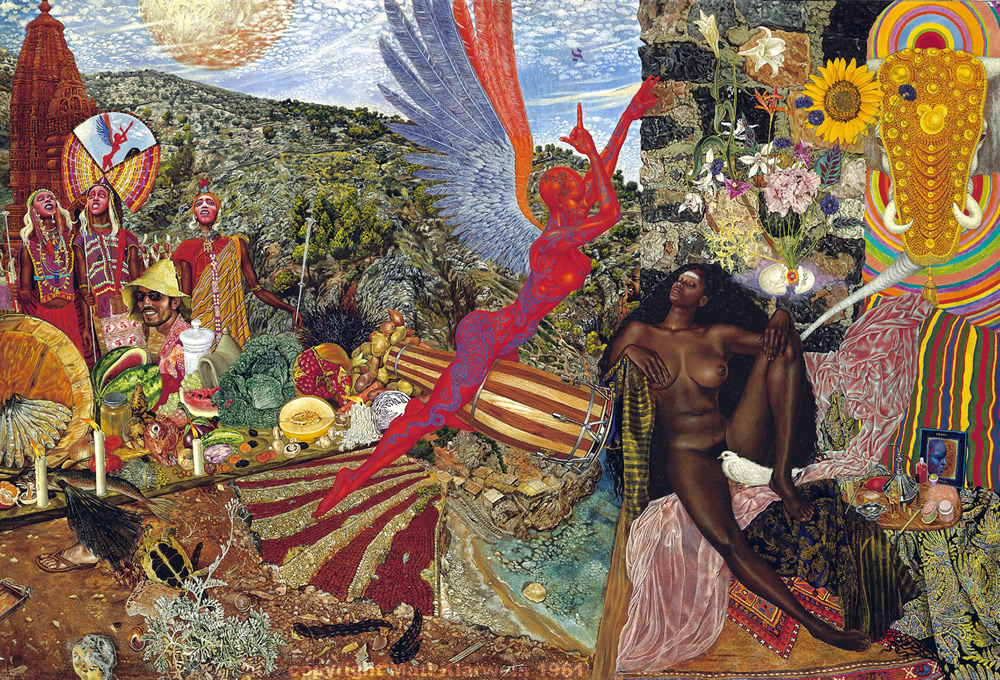
Mati Klarwein, Anunciation ( Abraxas ) 1961
In ”The Trial”, a priest tells Josef K., who, like Kafka, is consumed by the law, this story: ”Before the law stands a doorkeeper. To this doorkeeper there comes a man from the country who begs for admittance to the Law. But the doorkeeper says that he cannot admit the man at the moment. The man, on reflection, asks if he will be allowed, then to enter later. ‘It is possible,’ answers the doorkeeper, ‘but not at this moment’.” The man peers through the door. The doorkeeper laughs: ”If you are so strongly tempted, try to get in without my permission. But note that I am powerful…From hall to hall, keepers stand at every door, one more powerful than the other’.” The man decides to wait. The doorkeeper gives him a stool, and he sits and waits…for years. Finally, old and dying he thinks of a question he has never asked the doorkeeper: ” ‘ Everyone strives to attain the Law … how does it come about then, that in all these years no one has come seeking admittance but me?’ The doorkeeper perceives that the man is nearing his end and his hearing is failing, so he bellows in his ear: ‘No one but you could admittance through this door, since the door was intended for you. I am now going to shut it.’ ”
The virtues of impatience are rarely dignified. One the one hand, Kafka counseled patience as a virtue and impatience as a kind of denaturalized condition in which the emotions control the reasoning process. The proclivity of impatient behavior establishing a form of tormenting guilt. its a paradox of perception, in that K. wished, we presuppose, be granted admittance, but in reality, he may have been quite determined not pass the door as a form of protest to K. perfectly reasonable assumption that the law is so ambivalent, and ambiguous, the results so seemingly absurd, that no effort to pass the door would be worth the exertion required. Meaning, the attitude to adopt was impatiently being patient.

Twilight
The almost surreal quality of Kafka’s work, is reminiscent in its shape shifting forms and descriptions as that found in Aldous Huxley and his ”Doors of Perception ”If the doors of perception were cleansed every thing would appear to man as it is, infinite. ”(William Blake) It was as if Kafka had passed his own door of perception without peddling mescaline to the doorman and without need to imbibe it as recreational activity. He was satisfied just to peek into the keyhole of the door to get a glimpse, an ocular dose of metaphysical truth as a form of hallucinogenic for him. Instead of chasing after the mystery with the aid of narcotics, let the mystery come to you.
Aldous Huxley and Franz Kafka wrote about different topics in their respective Modernist works. However, both use manipulation of language in such novels such as Brave New World and The Metamorphosis, respectively, to satirize how the world had become heartless, robotic and monotonous with little to no consideration to human life, possibly because of industrialization. The fact that both of these authors subconsciously plant these satirical critiques of our society into their works shows that Kafka and Huxley both possess a strong inclination for displaying the flaws of society and state, by satire, that our world and lives, unless something drastic occurs, has a very high likelihood of ending up barren, emotionally and spiritually.
.jpg "rhinoceros1")
Rhinoceros, 1968
”To see ourselves as others see us is a most salutary gift. Hardly less important is the capacity to see others as they see themselves. But what if these others belong to a different species and inhabit a radically alien universe? For example, how can the sane get to know what it actually feels like to be mad? Or, short of being born again as a visionary, a medium, or a musical genius, how can we ever visit the worlds which, to Blake, to Swedenborg, to Johann Sebastian Bach, were home? And how can a man at the extreme limits of ectomorphy and cerebrotonia ever put himself in the place of one at the limits of endomorphy and viscerotonia, or, except within certain circumscribed areas, share the feelings of one who stands at the limits of mesomorphy and somatotonia? To the unmitigated behaviorist such questions, I suppose, are meaningless. But for those who theoretically believe what in practice they know to be true – namely, that there is an inside to experience as well as an outside – the problems posed are real problems, all the more grave for being, some completely insoluble, some soluble only in exceptional circumstances and by methods not available to everyone….it had always seemed to me possible that, through hypnosis, for example, or autohypnosis, by means of systematic meditation, or else by taking the appropriate drug, I might so change my ordinary mode of consciousness as to be able to know, from the inside, what the visionary, the medium, even the mystic were talking about.” ( Aldous Huxley )

Performance Film, 1970. Mick Jagger. Nicolas Roeg. co-director
Kafka had come to detest his city; its commercial center, its ghetto, and Hradcany Hill. Yet he struggled always to imbue his nightmare vision of it with meaning and even hope. As his friend and biographer Max Brod wrote,”Through… Kafka’s world, there sounds softly but unmistakably the note of love for the human creature who will ‘nevertheless’ not be abandoned, so runs the promise, by the divine powers…” ”But Franz Kafka, the man, or better still the noun-phrase, conjures up far much more than that. The K-word evokes a beautiful soul tortured by human relationships; a lonely seer too saintly for this rank, sunken world; and consequently, a tragic genius for whom art beat life, every time. ‘I am literature and nothing else’, he once proclaimed. Beside ‘Franz Kafka’ all earthly creatures pale. There’s more. As a German-speaking Jew adrift within a Czech-speaking enclave of the Austro-Hungarian Empire, we are told, his profoundly estranged perspective drove him to the darkest of insights. Persecution, dehumanisation, and torture; in Kafka, the Europe of the Gulag and the gas chamber found its baleful prophet.

Kafka, Robert Crumb. Illustration
And it’s all captured in the brooding, melancholy image of Kafka, the one which appears on his books, the one which sustains the international Kafka industry – the one, in other words, that everybody knows. And as James Hawes seeks to show in his wonderful Excavating Kafka, it is completely misleading. The ‘K-myth’, as Hawes calls it, is pure spin. So what, you might ask? When reading, it’s usually possible to do so without knowledge of the author’s life intruding too much. Which in many cases is just as well. But the K-myth is strange. It does more than just footnote Kafka’s work – it engulfs it. The Trial ceases to appear as the tale of Josef K’s arrest, drawing on the inquisitorial as opposed to adversarial nature of European legal proceedings; it is instead presented as a forewarning of the Holocaust. The Metamorphosis stops being read as a black comedy in which Gregor Samsa wakes up as a giant bug and worries about how he’s going to get to work, and becomes instead a critique of anti-Semitism. Indeed, such is the potency of the K-myth that it has even generated its own adjective – Kafkaesque – to refer to anything that resembles oppressive state bureaucratic persecution.
This isn’t to say that such readings of The Trial are wrong, just myopic. And the cause, as Hawes argues, is the K-myth. It transforms Kafka’s works into pre-read, pre-packaged prophesies of totalitarianism, baleful intimations of the Shoah. The K-myth ‘makes people – even highly educated German scholars – incapable of reading what Kafka actually wrote’. ‘Superb writing’, says Hawes, is lost to idolatry.”


 COMMENTS